 Add to Chrome
 Add to Firefox
 Add to Edge
MNet++: Extended 2D/3D Networks for Anisotropic Medical Image Segmentation
Jun 13, 2026
This work demonstrates a full reproduction and extension of MNet, a hybrid 2D/3D convolutional network designed for anisotropic medical image segmentation. The original architecture was re-implemented within the nnU-Net framework to verify its reported performance and robustness to variable voxel spacing, known as anisotropy. Experiments were conducted on PROMISE prostate MRI and a controlled subset of LiTS liver CT under matched preprocessing and compute constraints. The reproduced MNet achieved a Dice similarity coefficient (DSC) of 89.0 +/- 0.9% on PROMISE, within 0.8% of the published result, and 94.3 +/- 1.9% / 54.6 +/- 3.1% for liver and tumor segmentation on LiTS, respectively. Two lightweight extensions were further introduced: (1) a learned Fusion Gating mechanism enabling adaptive 2D-3D feature blending, and (2) a VMamba state-space module for efficient long-range depth modelling. The Spatial Gating variant improved DSC by +0.8% with less than 3% inference overhead, while VMamba improved performance consistency, reducing PROMISE Dice variation to +/- 0.7% and achieving the strongest LiTS liver performance at 95.8% Dice. Both extensions preserved MNet robustness to anisotropy, with delta Dice = 1.5% across 1-4 mm voxel spacing. Overall, the study confirms MNet reproducibility and demonstrates that adaptive fusion and state-space modelling have the potential to further strengthen segmentation reliability under anisotropic conditions. However, further tests are required to provide definitive conclusions.

ShipNet: A Geometric Deep Learning Surrogate for Real-Time Ship Hydrodynamics
Jun 13, 2026Accurate prediction of hydrodynamic performance is central to ship design, yet high-fidelity computational fluid dynamics remains prohibitively expensive for large-scale parametric exploration. This motivates the development of data-driven surrogate models that provide rapid approximations to hydrodynamic predictions at substantially reduced cost. We present ShipNet, a geometric deep-learning surrogate that predicts both hull-surface pressure distributions and far-field free-surface wave patterns directly from hull geometry and speed. The network employs a regularized dynamic graph convolutional backbone on hull point clouds, with a multi-head decoder for simultaneous near-body pressure and free-surface elevation outputs. Training data consist of 420 inviscid free-surface simulations generated using a potential-flow panel method for two parent yacht hulls, each parameterized into 70 variants and evaluated at three speeds. ShipNet predicts per-point pressure coefficient and two-dimensional wave elevation map using a composite loss that combines point-wise regression and image-structure terms. On a geometry-held-out test set, ShipNet achieves R^2=0.98 for hull pressure and R^2=0.91 for wave fields. Inference requires approximately 0.15s per case, yielding over a 550x speedup relative to the potential-flow solver on conventional hardware. Limitations include the restricted geometry and speed ranges and the inviscid training data, while future work will extend the model to high-fidelity viscous simulations with physics-informed regularization.
DragGANSpace: Latent Space Exploration and Control for GANs
Sep 26, 2025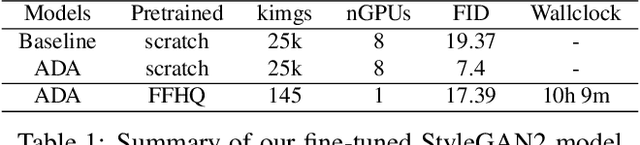
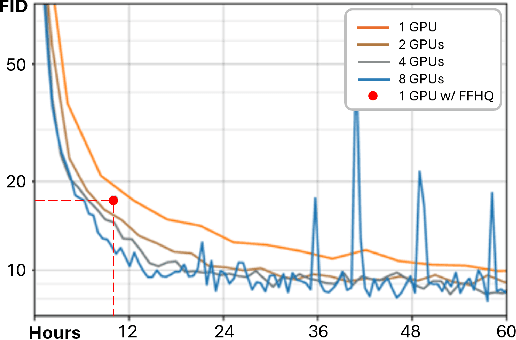
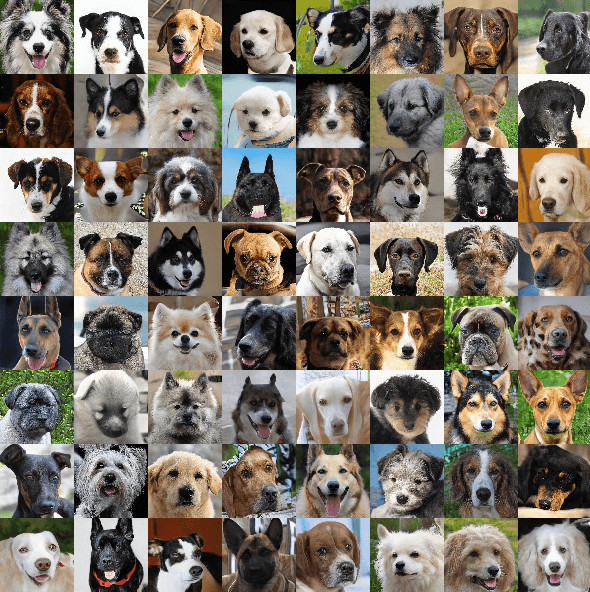
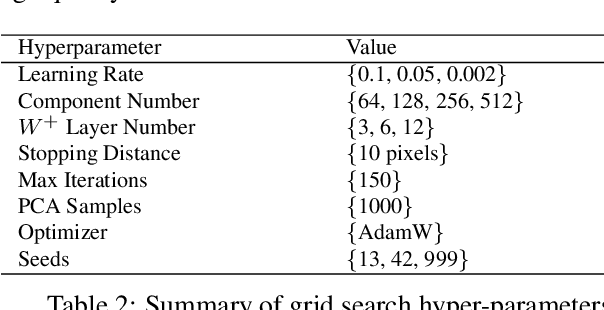
This work integrates StyleGAN, DragGAN and Principal Component Analysis (PCA) to enhance the latent space efficiency and controllability of GAN-generated images. Style-GAN provides a structured latent space, DragGAN enables intuitive image manipulation, and PCA reduces dimensionality and facilitates cross-model alignment for more streamlined and interpretable exploration of latent spaces. We apply our techniques to the Animal Faces High Quality (AFHQ) dataset, and find that our approach of integrating PCA-based dimensionality reduction with the Drag-GAN framework for image manipulation retains performance while improving optimization efficiency. Notably, introducing PCA into the latent W+ layers of DragGAN can consistently reduce the total optimization time while maintaining good visual quality and even boosting the Structural Similarity Index Measure (SSIM) of the optimized image, particularly in shallower latent spaces (W+ layers = 3). We also demonstrate capability for aligning images generated by two StyleGAN models trained on similar but distinct data domains (AFHQ-Dog and AFHQ-Cat), and show that we can control the latent space of these aligned images to manipulate the images in an intuitive and interpretable manner. Our findings highlight the possibility for efficient and interpretable latent space control for a wide range of image synthesis and editing applications.