 Add to Chrome
 Add to Firefox
 Add to Edge
SR-Prominence: A Crowdsourced Protocol and Dataset Suite for Perceptually-Weighted Super-Resolution Artifact Evaluation
May 14, 2026
Modern image super-resolution methods generate detailed, visually appealing results, but they often introduce visual artifacts: unnatural patterns and texture distortions that degrade perceived quality. These defects vary widely in perceptual impact--some are barely noticeable, while others are highly disturbing--yet existing detection methods treat them equally. We propose artifact prominence as an evaluative target, defined as the fraction of viewers who judge a highlighted region to contain a noticeable artifact. We design a crowdsourced annotation protocol and construct SR-Prominence, a dataset suite containing 3,935 artifact masks from DeSRA, Open Images, Urban100, and a realistic no-ground-truth Urban100-HR setting, annotated with prominence. Re-annotating DeSRA reveals that 48.2% of its in-lab binary artifacts are not noticed by a majority of viewers. Across the suite, we audit SR artifact detectors, image-quality metrics, and SR methods. We find that classical full-reference metrics, especially SSIM and DISTS, provide surprisingly strong localized prominence signals, whereas no-reference IQA methods and specialized artifact detectors often fail to generalize across datasets and reference settings. SR-Prominence is released with an objective scoring protocol that allows new metrics to be benchmarked on our suite without further crowdsourcing. Together, the data and protocols enable SR artifact evaluation to move from binary defect presence toward perceptual impact. SR-Prominence is available at https://huggingface.co/datasets/imolodetskikh/sr-artifact-prominence.

Guardians of Image Quality: Benchmarking Defenses Against Adversarial Attacks on Image Quality Metrics
Aug 02, 2024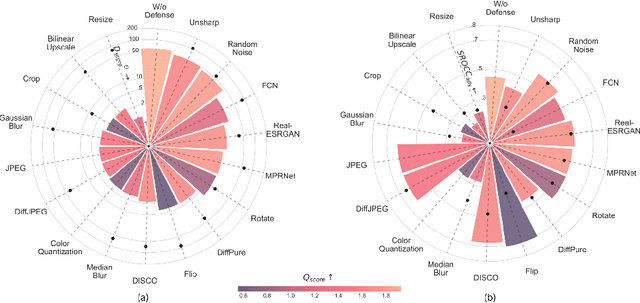
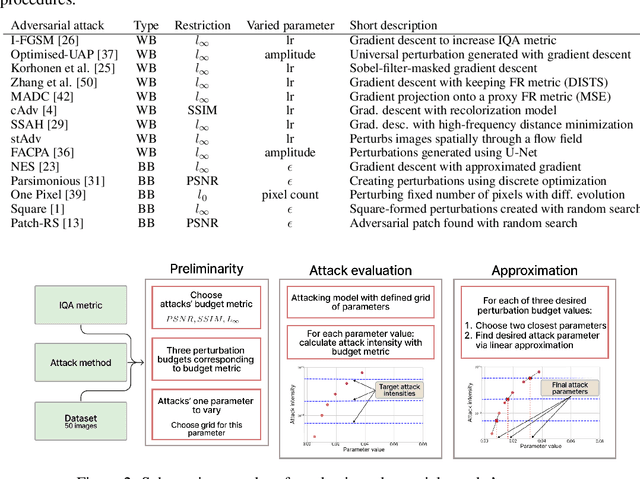
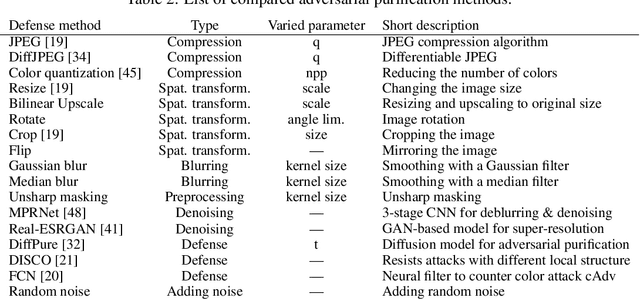

In the field of Image Quality Assessment (IQA), the adversarial robustness of the metrics poses a critical concern. This paper presents a comprehensive benchmarking study of various defense mechanisms in response to the rise in adversarial attacks on IQA. We systematically evaluate 25 defense strategies, including adversarial purification, adversarial training, and certified robustness methods. We applied 14 adversarial attack algorithms of various types in both non-adaptive and adaptive settings and tested these defenses against them. We analyze the differences between defenses and their applicability to IQA tasks, considering that they should preserve IQA scores and image quality. The proposed benchmark aims to guide future developments and accepts submissions of new methods, with the latest results available online: https://videoprocessing.ai/benchmarks/iqa-defenses.html.