 Add to Chrome
 Add to Firefox
 Add to Edge
VISTA: Visualization of Token Attribution via Efficient Analysis
Apr 02, 2026
Understanding how Large Language Models (LLMs) process information from prompts remains a significant challenge. To shed light on this "black box," attention visualization techniques have been developed to capture neuron-level perceptions and interpret how models focus on different parts of input data. However, many existing techniques are tailored to specific model architectures, particularly within the Transformer family, and often require backpropagation, resulting in nearly double the GPU memory usage and increased computational cost. A lightweight, model-agnostic approach for attention visualization remains lacking. In this paper, we introduce a model-agnostic token importance visualization technique to better understand how generative AI systems perceive and prioritize information from input text, without incurring additional computational cost. Our method leverages perturbation-based strategies combined with a three-matrix analytical framework to generate relevance maps that illustrate token-level contributions to model predictions. The framework comprises: (1) the Angular Deviation Matrix, which captures shifts in semantic direction; (2) the Magnitude Deviation Matrix, which measures changes in semantic intensity; and (3) the Dimensional Importance Matrix, which evaluates contributions across individual vector dimensions. By systematically removing each token and measuring the resulting impact across these three complementary dimensions, we derive a composite importance score that provides a nuanced and mathematically grounded measure of token significance. To support reproducibility and foster wider adoption, we provide open-source implementations of all proposed and utilized explainability techniques, with code and resources publicly available at https://github.com/Infosys/Infosys-Responsible-AI-Toolkit

Comparative Evaluation of Traditional Methods and Deep Learning for Brain Glioma Imaging. Review Paper
Mar 05, 2026Segmentation is crucial for brain gliomas as it delineates the glioma s extent and location, aiding in precise treatment planning and monitoring, thus improving patient outcomes. Accurate segmentation ensures proper identification of the glioma s size and position, transforming images into applicable data for analysis. Classification of brain gliomas is also essential because different types require different treatment approaches. Accurately classifying brain gliomas by size, location, and aggressiveness is essential for personalized prognosis prediction, follow-up care, and monitoring disease progression, ensuring effective diagnosis, treatment, and management. In glioma research, irregular tissues are often observable, but error free and reproducible segmentation is challenging. Many researchers have surveyed brain glioma segmentation, proposing both fully automatic and semi-automatic techniques. The adoption of these methods by radiologists depends on ease of use and supervision, with semi-automatic techniques preferred due to the need for accurate evaluations. This review evaluates effective segmentation and classification techniques post magnetic resonance imaging acquisition, highlighting that convolutional neural network architectures outperform traditional techniques in these tasks.
* 22 pages, 4 Figures
Design Behaviour Codes (DBCs): A Taxonomy-Driven Layered Governance Benchmark for Large Language Models
Mar 05, 2026We introduce the Dynamic Behavioral Constraint (DBC) benchmark, the first empirical framework for evaluating the efficacy of a structured, 150-control behavioral governance layer, the MDBC (Madan DBC) system, applied at inference time to large language models (LLMs). Unlike training time alignment methods (RLHF, DPO) or post-hoc content moderation APIs, DBCs constitute a system prompt level governance layer that is model-agnostic, jurisdiction-mappable, and auditable. We evaluate the DBC Framework across a 30 domain risk taxonomy organized into six clusters (Hallucination and Calibration, Bias and Fairness, Malicious Use, Privacy and Data Protection, Robustness and Reliability, and Misalignment Agency) using an agentic red-team protocol with five adversarial attack strategies (Direct, Roleplay, Few-Shot, Hypothetical, Authority Spoof) across 3 model families. Our three-arm controlled design (Base, Base plus Moderation, Base plus DBC) enables causal attribution of risk reduction. Key findings: the DBC layer reduces the aggregate Risk Exposure Rate (RER) from 7.19 percent (Base) to 4.55 percent (Base plus DBC), representing a 36.8 percent relative risk reduction, compared with 0.6 percent for a standard safety moderation prompt. MDBC Adherence Scores improve from 8.6 by 10 (Base) to 8.7 by 10 (Base plus DBC). EU AI Act compliance (automated scoring) reaches 8.5by 10 under the DBC layer. A three judge evaluation ensemble yields Fleiss kappa greater than 0.70 (substantial agreement), validating our automated pipeline. Cluster ablation identifies the Integrity Protection cluster (MDBC 081 099) as delivering the highest per domain risk reduction, while graybox adversarial attacks achieve a DBC Bypass Rate of 4.83 percent . We release the benchmark code, prompt database, and all evaluation artefacts to enable reproducibility and longitudinal tracking as models evolve.
A Systematic Review of Algorithmic Red Teaming Methodologies for Assurance and Security of AI Applications
Feb 24, 2026Cybersecurity threats are becoming increasingly sophisticated, making traditional defense mechanisms and manual red teaming approaches insufficient for modern organizations. While red teaming has long been recognized as an effective method to identify vulnerabilities by simulating real-world attacks, its manual execution is resource-intensive, time-consuming, and lacks scalability for frequent assessments. These limitations have driven the evolution toward auto-mated red teaming, which leverages artificial intelligence and automation to deliver efficient and adaptive security evaluations. This systematic review consolidates existing research on automated red teaming, examining its methodologies, tools, benefits, and limitations. The paper also highlights current trends, challenges, and research gaps, offering insights into future directions for improving automated red teaming as a critical component of proactive cybersecurity strategies. By synthesizing findings from diverse studies, this review aims to provide a comprehensive understanding of how automation enhances red teaming and strengthens organizational resilience against evolving cyber threats.
Glioma Classification using Multi-sequence MRI and Novel Wavelets-based Feature Fusion
Feb 28, 2025Glioma, a prevalent and heterogeneous tumor originating from the glial cells, can be differentiated as Low Grade Glioma (LGG) and High Grade Glioma (HGG) according to World Health Organization's norms. Classifying gliomas is essential for treatment protocols that depend extensively on subtype differentiation. For non-invasive glioma evaluation, Magnetic Resonance Imaging (MRI) offers vital information about the morphology and location of the the tumor. The versatility of MRI allows the classification of gliomas as LGG and HGG based on their texture, perfusion, and diffusion characteristics, and further for improving the diagnosis and providing tailored treatments. Nevertheless, the precise classification is complicated by tumor heterogeneity and overlapping radiomic characteristics. Thus, in this work, wavelet based novel fusion algorithm were implemented on multi-sequence T1, T1-contrast enhanced (T1CE), T2 and Fluid Attenuated Inversion Recovery (FLAIR) MRI images to compute the radiomics features. Furthermore, principal component analysis is applied to reduce the feature space and XGBoost, Support Vector Machine, and Random Forest Classifier are used for the classification. The result shows that the SVM algorithm performs comparatively well with an accuracy of 90.17%, precision of 91.04% and recall of 96.19%, F1-score of 93.53%, and AUC of 94.60% when implemented on BraTS 2018 dataset and with an accuracy of 91.34%, precision of 93.05% and recall of 96.13%, F1-score of 94.53%, and AUC of 93.71% for BraTS 2018 dataset. Thus, the proposed algorithm could be potentially implemented for the computer-aided diagnosis and grading system for gliomas.
* 18 pages, 11 figures, 6 tables, journal paper
Deep Learning-Based Approach for Automatic 2D and 3D MRI Segmentation of Gliomas
Feb 27, 2025
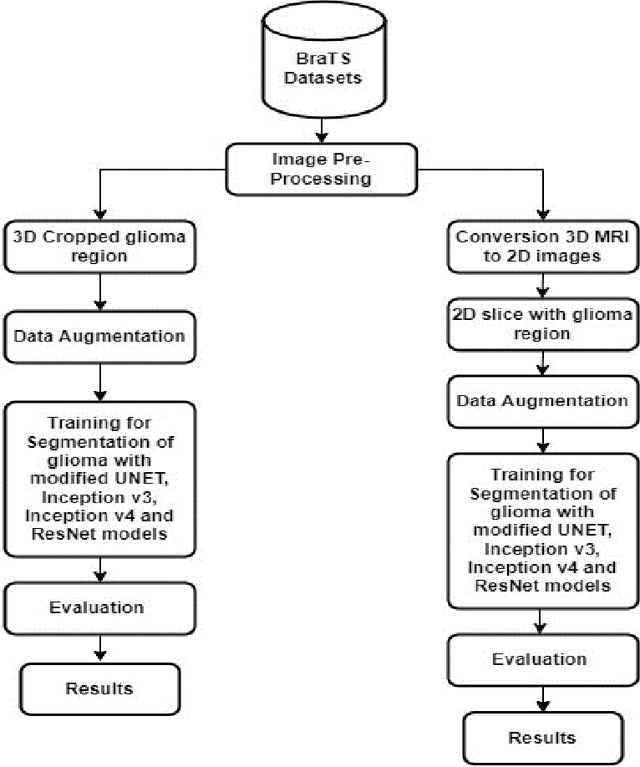
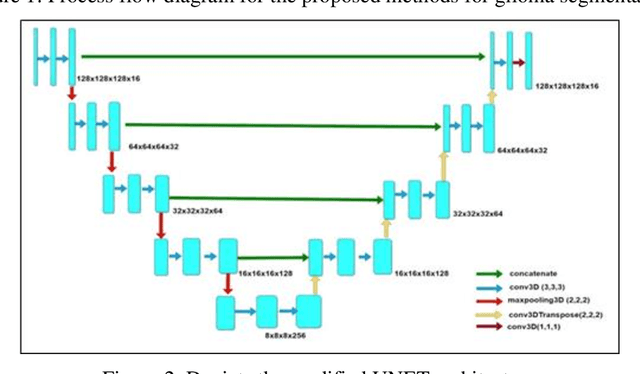
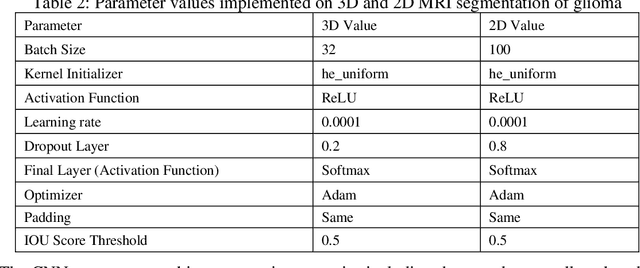
Brain tumor diagnosis is a challenging task for clinicians in the modern world. Among the major reasons for cancer-related death is the brain tumor. Gliomas, a category of central nervous system (CNS) tumors, encompass diverse subregions. For accurate diagnosis of brain tumors, precise segmentation of brain images and quantitative analysis are required. A fully automatic approach to glioma segmentation is required because the manual segmentation process is laborious, prone to mistakes, as well as time-consuming. Modern techniques for segmenting gliomas are based on fully convolutional neural networks (FCNs), which can either use two-dimensional (2D) or three-dimensional (3D) convolutions. Nevertheless, 3D convolutions suffer from computational costs and memory demand, while 2D convolutions cannot fully utilize the spatial insights of volumetric clinical imaging data. To obtain an optimal solution, it is vital to balance the computational efficiency of 2D convolutions along with the spatial accuracy of 3D convolutions. This balance can potentially be realized by developing an advanced model to overcome these challenges. The 2D and 3D models implemented here are based on UNET architecture, Inception, and ResNet models. The research work has been implemented on the BraTS 2018, 2019, and 2020 datasets. The best performer of all the models' evaluations metrics for proposed methodologies offer superior potential in terms of the effective segmentation of gliomas. The ResNet model has resulted in 98.91% accuracy for 3D segmentation and 99.77 for 2D segmentations. The dice scores for 2D and 3D segmentations are 0.8312 and 0.9888, respectively. This model can be applied to various other medical applications with fine-tuning, thereby aiding clinicians in brain tumor analysis and improving the diagnosis process effectively.
* 20 pages, 11 figures, journal paper
Subclass Classification of Gliomas Using MRI Fusion Technique
Feb 26, 2025Glioma, the prevalent primary brain tumor, exhibits diverse aggressiveness levels and prognoses. Precise classification of glioma is paramount for treatment planning and predicting prognosis. This study aims to develop an algorithm to fuse the MRI images from T1, T2, T1ce, and fluid-attenuated inversion recovery (FLAIR) sequences to enhance the efficacy of glioma subclass classification as no tumor, necrotic core, peritumoral edema, and enhancing tumor. The MRI images from BraTS datasets were used in this work. The images were pre-processed using max-min normalization to ensure consistency in pixel intensity values across different images. The segmentation of the necrotic core, peritumoral edema, and enhancing tumor was performed on 2D and 3D images separately using UNET architecture. Further, the segmented regions from multimodal MRI images were fused using the weighted averaging technique. Integrating 2D and 3D segmented outputs enhances classification accuracy by capturing detailed features like tumor shape, boundaries, and intensity distribution in slices, while also providing a comprehensive view of spatial extent, shape, texture, and localization within the brain volume. The fused images were used as input to the pre-trained ResNet50 model for glioma subclass classification. The network is trained on 80% and validated on 20% of the data. The proposed method achieved a classification of accuracy of 99.25%, precision of 99.30%, recall of 99.10, F1 score of 99.19%, Intersection Over Union of 84.49%, and specificity of 99.76, which showed a significantly higher performance than existing techniques. These findings emphasize the significance of glioma segmentation and classification in aiding accurate diagnosis.
* 15 pages, 7 figures, 1 algorithm, 4 tables, journal paper