 Add to Chrome
 Add to Firefox
 Add to Edge
Fluid-Antenna-Enabled Integrated Bistatic Sensing and Backscatter Communication Systems
Feb 11, 2026
This paper studies a fluid-antenna-enabled integrated bistatic sensing and backscatter communication system for future networks where connectivity, power delivery, and environmental awareness are jointly supported by the same infrastructure. A multi-antenna base station (BS) with transmitting fluid antennas serves downlink users, energizes passive tags, and illuminates radar targets, while a spatially separated multi-antenna reader decodes tag backscatter and processes radar echoes to avoid the strong self-interference that would otherwise obscure weak returns at the BS. The coexistence of tags and targets, however, induces severe near--far disparities and multi-signal interference, which can be mitigated by fluid antennas through additional spatial degrees of freedom that reshape the multi-hop channels. We formulate a transmit-power minimization problem that jointly optimizes the BS information beamformers, sensing covariance matrix, reader receive beamformers, tag reflection coefficients, and fluid-antenna (FA) positions under heterogeneous quality of service constraints for communication, backscatter, and sensing, as well as energy-harvesting and FA geometry requirements. To tackle the resulting non-convex problem, we develop an alternating-optimization block-coordinate framework that solves four tractable subproblems using semidefinite relaxation, majorization--minimization, and successive convex approximation. Numerical results show consistent transmit-power savings over fixed-position antennas and zero-forcing baselines, achieving about 13.7% and 54.5% reductions, respectively.

Robust Secure ISAC: How RSMA and Active RIS Manage Eavesdropper's Spatial Uncertainty
Jul 21, 2024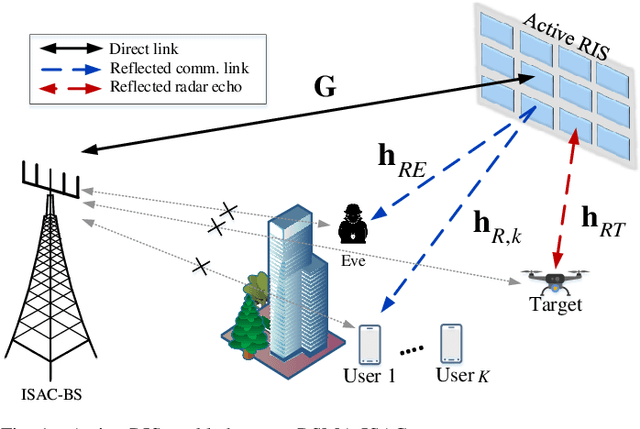
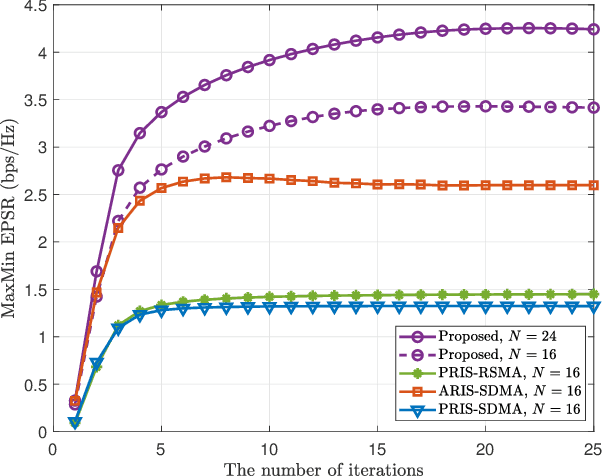
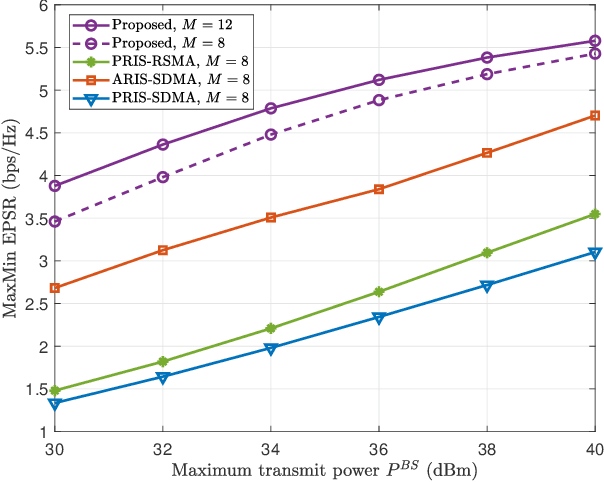
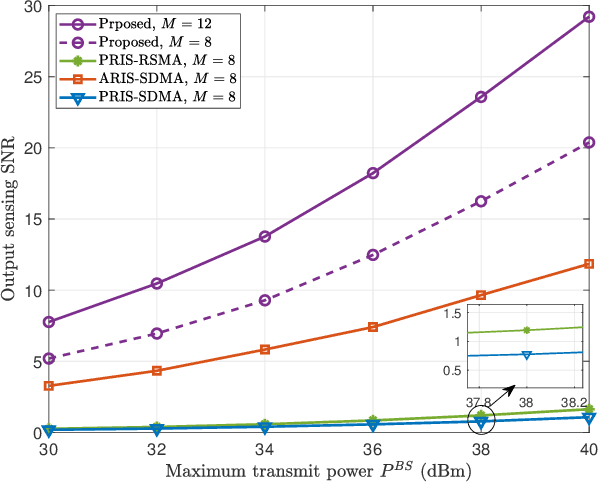
Incorporating rate splitting multiple access (RSMA) into integrated sensing and communication (ISAC) presents a significant security challenge, particularly in scenarios where the location of a potential eavesdropper (Eve) is unidentified. Splitting users' messages into common and private streams exposes them to eavesdropping, with the common stream dedicated for sensing and accessible to multiple users. In response to this challenge, this paper proposes a novel approach that leverages active reconfigurable intelligent surface (RIS) aided beamforming and artificial noise (AN) to enhance the security of RSMA-enabled ISAC. Specifically, we first derive the ergodic private secrecy rate (EPSR) based on mathematical approximation of the average Eve channel gain. An optimization problem is then formulated to maximize the minimum EPSR, while satisfying the minimum required thresholds on ergodic common secrecy rate, radar sensing and RIS power budget. To address this non-convex problem, a novel optimization strategy is developed, whereby we alternatively optimize the transmit beamforming matrix for the common and private streams, rate splitting, AN, RIS reflection coefficient matrix, and radar receive beamformer. Successive convex approximation (SCA) and Majorization-Minimization (MM) are employed to convexify the beamforming and RIS sub-problems. Simulations are conducted to showcase the effectiveness of the proposed framework against established benchmarks.