 Add to Chrome
 Add to Firefox
 Add to Edge
TransitNet: A Compact Attention-Augmented Deep Learning Framework for Low-SNR Transit Blind Searches
Jun 17, 2026
Motivated by the observational incompleteness of intermediate-to-long-period Earth-size planets, we present TransitNet, a compact attention-augmented deep-learning framework for low-SNR transit blind searches. To enable realistic method development and objective threshold calibration under blind-search conditions, we develop a unified dataset construction, benchmarking, and threshold-selection framework. On recovery benchmarks constructed from unseen Kepler targets, TransitNet attains 95.2 percent accuracy in the challenging SNR range of 6 to 8 and outperforms both TLS and BLS, achieving ROC-AUC and PR-AP values of 0.974 and 0.982, respectively. In an injected Earth-size and sub-Earth-size transit recovery experiment, TransitNet achieves a recovery rate of 93.0 percent, substantially exceeding those of TLS (63.1 percent) and BLS (60.0 percent). In addition to detection, TransitNet provides attention-based estimates of transit windows and midpoints. On an independent evaluation set, 97.4 percent of injected transits are fully covered by the estimated transit window. Applied to real Kepler observations, the model successfully recovers all 34 selected confirmed Kepler planets, with a mean absolute transit midpoint error of 1.24 hours. The model combines a compact footprint of about 1.5 MB with high inference efficiency, yielding speed-ups of about 12 to 25 times relative to CPU-TLS and about 4 to 5 times relative to CPU-BLS. These results demonstrate that TransitNet provides an accurate, scalable, and computationally efficient framework for low-SNR transit blind searches in the tested regime and motivate its extension to longer-period Earth-size planet searches.

DELOS: Detecting Shallow Transits in Kepler Photometry Using a Contrastive-Learning Framework
May 28, 2026We present DEtection in phase-folded Light curves with cOntrastive Scoring (DELOS), a contrastive-learning-based framework designed to search for shallow transits in Kepler photometry. DELOS combines GPU-accelerated phase folding, optimized phase binning, and a custom one-dimensional convolutional encoder to assign a transit-likeness score to each folded light curve, thereby producing a score periodogram over trial periods without relying on pre-detected threshold-crossing events. Focusing on intermediate-to-long-period signals with orbital periods of 100-150 days, DELOS was trained on 20 million synthetic light curves generated with realistic transit models and Kepler-like noise properties, achieving a validation accuracy of 99.3 percent on the synthetic validation set. In controlled injection-recovery experiments, DELOS improves the combined precision-recall performance by 15.5 percent relative to Box-fitting Least Squares (BLS) and 11.25 percent relative to Transit Least Squares (TLS) in the low Signal-to-Noise Ratios (low-SNR) regime. It also accelerates the search by factors of approximately 3-5 and 74-80 compared with BLS and TLS, respectively. Applied to a selected Kepler validation sample, DELOS recovered all known shallow intermediate-to-long-period transit signals in the tested period range. These results demonstrate that DELOS provides an efficient and sensitive framework for low-SNR transit searches and represents a practical step toward future searches for longer-period terrestrial planets in Kepler, K2, TESS, PLATO, and Earth 2.0 data. Accordingly, this work is intended as a methodological development and validation study, with the detailed astrophysical validation of newly identified candidates deferred to future work.
Discovery of Small Ultra-short-period Planets Orbiting KG Dwarfs in Kepler Survey Using GPU Phase Folding and Deep Learning Detection System
Dec 28, 2023Since the discovery of the first hot Jupiter orbiting a solar-type star, 51 Peg, in 1995, more than 4000 exoplanets have been identified using various observational techniques. The formation process of these sub-Earths remains elusive, and acquiring additional samples is essential for investigating this unique population. In our study, we employ a novel GPU Phase Folding algorithm combined with a Convolutional Neural Network, termed the GPFC method, on Kepler photometry data. This method enhances the transit search speed significantly over the traditional Box-fitting Least Squares method, allowing a complete search of the known KOI photometry data within hours using a commercial GPU card. To date, we have identified five promising sub-Earth short-period candidates: K00446.c, K01821.b, K01522.c, K03404.b, and K04978.b. A closer analysis reveals the following characteristics: K00446.c orbits a K dwarf on a 0.645091-day period. With a radius of $0.461R_\oplus$, it ranks as the second smallest USP discovered to date. K01821.b is a sub-Earth with a radius of $0.648R_\oplus$, orbiting a G dwarf over a 0.91978-day period. It is the second smallest USP among all confirmed USPs orbiting G dwarfs in the NASA Archive. K01522.c has a radius of $0.704 R_\oplus$ and completes an orbit around a Sun-like G dwarf in 0.64672 days; K03404.b, with a radius of $0.738 R_\oplus$, orbits a G dwarf on a 0.68074-day period; and K04978.b, with its planetary radius of $0.912 R_\oplus$, orbits a G dwarf, completing an orbit every 0.94197 days. Three of our finds, K01821.b, K01522.c and K03404.b, rank as the smallest planets among all confirmed USPs orbiting G dwarfs in the Kepler dataset. The discovery of these small exoplanets underscores the promising capability of the GPFC method for searching for small, new transiting exoplanets in photometry data from Kepler, TESS, and future space transit missions.
The GPU Phase Folding and Deep Learning Method for Detecting Exoplanet Transits
Dec 04, 2023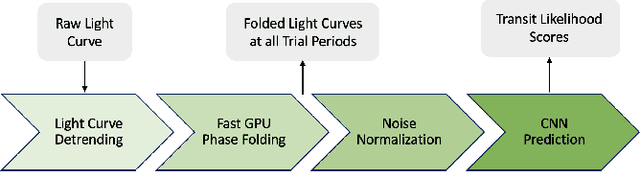
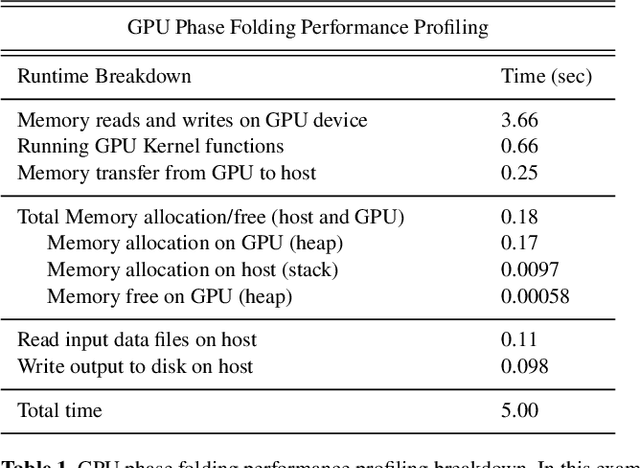

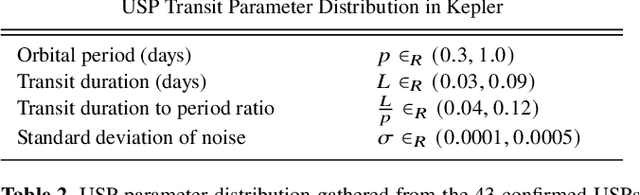
This paper presents GPFC, a novel Graphics Processing Unit (GPU) Phase Folding and Convolutional Neural Network (CNN) system to detect exoplanets using the transit method. We devise a fast folding algorithm parallelized on a GPU to amplify low signal-to-noise ratio transit signals, allowing a search at high precision and speed. A CNN trained on two million synthetic light curves reports a score indicating the likelihood of a planetary signal at each period. GPFC improves on speed by three orders of magnitude over the predominant Box-fitting Least Squares (BLS) method. Our simulation results show GPFC achieves 97% training accuracy, higher true positive rate at the same false positive rate of detection, and higher precision at the same recall rate when compared to BLS. GPFC recovers 100% of known ultra-short-period planets in Kepler light curves from a blind search. These results highlight the promise of GPFC as an alternative approach to the traditional BLS algorithm for finding new transiting exoplanets in data taken with Kepler and other space transit missions such as K2, TESS and future PLATO and Earth 2.0.
Discovering Faint and High Apparent Motion Rate Near-Earth Asteroids Using A Deep Learning Program
Aug 19, 2022
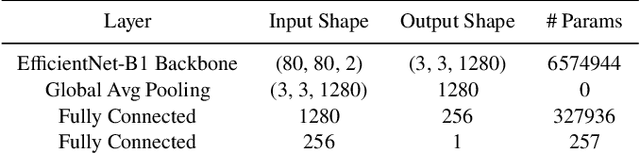
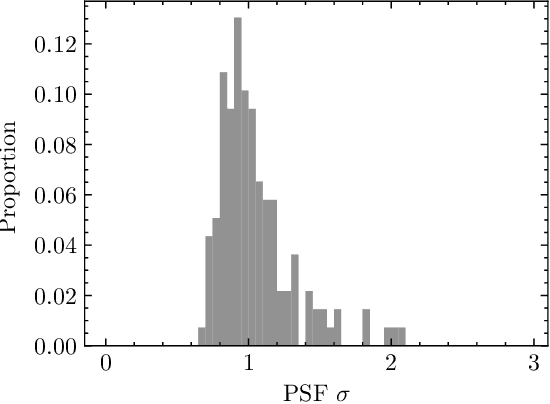
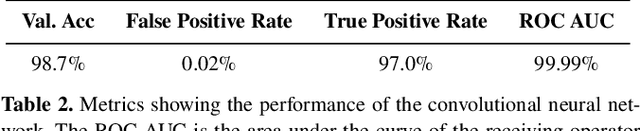
Although many near-Earth objects have been found by ground-based telescopes, some fast-moving ones, especially those near detection limits, have been missed by observatories. We developed a convolutional neural network for detecting faint fast-moving near-Earth objects. It was trained with artificial streaks generated from simulations and was able to find these asteroid streaks with an accuracy of 98.7% and a false positive rate of 0.02% on simulated data. This program was used to search image data from the Zwicky Transient Facility (ZTF) in four nights in 2019, and it identified six previously undiscovered asteroids. The visual magnitudes of our detections range from ~19.0 - 20.3 and motion rates range from ~6.8 - 24 deg/day, which is very faint compared to other ZTF detections moving at similar motion rates. Our asteroids are also ~1 - 51 m diameter in size and ~5 - 60 lunar distances away at close approach, assuming their albedo values follow the albedo distribution function of known asteroids. The use of a purely simulated dataset to train our model enables the program to gain sensitivity in detecting faint and fast-moving objects while still being able to recover nearly all discoveries made by previously designed neural networks which used real detections to train neural networks. Our approach can be adopted by any observatory for detecting fast-moving asteroid streaks.