 Add to Chrome
 Add to Firefox
 Add to Edge
DirMoE: Dirichlet-routed Mixture of Experts
Feb 09, 2026
Mixture-of-Experts (MoE) models have demonstrated exceptional performance in large-scale language models. Existing routers typically rely on non-differentiable Top-$k$+Softmax, limiting their performance and scalability. We argue that two distinct decisions, which experts to activate and how to distribute expert contributions among them, are conflated in standard Top-$k$+Softmax. We introduce Dirichlet-Routed MoE (DirMoE), a novel end-to-end differentiable routing mechanism built on a Dirichlet variational autoencoder framework. This design fundamentally disentangles the core routing problems: expert selection, modeled by a Bernoulli component, and expert contribution among chosen experts, handled by a Dirichlet component. The entire forward pass remains fully differentiable through the use of Gumbel-Sigmoid relaxation for the expert selection and implicit reparameterization for the Dirichlet distribution. Our training objective, a variational ELBO, includes a direct sparsity penalty that precisely controls the number of active experts in expectation, alongside a schedule for key hyperparameters that guides the model from an exploratory to a definitive routing state. Moreover, our DirMoE router matches or exceeds other methods while improving expert specialization.

SIGMMA: Hierarchical Graph-Based Multi-Scale Multi-modal Contrastive Alignment of Histopathology Image and Spatial Transcriptome
Nov 19, 2025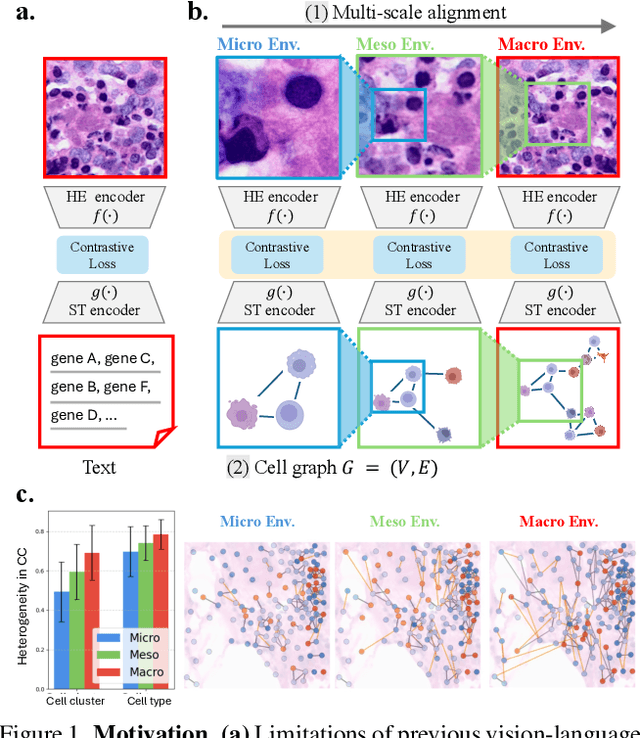
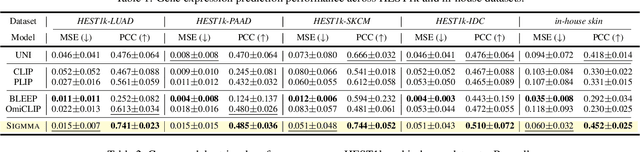
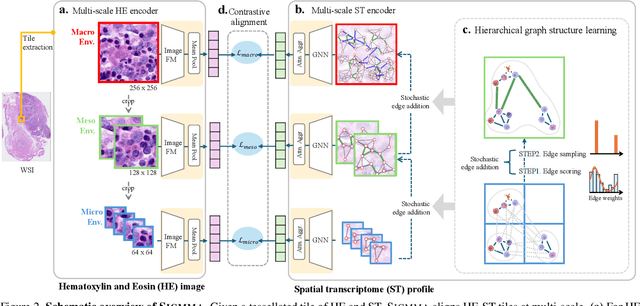
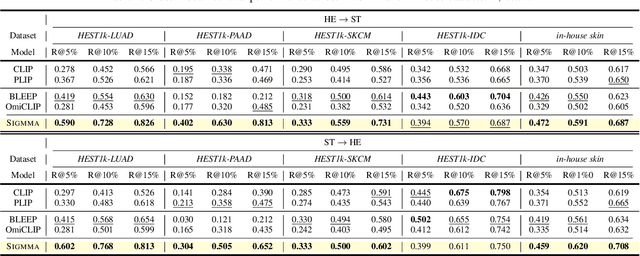
Recent advances in computational pathology have leveraged vision-language models to learn joint representations of Hematoxylin and Eosin (HE) images with spatial transcriptomic (ST) profiles. However, existing approaches typically align HE tiles with their corresponding ST profiles at a single scale, overlooking fine-grained cellular structures and their spatial organization. To address this, we propose Sigmma, a multi-modal contrastive alignment framework for learning hierarchical representations of HE images and spatial transcriptome profiles across multiple scales. Sigmma introduces multi-scale contrastive alignment, ensuring that representations learned at different scales remain coherent across modalities. Furthermore, by representing cell interactions as a graph and integrating inter- and intra-subgraph relationships, our approach effectively captures cell-cell interactions, ranging from fine to coarse, within the tissue microenvironment. We demonstrate that Sigmm learns representations that better capture cross-modal correspondences, leading to an improvement of avg. 9.78\% in the gene-expression prediction task and avg. 26.93\% in the cross-modal retrieval task across datasets. We further show that it learns meaningful multi-tissue organization in downstream analyses.