 Add to Chrome
 Add to Firefox
 Add to Edge
Temporal Generalization in fNIRS-Based Autism Classification: A Cross-Time-Window Transfer Benchmark
Aug 03, 2026
Functional near-infrared spectroscopy (fNIRS) is a promising modality for autism spectrum disorder (ASD) classification, yet existing approaches assume temporally aligned evaluation. In practice, the optimal observation window varies across subjects due to differences in hemodynamic delay and neurovascular coupling, creating a temporal distribution shift that degrades performance. We formalize this as a \textit{cross-time-window transfer problem}, introducing a protocol that varies window length (2.5--10\,s) and offset within biological motion trials. Using topographic map representations of fNIRS recordings, we benchmark three vision architectures under two zero-shot baselines and eight adaptation strategies under leave-one-subject-out cross-validation ($N{=}124$). Key findings: (1) zero-shot cross-window accuracy is near chance (54--69\%); (2) ${\approx}5\%$ subject-specific fine-tuning recovers 90--96\%, while a subject-specific upper bound reaches 97--100\%, identifying inter-subject variability as the dominant barrier; (3) domain-adversarial and self-supervised strategies achieve 78--90\% without target-subject data; and (4) discriminative information is recoverable from windows as short as 2.5\,s. These findings provide a practical roadmap for deploying fNIRS-based ASD classifiers under realistic temporal variability.

CALM: Interpretable Cross-Modal Alignment for Biomarker Discovery from Unpaired Data
Jul 02, 2026The interaction between brain structure and genetic influences is key to understanding neuropsychiatric disorders. However, most large-scale datasets are unimodal, providing either neuroimaging or genetics data. We propose CALM, a framework that learns interpretable associations between brain ROIs and genetic pathways from completely disjoint populations. CALM aligns the two modalities in a shared latent space via linear projections that simultaneously match the class-conditional latent distributions and ensure group separability. These projections provide interpretable pathway--ROI associations. When trained on unimodal imaging and genetics datasets, CALM generalizes to an unseen paired dataset, outperforming several state-of-the-art methods and ablation baselines. We also demonstrate stability of the learned associations against a paired baseline. Our experiments on autism spectrum disorder reveal immune and metabolic pathways linked to specific cortical regions and are consistent with established literature. Thus, CALM opens the door to leveraging large unimodal repositories for studying cross-modal interactions in brain disorders across disparate datasets.
Prediction of Autism Treatment Response from Baseline fMRI using Random Forests and Tree Bagging
May 24, 2018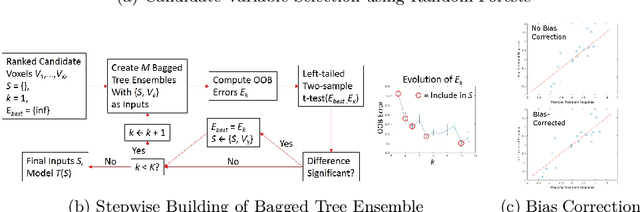
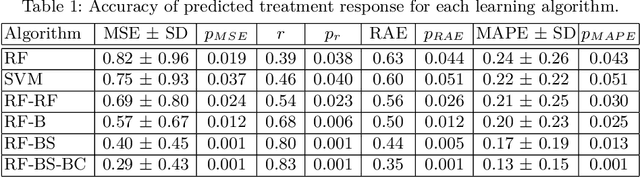
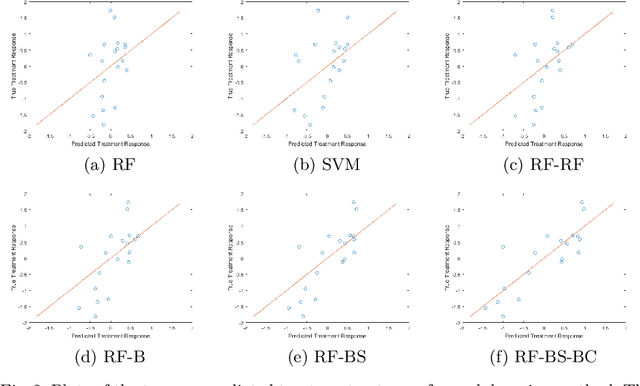

Treating children with autism spectrum disorders (ASD) with behavioral interventions, such as Pivotal Response Treatment (PRT), has shown promise in recent studies. However, deciding which therapy is best for a given patient is largely by trial and error, and choosing an ineffective intervention results in loss of valuable treatment time. We propose predicting patient response to PRT from baseline task-based fMRI by the novel application of a random forest and tree bagging strategy. Our proposed learning pipeline uses random forest regression to determine candidate brain voxels that may be informative in predicting treatment response. The candidate voxels are then tested stepwise for inclusion in a bagged tree ensemble. After the predictive model is constructed, bias correction is performed to further increase prediction accuracy. Using data from 19 ASD children who underwent a 16 week trial of PRT and a leave-one-out cross-validation framework, the presented learning pipeline was tested against several standard methods and variations of the pipeline and resulted in the highest prediction accuracy.