 Add to Chrome
 Add to Firefox
 Add to Edge
Zero-shot adaptable task planning for autonomous construction robots: a comparative study of lightweight single and multi-AI agent systems
Jan 20, 2026
Robots are expected to play a major role in the future construction industry but face challenges due to high costs and difficulty adapting to dynamic tasks. This study explores the potential of foundation models to enhance the adaptability and generalizability of task planning in construction robots. Four models are proposed and implemented using lightweight, open-source large language models (LLMs) and vision language models (VLMs). These models include one single agent and three multi-agent teams that collaborate to create robot action plans. The models are evaluated across three construction roles: Painter, Safety Inspector, and Floor Tiling. Results show that the four-agent team outperforms the state-of-the-art GPT-4o in most metrics while being ten times more cost-effective. Additionally, teams with three and four agents demonstrate the improved generalizability. By discussing how agent behaviors influence outputs, this study enhances the understanding of AI teams and supports future research in diverse unstructured environments beyond construction.

Impact of Robot Facial-Audio Expressions on Human Robot Trust Dynamics and Trust Repair
Dec 16, 2025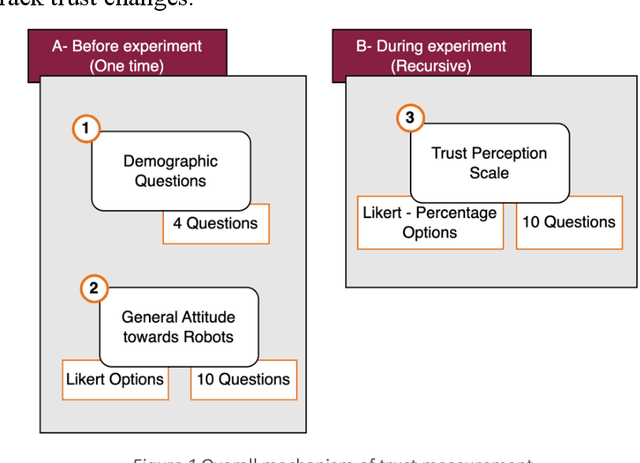
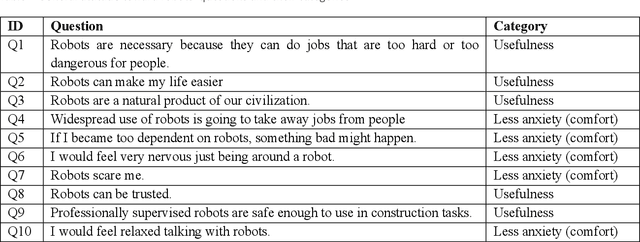
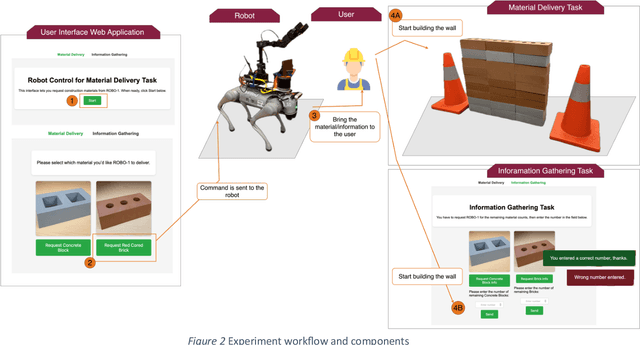
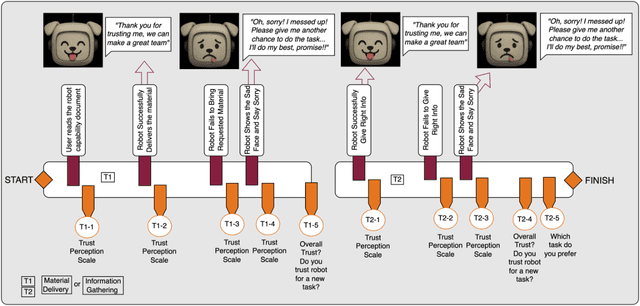
Despite recent advances in robotics and human-robot collaboration in the AEC industry, trust has mostly been treated as a static factor, with little guidance on how it changes across events during collaboration. This paper investigates how a robot's task performance and its expressive responses after outcomes shape the dynamics of human trust over time. To this end, we designed a controlled within-subjects study with two construction-inspired tasks, Material Delivery (physical assistance) and Information Gathering (perceptual assistance), and measured trust repeatedly (four times per task) using the 14-item Trust Perception Scale for HRI plus a redelegation choice. The robot produced two multimodal expressions, a "glad" display with a brief confirmation after success, and a "sad" display with an apology and a request for a second chance after failure. The study was conducted in a lab environment with 30 participants and a quadruped platform, and we evaluated trust dynamics and repair across both tasks. Results show that robot success reliably increases trust, failure causes sharp drops, and apology-based expressions partially restores trust (44% recovery in Material Delivery; 38% in Information Gathering). Item-level analysis indicates that recovered trust was driven mostly by interaction and communication factors, with competence recovering partially and autonomy aspects changing least. Additionally, age group and prior attitudes moderated trust dynamics with younger participants showed larger but shorter-lived changes, mid-20s participants exhibited the most durable repair, and older participants showed most conservative dynamics. This work provides a foundation for future efforts that adapt repair strategies to task demands and user profiles to support safe, productive adoption of robots on construction sites.
Autonomous Construction-Site Safety Inspection Using Mobile Robots: A Multilayer VLM-LLM Pipeline
Dec 16, 2025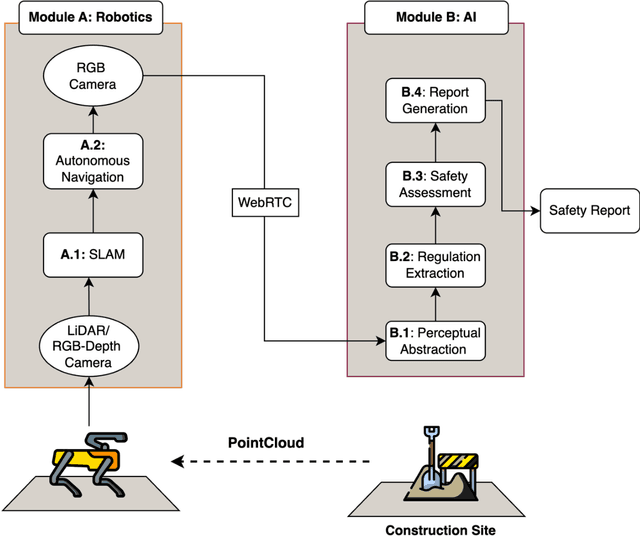
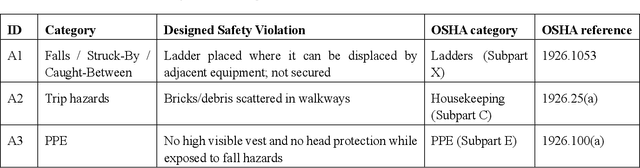
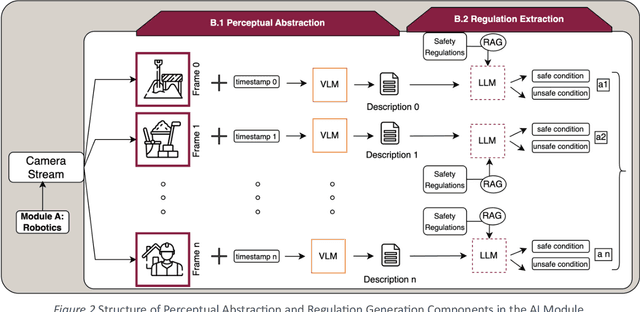
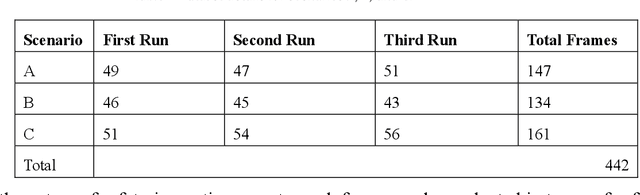
Construction safety inspection remains mostly manual, and automated approaches still rely on task-specific datasets that are hard to maintain in fast-changing construction environments due to frequent retraining. Meanwhile, field inspection with robots still depends on human teleoperation and manual reporting, which are labor-intensive. This paper aims to connect what a robot sees during autonomous navigation to the safety rules that are common in construction sites, automatically generating a safety inspection report. To this end, we proposed a multi-layer framework with two main modules: robotics and AI. On the robotics side, SLAM and autonomous navigation provide repeatable coverage and targeted revisits via waypoints. On AI side, a Vision Language Model (VLM)-based layer produces scene descriptions; a retrieval component powered grounds those descriptions in OSHA and site policies; Another VLM-based layer assesses the safety situation based on rules; and finally Large Language Model (LLM) layer generates safety reports based on previous outputs. The framework is validated with a proof-of-concept implementation and evaluated in a lab environment that simulates common hazards across three scenarios. Results show high recall with competitive precision compared to state-of-the-art closed-source models. This paper contributes a transparent, generalizable pipeline that moves beyond black-box models by exposing intermediate artifacts from each layer and keeping the human in the loop. This work provides a foundation for future extensions to additional tasks and settings within and beyond construction context.
A Robotic Cyber-Physical System for Automated Reality Capture and Visualization in Construction Progress Monitoring
Feb 10, 2024Effective progress monitoring is crucial for the successful delivery of the construction project within the stipulated time and budget. Construction projects are often monitored irregularly through time-consuming physical site visits by multiple project stakeholders. Remote monitoring using robotic cyber-physical systems (CPS) can make the process more efficient and safer. This article presents a conceptual framework for robotic CPS for automated reality capture and visualization for remote progress monitoring in construction. The CPS integrates quadruped robot, Building Information Modelling (BIM), and 360{\deg} reality capturing to autonomously capture, and visualize up-to-date site information. Additionally, the study explores the factors affecting acceptance of the proposed robotic CPS through semi-structured interviews with seventeen progress monitoring experts. The findings will guide construction management teams in adopting CPS in construction and drive further research in the human-centered development of CPS for construction.