 Add to Chrome
 Add to Firefox
 Add to Edge
Are Large Language Models Really Effective for Training-Free Cold-Start Recommendation?
Dec 15, 2025
Recommender systems usually rely on large-scale interaction data to learn from users' past behaviors and make accurate predictions. However, real-world applications often face situations where no training data is available, such as when launching new services or handling entirely new users. In such cases, conventional approaches cannot be applied. This study focuses on training-free recommendation, where no task-specific training is performed, and particularly on \textit{training-free cold-start recommendation} (TFCSR), the more challenging case where the target user has no interactions. Large language models (LLMs) have recently been explored as a promising solution, and numerous studies have been proposed. As the ability of text embedding models (TEMs) increases, they are increasingly recognized as applicable to training-free recommendation, but no prior work has directly compared LLMs and TEMs under identical conditions. We present the first controlled experiments that systematically evaluate these two approaches in the same setting. The results show that TEMs outperform LLM rerankers, and this trend holds not only in cold-start settings but also in warm-start settings with rich interactions. These findings indicate that direct LLM ranking is not the only viable option, contrary to the commonly shared belief, and TEM-based approaches provide a stronger and more scalable basis for training-free recommendation.

LLM-based Query Expansion Fails for Unfamiliar and Ambiguous Queries
May 19, 2025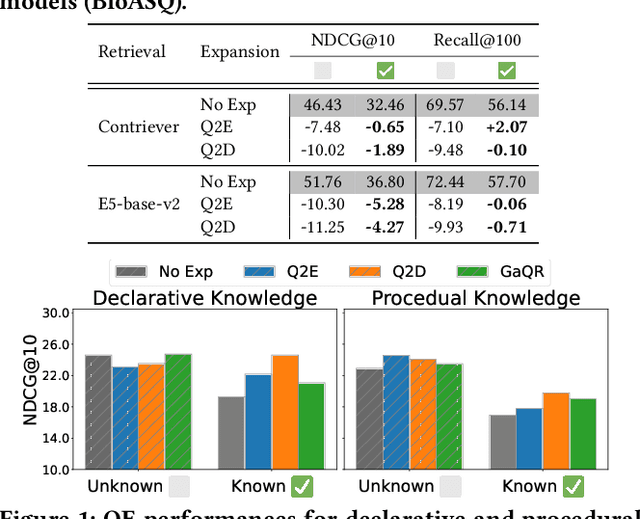
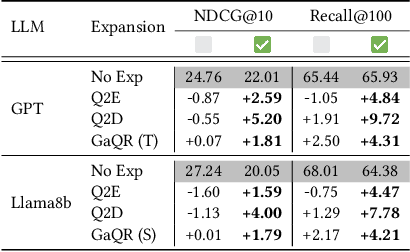
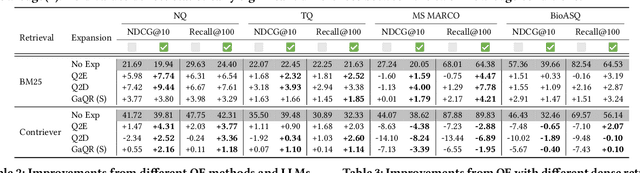
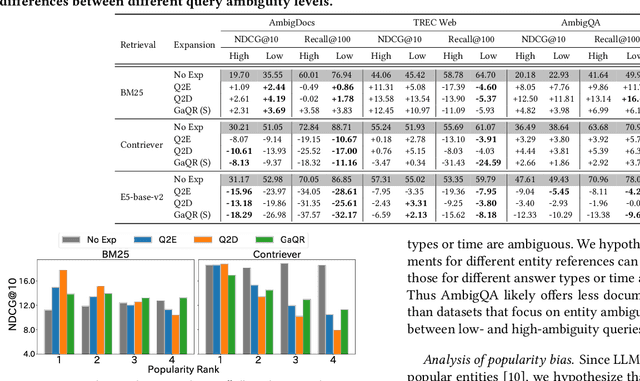
Query expansion (QE) enhances retrieval by incorporating relevant terms, with large language models (LLMs) offering an effective alternative to traditional rule-based and statistical methods. However, LLM-based QE suffers from a fundamental limitation: it often fails to generate relevant knowledge, degrading search performance. Prior studies have focused on hallucination, yet its underlying cause--LLM knowledge deficiencies--remains underexplored. This paper systematically examines two failure cases in LLM-based QE: (1) when the LLM lacks query knowledge, leading to incorrect expansions, and (2) when the query is ambiguous, causing biased refinements that narrow search coverage. We conduct controlled experiments across multiple datasets, evaluating the effects of knowledge and query ambiguity on retrieval performance using sparse and dense retrieval models. Our results reveal that LLM-based QE can significantly degrade the retrieval effectiveness when knowledge in the LLM is insufficient or query ambiguity is high. We introduce a framework for evaluating QE under these conditions, providing insights into the limitations of LLM-based retrieval augmentation.