 Add to Chrome
 Add to Firefox
 Add to Edge
Qumus: Realization of An Embodied AI Quantum Material Experimentalist
May 18, 2026
While modern Large Language Models (LLMs) and agentic artificial intelligence (AI) have demonstrated transformative capabilities in digital domains, the realization of embodied AI capable of real-world scientific discovery remains a difficult frontier. The advancements are hindered by the inherent complexity of integrating high-level reasoning, multimodal information processing and real-time physical execution. Here we introduce Qumus, the first AI quantum materials experimentalist. Physically embodied within a robotic mini-laboratory, Qumus is an intelligent, multimodal, and multi-agent system designed for the creation and nano-processing of atomically thin two-dimensional (2D) materials and stacked van der Waals (vdW) structures. Qumus autonomously navigates the full scientific cycle, from hypothesis generation and protocol planning to multi-step experimental execution, result analysis and reporting, acting as an experimentalist. Markedly, the system has achieved, for the first time, the AI-creation of graphene, as well as the first AI-fabrication of complex nanodevices including atomically thin field-effect transistors via vdW stacking. Qumus excels at these tasks by demonstrating autonomous error correction and closed-loop experimentation. Our results establish a generalizable framework for self-improving embodied AI systems that learn directly from the quantum world, opening a pathway toward accelerated discovery in quantum materials, electronics and beyond.

Cascaded Logic Gates Based on High-Performance Ambipolar Dual-Gate WSe2 Thin Film Transistors
May 02, 2023


Ambipolar dual-gate transistors based on two-dimensional (2D) materials, such as graphene, carbon nanotubes, black phosphorus, and certain transition metal dichalcogenides (TMDs), enable reconfigurable logic circuits with suppressed off-state current. These circuits achieve the same logical output as CMOS with fewer transistors and offer greater flexibility in design. The primary challenge lies in the cascadability and power consumption of these logic gates with static CMOS-like connections. In this article, high-performance ambipolar dual-gate transistors based on tungsten diselenide (WSe2) are fabricated. A high on-off ratio of 10^8 and 10^6, a low off-state current of 100 to 300 fA, a negligible hysteresis, and an ideal subthreshold swing of 62 and 63 mV/dec are measured in the p- and n-type transport, respectively. For the first time, we demonstrate cascadable and cascaded logic gates using ambipolar TMD transistors with minimal static power consumption, including inverters, XOR, NAND, NOR, and buffers made by cascaded inverters. A thorough study of both the control gate and polarity gate behavior is conducted, which has previously been lacking. The noise margin of the logic gates is measured and analyzed. The large noise margin enables the implementation of VT-drop circuits, a type of logic with reduced transistor number and simplified circuit design. Finally, the speed performance of the VT-drop and other circuits built by dual-gate devices are qualitatively analyzed. This work lays the foundation for future developments in the field of ambipolar dual-gate TMD transistors, showing their potential for low-power, high-speed and more flexible logic circuits.
A Stochastic Temporal Model of Polyphonic MIDI Performance with Ornaments
Aug 03, 2016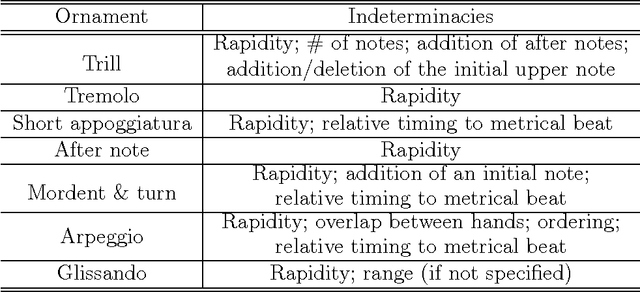

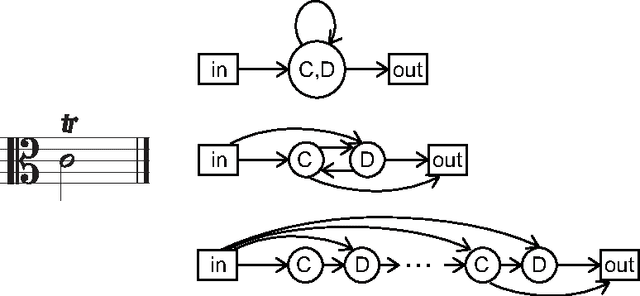
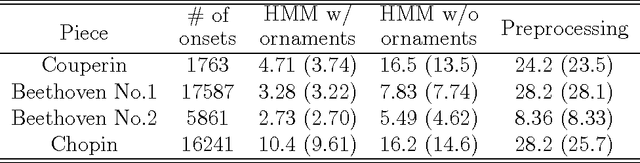
We study indeterminacies in realization of ornaments and how they can be incorporated in a stochastic performance model applicable for music information processing such as score-performance matching. We point out the importance of temporal information, and propose a hidden Markov model which describes it explicitly and represents ornaments with several state types. Following a review of the indeterminacies, they are carefully incorporated into the model through its topology and parameters, and the state construction for quite general polyphonic scores is explained in detail. By analyzing piano performance data, we find significant overlaps in inter-onset-interval distributions of chordal notes, ornaments, and inter-chord events, and the data is used to determine details of the model. The model is applied for score following and offline score-performance matching, yielding highly accurate matching for performances with many ornaments and relatively frequent errors, repeats, and skips.
* 35 pages, 6 figures, some explanations and evaluation results added, version accepted to JNMR