 Add to Chrome
 Add to Firefox
 Add to Edge
Impacts of Single-objective Landscapes on Multi-objective Optimization
Aug 04, 2026
This work revealed a relationship between a multi-objective optimization problem and single-objective optimization problems that exist in the multi-objective problem. This work focused on combinatorial problems and investigated the relations between the local optima networks of the single-objective problems and the Pareto optima network of the multi-objective problem. Each of their networks has a graph structure. We divided the entire network into subgraphs. Each subgraph was called a component and characterized by overlapping relations between the single-objective local optima networks and the multi-objective Pareto optima network. Results on multi-objective landscape problems showed that most Pareto optimal solutions were reachable from the single-objective local optimal solutions. This tendency was emphasized by increasing the number of objectives and the objective correlation. The number of co-variables impacted the number of cross-link relations between the single-objective local optima networks and the multi-objective Pareto optima network. The results suggested that searching for single-objective problems is a clue to multi-objective optimization.
* 9 pages, 12 figures, 1 table. Author's accepted version. Published in Proc. 2022 IEEE Congress on Evolutionary Computation (CEC), part of IEEE WCCI 2022

Guided Dyna-Q for Mobile Robot Exploration and Navigation
Apr 23, 2020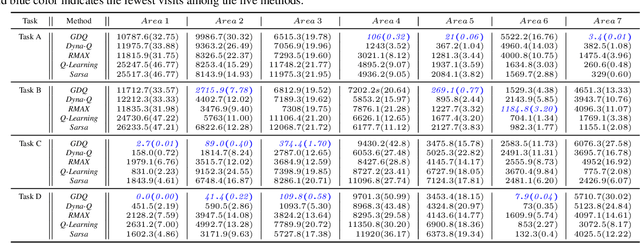
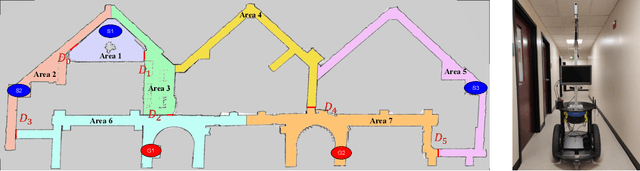
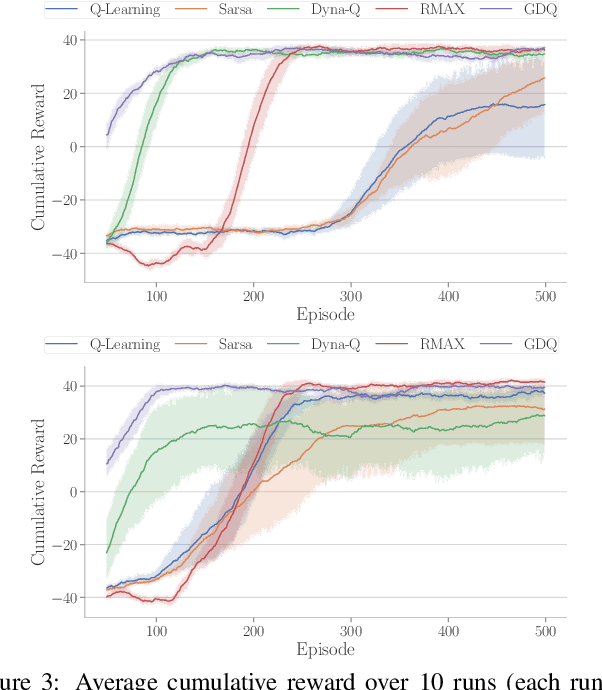
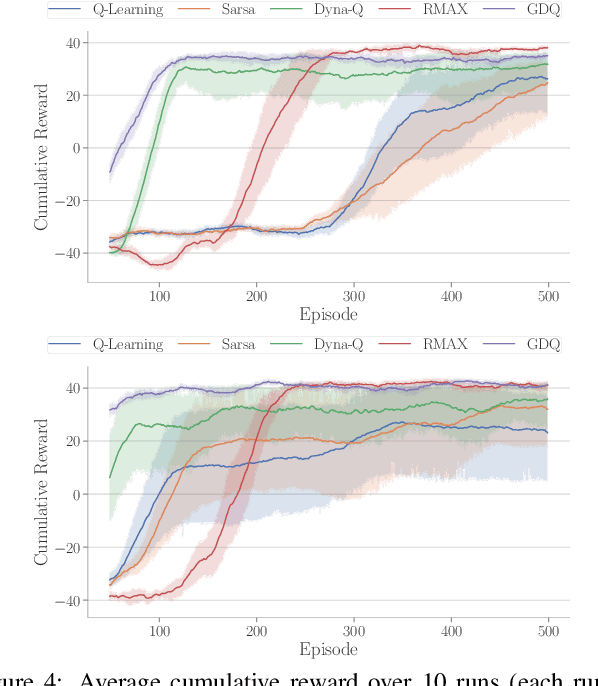
Model-based reinforcement learning (RL) enables an agent to learn world models from trial-and-error experiences toward achieving long-term goals. Automated planning, on the other hand, can be used for accomplishing tasks through reasoning with declarative action knowledge. Despite their shared goal of completing complex tasks, the development of RL and automated planning has mainly been isolated due to their different modalities of computation. Focusing on improving model-based RL agent's exploration strategy and sample efficiency, we develop Guided Dyna-Q (GDQ) to enable RL agents to reason with action knowledge to avoid exploring less-relevant states toward more efficient task accomplishment. GDQ has been evaluated in simulation and using a mobile robot conducting navigation tasks in an office environment. Results show that GDQ reduces the effort in exploration while improving the quality of learned policies.