 Add to Chrome
 Add to Firefox
 Add to Edge
Outdoor Crowd Flow Estimation Using RSRP from Commercial LTE Base Station: A Field Study
Dec 11, 2025
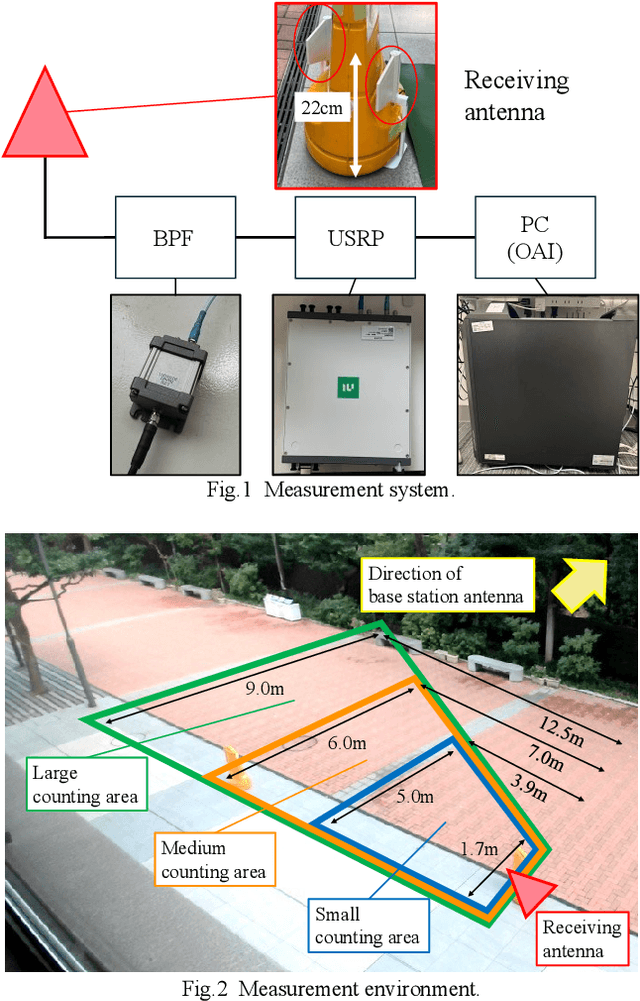
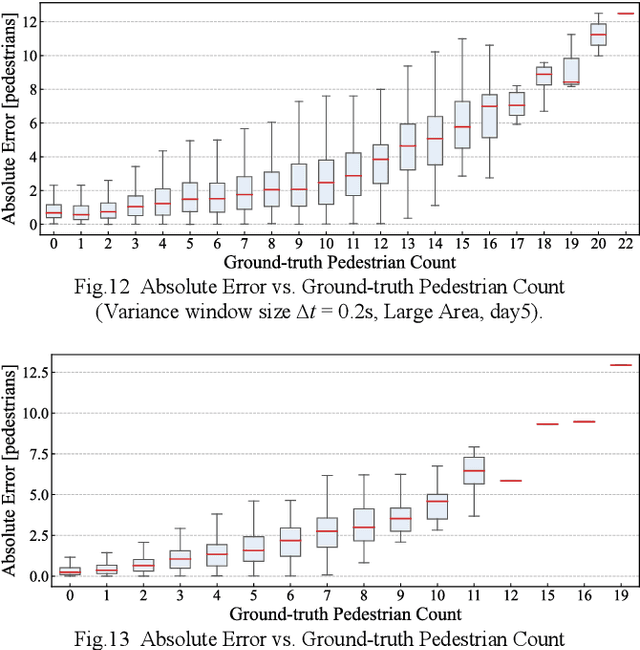
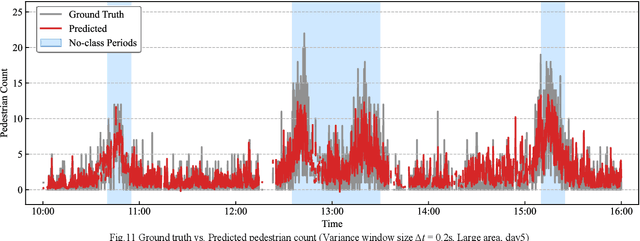
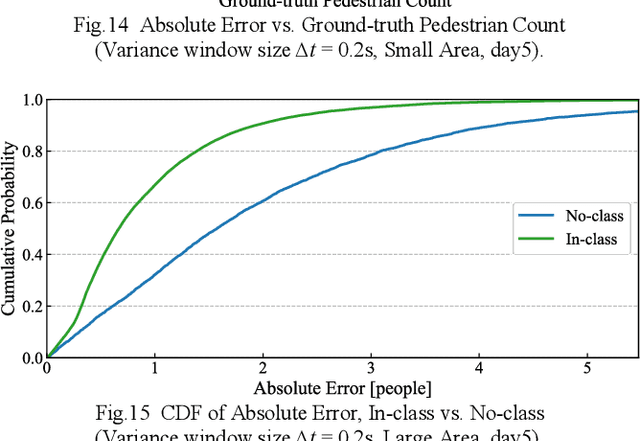
With the advent of the 6G era, Integrated Sensing and Communications (ISAC) has attracted increasing attention. One representative of use cases is crowd flow estimation on outdoor streets. However, most existing studies have focused on indoor environments or vehicles, and demonstrations of outdoor crowd flow estimation using commercial LTE base station remain limited. This study addresses this use case and proposes an analysis of a crowd flow estimation method using Reference Signal Received Power (RSRP) obtained from a commercial LTE base station. Specifically, pedestrian counts derived from a camera-based object recognition algorithm were associated with the variance of RSRP. The features obtained from the variance were quantitatively evaluated by combining a CatBoost regression model with SHapley Additive exPlanations (SHAP) analysis. Through this investigation, we clarified that an optimal variance window size for RSRP is 0.1 to 0.2 seconds and that enlarging the counting area increased the features obtained from the variance of RSRP, for machine learning. Consequently, this study is the first to quantitatively demonstrate the effectiveness of outdoor crowd flow estimation using commercial LTE, while also revealing the characteristic behavior of variance window size and counting area size in feature design.

Reconstructing Depth Images of Moving Objects from Wi-Fi CSI Data
Mar 09, 2025This study proposes a new deep learning method for reconstructing depth images of moving objects within a specific area using Wi-Fi channel state information (CSI). The Wi-Fi-based depth imaging technique has novel applications in domains such as security and elder care. However, reconstructing depth images from CSI is challenging because learning the mapping function between CSI and depth images, both of which are high-dimensional data, is particularly difficult. To address the challenge, we propose a new approach called Wi-Depth. The main idea behind the design of Wi-Depth is that a depth image of a moving object can be decomposed into three core components: the shape, depth, and position of the target. Therefore, in the depth-image reconstruction task, Wi-Depth simultaneously estimates the three core pieces of information as auxiliary tasks in our proposed VAE-based teacher-student architecture, enabling it to output images with the consistency of a correct shape, depth, and position. In addition, the design of Wi-Depth is based on our idea that this decomposition efficiently takes advantage of the fact that shape, depth, and position relate to primitive information inferred from CSI such as angle-of-arrival, time-of-flight, and Doppler frequency shift.