 Add to Chrome
 Add to Firefox
 Add to Edge
The Finetuner's Fallacy: When to Pretrain with Your Finetuning Data
Mar 17, 2026
Real-world model deployments demand strong performance on narrow domains where data is often scarce. Typically, practitioners finetune models to specialize them, but this risks overfitting to the domain and forgetting general knowledge. We study a simple strategy, specialized pretraining (SPT), where a small domain dataset, typically reserved for finetuning, is repeated starting from pretraining as a fraction of the total tokens. Across three specialized domains (ChemPile, MusicPile, and ProofPile), SPT improves domain performance and preserves general capabilities after finetuning compared to standard pretraining. In our experiments, SPT reduces the pretraining tokens needed to reach a given domain performance by up to 1.75x. These gains grow when the target domain is underrepresented in the pretraining corpus: on domains far from web text, a 1B SPT model outperforms a 3B standard pretrained model. Beyond these empirical gains, we derive overfitting scaling laws to guide practitioners in selecting the optimal domain-data repetition for a given pretraining compute budget. Our observations reveal the finetuner's fallacy: while finetuning may appear to be the cheapest path to domain adaptation, introducing specialized domain data during pretraining stretches its utility. SPT yields better specialized domain performance (via reduced overfitting across repeated exposures) and better general domain performance (via reduced forgetting during finetuning), ultimately achieving stronger results with fewer parameters and less total compute when amortized over inference. To get the most out of domain data, incorporate it as early in training as possible.

Scaling Training Data with Lossy Image Compression
Jul 25, 2024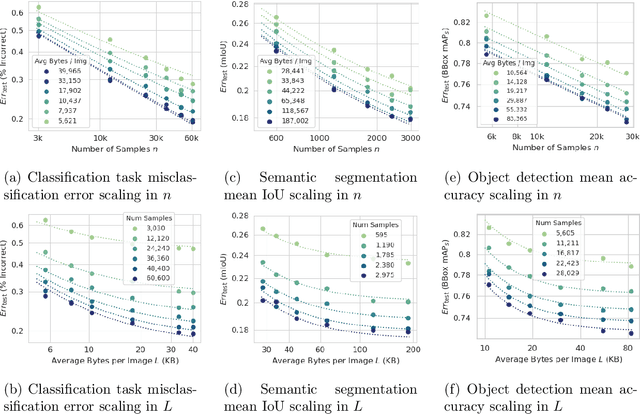
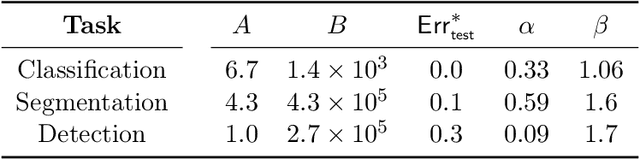
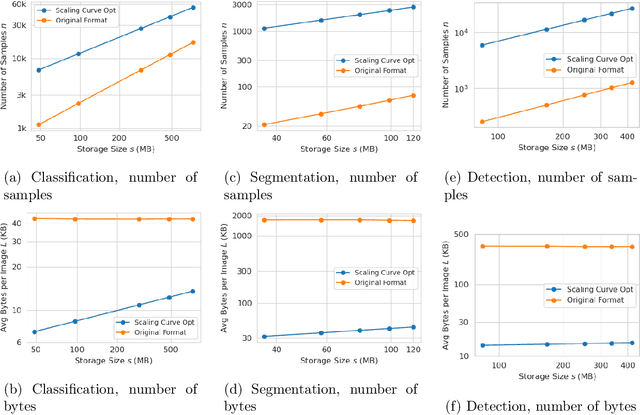
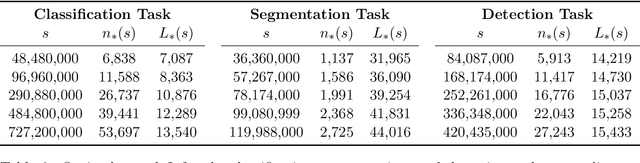
Empirically-determined scaling laws have been broadly successful in predicting the evolution of large machine learning models with training data and number of parameters. As a consequence, they have been useful for optimizing the allocation of limited resources, most notably compute time. In certain applications, storage space is an important constraint, and data format needs to be chosen carefully as a consequence. Computer vision is a prominent example: images are inherently analog, but are always stored in a digital format using a finite number of bits. Given a dataset of digital images, the number of bits $L$ to store each of them can be further reduced using lossy data compression. This, however, can degrade the quality of the model trained on such images, since each example has lower resolution. In order to capture this trade-off and optimize storage of training data, we propose a `storage scaling law' that describes the joint evolution of test error with sample size and number of bits per image. We prove that this law holds within a stylized model for image compression, and verify it empirically on two computer vision tasks, extracting the relevant parameters. We then show that this law can be used to optimize the lossy compression level. At given storage, models trained on optimally compressed images present a significantly smaller test error with respect to models trained on the original data. Finally, we investigate the potential benefits of randomizing the compression level.