 Add to Chrome
 Add to Firefox
 Add to Edge
Jako Tako or Fluent? Presenting PoVisLE: A Polish Vision-Language Evaluation
Aug 07, 2026
Vision-language models (VLMs) have achieved strong performance on tasks such as image captioning, visual question answering, and image-to-text generation. However, they are predominantly trained on English-centric data, which limits their ability to handle culturally grounded visual understanding and leads to failures in interpreting region-specific meanings, symbolic content, and context-dependent visual cues. Existing benchmarks for cultural competence are often template-driven and focused on surface-level recognition, making them insufficient for evaluating deeper linguistic and pragmatic understanding in culturally situated settings. We introduce PoVisLE, a monocultural vision-language benchmark for Polish designed to evaluate culturally grounded multimodal understanding under a grounded evaluation paradigm, where language is interpreted in interaction with visual context. The dataset contains 1,117 images and 2,366 manually annotated VQA pairs. Overall, our dataset provides a controlled and challenging resource for assessing culturally grounded vision-language understanding beyond surface-level recognition.

PLLuM: A Family of Polish Large Language Models
Nov 05, 2025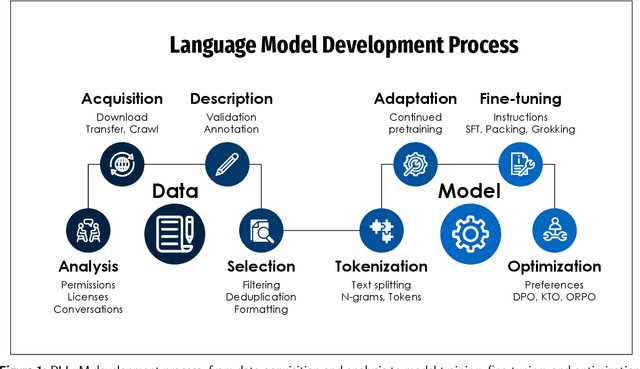
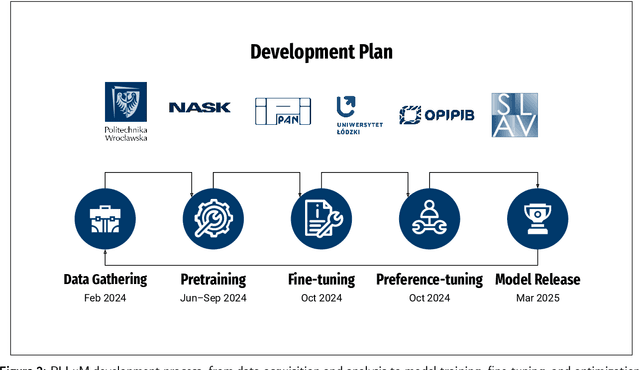

Large Language Models (LLMs) play a central role in modern artificial intelligence, yet their development has been primarily focused on English, resulting in limited support for other languages. We present PLLuM (Polish Large Language Model), the largest open-source family of foundation models tailored specifically for the Polish language. Developed by a consortium of major Polish research institutions, PLLuM addresses the need for high-quality, transparent, and culturally relevant language models beyond the English-centric commercial landscape. We describe the development process, including the construction of a new 140-billion-token Polish text corpus for pre-training, a 77k custom instructions dataset, and a 100k preference optimization dataset. A key component is a Responsible AI framework that incorporates strict data governance and a hybrid module for output correction and safety filtering. We detail the models' architecture, training procedures, and alignment techniques for both base and instruction-tuned variants, and demonstrate their utility in a downstream task within public administration. By releasing these models publicly, PLLuM aims to foster open research and strengthen sovereign AI technologies in Poland.