 Add to Chrome
 Add to Firefox
 Add to Edge
A Composable Channel-Adaptive Architecture for Seizure Classification
Dec 22, 2025
Objective: We develop a channel-adaptive (CA) architecture that seamlessly processes multi-variate time-series with an arbitrary number of channels, and in particular intracranial electroencephalography (iEEG) recordings. Methods: Our CA architecture first processes the iEEG signal using state-of-the-art models applied to each single channel independently. The resulting features are then fused using a vector-symbolic algorithm which reconstructs the spatial relationship using a trainable scalar per channel. Finally, the fused features are accumulated in a long-term memory of up to 2 minutes to perform the classification. Each CA-model can then be pre-trained on a large corpus of iEEG recordings from multiple heterogeneous subjects. The pre-trained model is personalized to each subject via a quick fine-tuning routine, which uses equal or lower amounts of data compared to existing state-of-the-art models, but requiring only 1/5 of the time. Results: We evaluate our CA-models on a seizure detection task both on a short-term (~20 hours) and a long-term (~2500 hours) dataset. In particular, our CA-EEGWaveNet is trained on a single seizure of the tested subject, while the baseline EEGWaveNet is trained on all but one. Even in this challenging scenario, our CA-EEGWaveNet surpasses the baseline in median F1-score (0.78 vs 0.76). Similarly, CA-EEGNet based on EEGNet, also surpasses its baseline in median F1-score (0.79 vs 0.74). Conclusion and significance: Our CA-model addresses two issues: first, it is channel-adaptive and can therefore be trained across heterogeneous subjects without loss of performance; second, it increases the effective temporal context size to a clinically-relevant length. Therefore, our model is a drop-in replacement for existing models, bringing better characteristics and performance across the board.

One-shot Learning for iEEG Seizure Detection Using End-to-end Binary Operations: Local Binary Patterns with Hyperdimensional Computing
Sep 06, 2018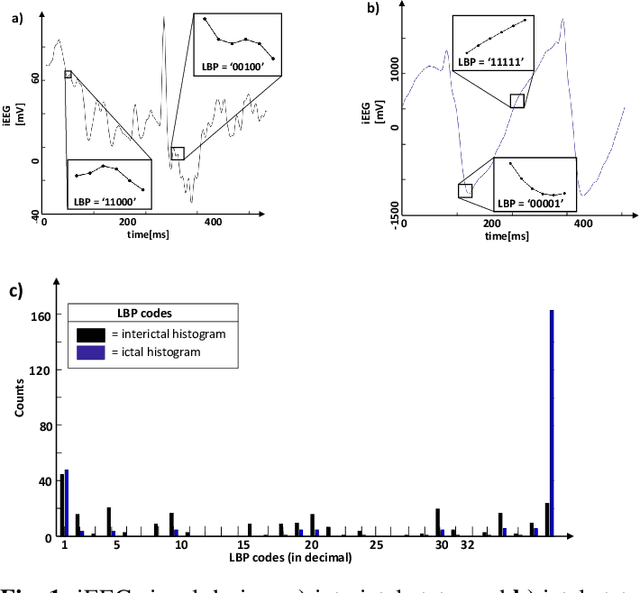
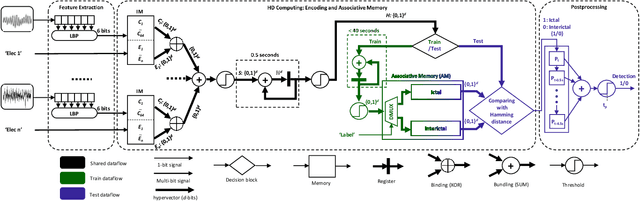
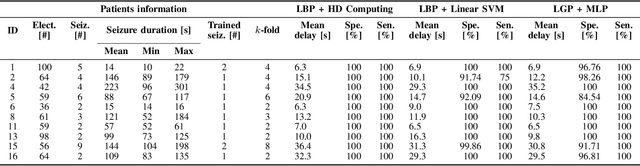
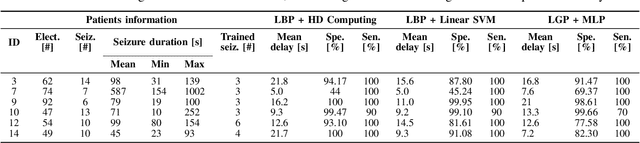
This paper presents an efficient binarized algorithm for both learning and classification of human epileptic seizures from intracranial electroencephalography (iEEG). The algorithm combines local binary patterns with brain-inspired hyperdimensional computing to enable end-to-end learning and inference with binary operations. The algorithm first transforms iEEG time series from each electrode into local binary pattern codes. Then atomic high-dimensional binary vectors are used to construct composite representations of seizures across all electrodes. For the majority of our patients (10 out of 16), the algorithm quickly learns from one or two seizures (i.e., one-/few-shot learning) and perfectly generalizes on 27 further seizures. For other patients, the algorithm requires three to six seizures for learning. Overall, our algorithm surpasses the state-of-the-art methods for detecting 65 novel seizures with higher specificity and sensitivity, and lower memory footprint.