 Add to Chrome
 Add to Firefox
 Add to Edge
Toward Ethical AIED
Mar 11, 2022
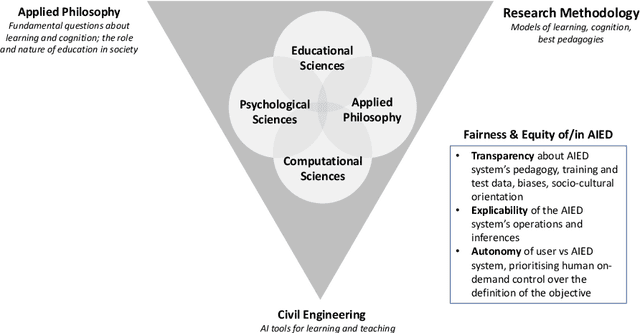
This paper presents the key conclusions to the forthcoming edited book on The Ethics of Artificial Intelligence in Education: Practices, Challenges and Debates (August 2022, Routlege). As well as highlighting the key contributions to the book, it discusses the key questions and the grand challenges for the field of AI in Education (AIED)in the context of ethics and ethical practices within the field. The book itself presents diverse perspectives from outside and from within the AIED as a way of achieving a broad perspective in the key ethical issues for AIED and a deep understanding of work conducted to date by the AIED community.

AI in Education needs interpretable machine learning: Lessons from Open Learner Modelling
Jun 30, 2018

Interpretability of the underlying AI representations is a key raison d'\^{e}tre for Open Learner Modelling (OLM) -- a branch of Intelligent Tutoring Systems (ITS) research. OLMs provide tools for 'opening' up the AI models of learners' cognition and emotions for the purpose of supporting human learning and teaching. Over thirty years of research in ITS (also known as AI in Education) produced important work, which informs about how AI can be used in Education to best effects and, through the OLM research, what are the necessary considerations to make it interpretable and explainable for the benefit of learning. We argue that this work can provide a valuable starting point for a framework of interpretable AI, and as such is of relevance to the application of both knowledge-based and machine learning systems in other high-stakes contexts, beyond education.