 Add to Chrome
 Add to Firefox
 Add to Edge
Mechanisms of Misgeneralization in Physical Sequence Modeling
May 19, 2026
Generative sequence models are often trained to plan motion in physical domains, from robotics to mechanical simulations. When constructing a dataset to train such a model, engineers may curate demonstrations to specify how trajectories should be distributed over a physical quantity like travel distance or mechanical energy. For example, a roboticist building a maze navigation agent might choose demonstrations whose travel distances cover a fixed range uniformly, hoping to constrain the agent's expected power usage. We find that standard deep learning can violate this intent: each generated trajectory can seem plausible on its own, but the aggregate distribution over the physical quantity is wrong. We call this failure physical misgeneralization, and develop an account of its mechanism. Using controlled synthetic tasks, we show that physical misgeneralization arises when local errors typical of the model class propagate through the physical measurement to shift the recovered distribution. We estimate these errors with a data deviation kernel, and we use it to predict which physical quantities gain or lose mass in both our synthetic and more applied maze navigation and double-pendulum motion tasks. Finally, our mechanistic interpretation helps identify which mitigation strategies are structurally promising, and we use it to propose a kernel-informed intervention.

SpeechNet: Weakly Supervised, End-to-End Speech Recognition at Industrial Scale
Nov 21, 2022
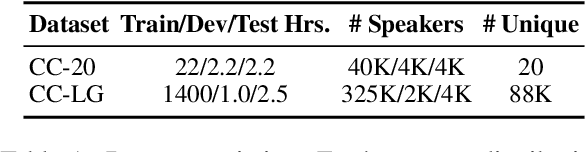
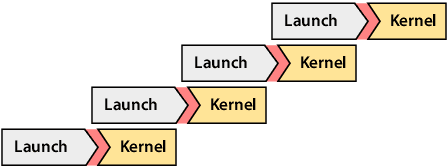
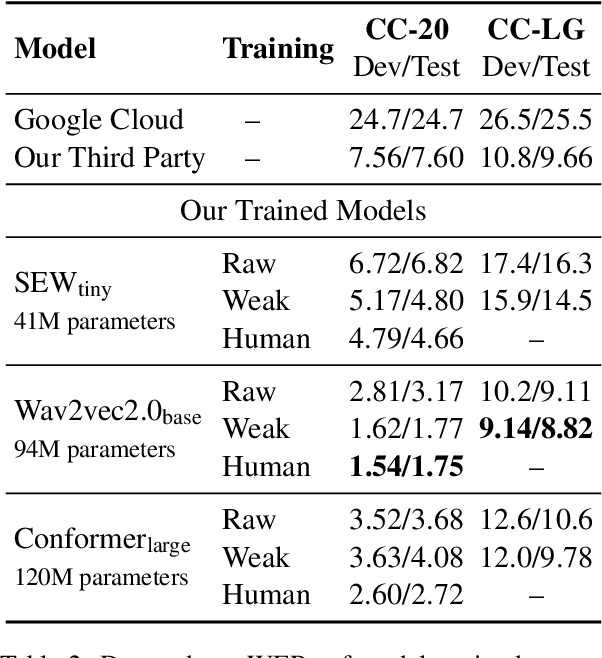
End-to-end automatic speech recognition systems represent the state of the art, but they rely on thousands of hours of manually annotated speech for training, as well as heavyweight computation for inference. Of course, this impedes commercialization since most companies lack vast human and computational resources. In this paper, we explore training and deploying an ASR system in the label-scarce, compute-limited setting. To reduce human labor, we use a third-party ASR system as a weak supervision source, supplemented with labeling functions derived from implicit user feedback. To accelerate inference, we propose to route production-time queries across a pool of CUDA graphs of varying input lengths, the distribution of which best matches the traffic's. Compared to our third-party ASR, we achieve a relative improvement in word-error rate of 8% and a speedup of 600%. Our system, called SpeechNet, currently serves 12 million queries per day on our voice-enabled smart television. To our knowledge, this is the first time a large-scale, Wav2vec-based deployment has been described in the academic literature.
What the DAAM: Interpreting Stable Diffusion Using Cross Attention
Oct 11, 2022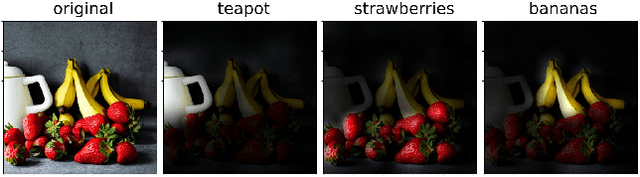
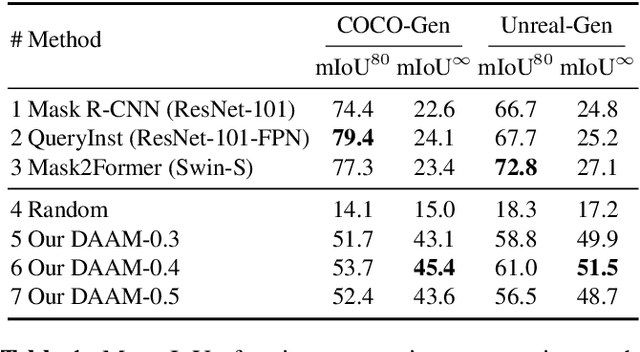
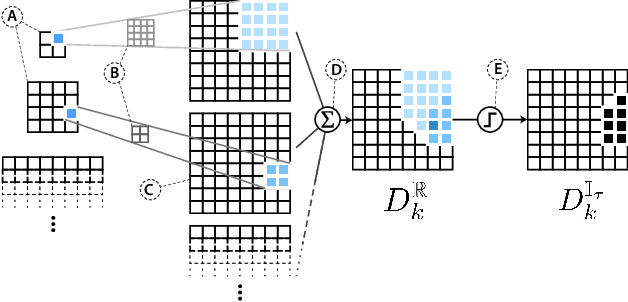
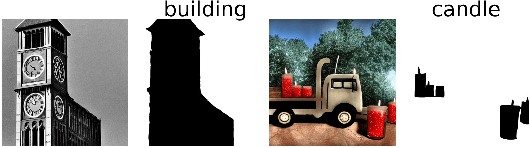
Large-scale diffusion neural networks represent a substantial milestone in text-to-image generation, with some performing similar to real photographs in human evaluation. However, they remain poorly understood, lacking explainability and interpretability analyses, largely due to their proprietary, closed-source nature. In this paper, to shine some much-needed light on text-to-image diffusion models, we perform a text-image attribution analysis on Stable Diffusion, a recently open-sourced large diffusion model. To produce pixel-level attribution maps, we propose DAAM, a novel method based on upscaling and aggregating cross-attention activations in the latent denoising subnetwork. We support its correctness by evaluating its unsupervised semantic segmentation quality on its own generated imagery, compared to supervised segmentation models. We show that DAAM performs strongly on COCO caption-generated images, achieving an mIoU of 61.0, and it outperforms supervised models on open-vocabulary segmentation, for an mIoU of 51.5. We further find that certain parts of speech, like punctuation and conjunctions, influence the generated imagery most, which agrees with the prior literature, while determiners and numerals the least, suggesting poor numeracy. To our knowledge, we are the first to propose and study word-pixel attribution for large-scale text-to-image diffusion models. Our code and data are at https://github.com/castorini/daam.