 Add to Chrome
 Add to Firefox
 Add to Edge
Gemma 4 Technical Report
Jul 02, 2026
We introduce Gemma 4, a new generation of open-weight, natively multimodal language models in the Gemma model family. Designed to advance compute efficiency and reasoning, the Gemma 4 model suite features dense and Mixture-of-Experts architectures, ranging from 2.3B to 31B parameters. Alongside improved vision and audio encoders for all model sizes, we propose a unified, encoder-free architecture for our 12B model, which ingests raw audio and image patches. Furthermore, we integrate a thinking mode, enabling Gemma models to generate reasoning traces prior to responding. We improve inference speed, memory, and compute efficiency, as well as long-context abilities through critical design choices. Gemma 4 establishes a leap in performance across STEM, multimodal, and long-context benchmarks, and rivals larger, frontier open models in human-rated tasks.

Neural Architecture Search for Energy Efficient Always-on Audio Models
Feb 09, 2022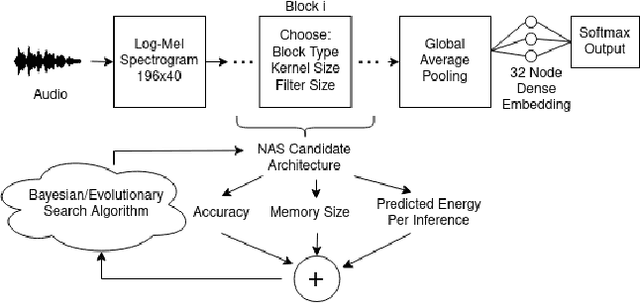
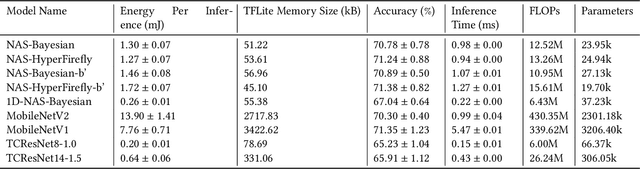
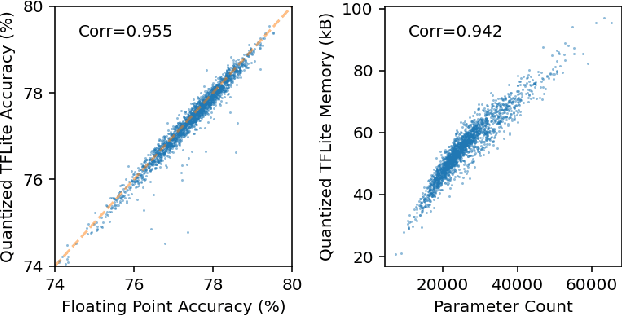
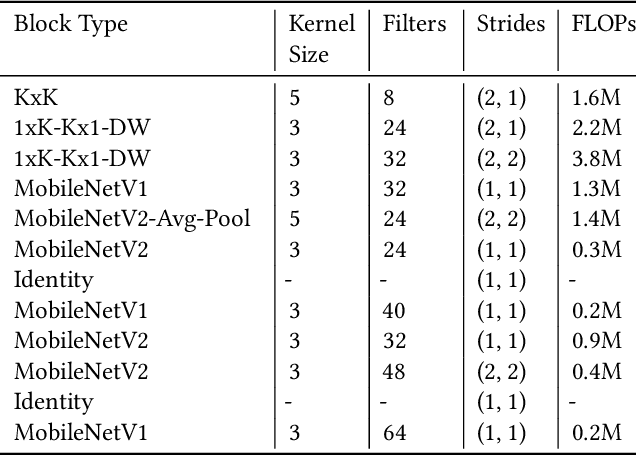
Mobile and edge computing devices for always-on audio classification require energy-efficient neural network architectures. We present a neural architecture search (NAS) that optimizes accuracy, energy efficiency and memory usage. The search is run on Vizier, a black-box optimization service. We present a search strategy that uses both Bayesian and regularized evolutionary search with particle swarms, and employs early-stopping to reduce the computational burden. The search returns architectures for a sound-event classification dataset based upon AudioSet with similar accuracy to MobileNetV1/V2 implementations but with an order of magnitude less energy per inference and a much smaller memory footprint.
SEANet: A Multi-modal Speech Enhancement Network
Oct 01, 2020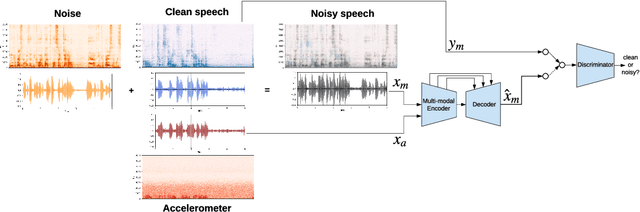
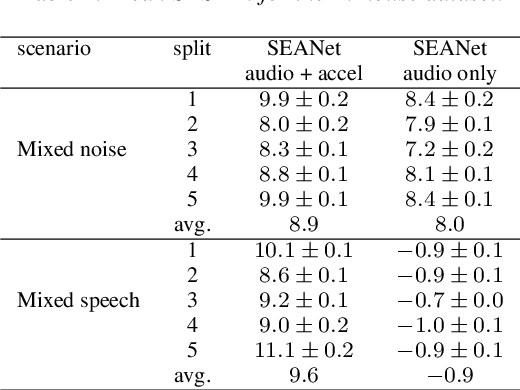
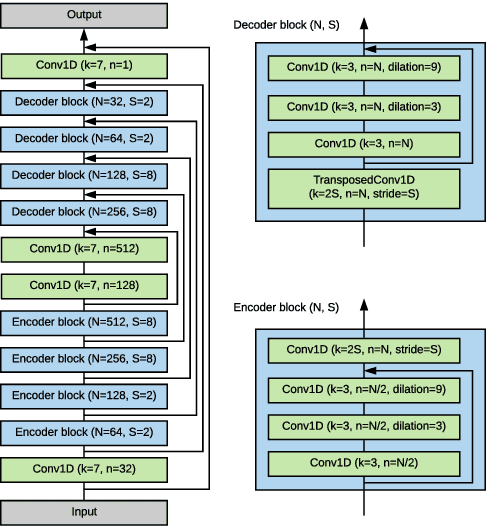
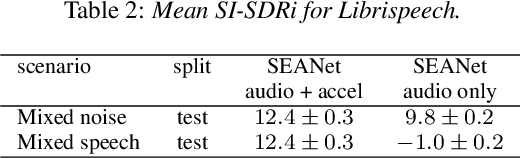
We explore the possibility of leveraging accelerometer data to perform speech enhancement in very noisy conditions. Although it is possible to only partially reconstruct user's speech from the accelerometer, the latter provides a strong conditioning signal that is not influenced from noise sources in the environment. Based on this observation, we feed a multi-modal input to SEANet (Sound EnhAncement Network), a wave-to-wave fully convolutional model, which adopts a combination of feature losses and adversarial losses to reconstruct an enhanced version of user's speech. We trained our model with data collected by sensors mounted on an earbud and synthetically corrupted by adding different kinds of noise sources to the audio signal. Our experimental results demonstrate that it is possible to achieve very high quality results, even in the case of interfering speech at the same level of loudness. A sample of the output produced by our model is available at https://google-research.github.io/seanet/multimodal/speech.