 Add to Chrome
 Add to Firefox
 Add to Edge
Renormalising Generative Models for Active Inference: Foundations, Derivations, and Verification
Aug 10, 2026
Active inference offers a unified framework for perception, learning, and action, but scaling discrete active-inference models to rich spatial and temporal domains remains difficult. Renormalising generative models (RGMs) address this challenge by composing discrete generative models across spatial and temporal scales, coarse-graining lower-level states and paths into higher-level causes for objects, events, and action. However, fully reproducing and adapting the framework remains difficult: the mathematical exposition is compact, and the reference implementations are deeply integrated within specialized software environments, leaving many algorithmic details implicit. This paper addresses these challenges by providing a self-contained, derivation-oriented account of RGMs together with an open, verified implementation. We explain how the hierarchy is built, how beliefs and actions are updated within it, and how information is passed between levels. Where the published equations and implementation differ in emphasis, we make those choices explicit and explain their modelling consequences. By clarifying the theory and separating it from its original implementation context, this work lowers practical barriers to entry and makes RGMs more transparent, auditable, and reproducible, providing a foundation for future quantitative evaluation and development on machine-learning benchmarks.

An Efficient Language-Independent Multi-Font OCR for Arabic Script
Sep 18, 2020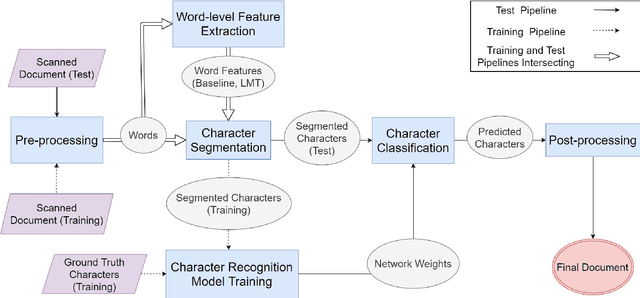
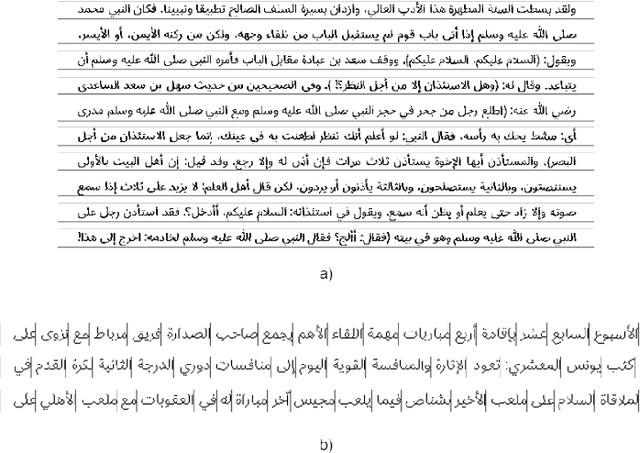
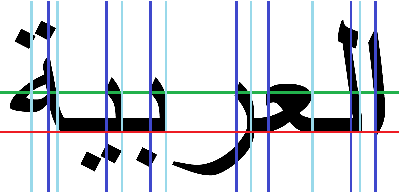
Optical Character Recognition (OCR) is the process of extracting digitized text from images of scanned documents. While OCR systems have already matured in many languages, they still have shortcomings in cursive languages with overlapping letters such as the Arabic language. This paper proposes a complete Arabic OCR system that takes a scanned image of Arabic Naskh script as an input and generates a corresponding digital document. Our Arabic OCR system consists of the following modules: Pre-processing, Word-level Feature Extraction, Character Segmentation, Character Recognition, and Post-processing. This paper also proposes an improved font-independent character segmentation algorithm that outperforms the state-of-the-art segmentation algorithms. Lastly, the paper proposes a neural network model for the character recognition task. The system has experimented on several open Arabic corpora datasets with an average character segmentation accuracy 98.06%, character recognition accuracy 99.89%, and overall system accuracy 97.94% achieving outstanding results compared to the state-of-the-art Arabic OCR systems.