 Add to Chrome
 Add to Firefox
 Add to Edge
T-VSS: Test-Time Visual Subspace Steering for Adversarial Robustness of Vision-Language Models
Jun 22, 2026
Vision-language models (VLMs) achieve strong zero-shot recognition, but they remain highly vulnerable to adversarial perturbations. Recent test-time adaptations improve robustness without retraining, but they do not directly adapt the corrupted visual representation itself. Prompt-based methods adapt the learnable text prompts, while input-space methods optimize pixels or padding at test time. These approaches can improve predictions, but they do so through an indirect and expensive optimization path. We propose Test-time Visual Subspace Steering (T-VSS), a lightweight defense that performs test-time adaptation directly in the visual feature space. T-VSS first builds a sample-specific low-rank subspace from multi-view feature residuals anchored at the attacked image. It then learns a shared feature correction within this subspace using reliability-weighted entropy minimization. By constraining adaptation to a compact visual geometry, T-VSS steers attacked features toward more stable and discriminative predictions while avoiding noisy full-space updates. Experiments on fine-grained, ImageNet, and ImageNet-OOD benchmarks show that T-VSS improves adversarial robustness while maintaining competitive clean accuracy and better efficiency than prior test-time adaptations.

VideoMamba: Spatio-Temporal Selective State Space Model
Jul 11, 2024


We introduce VideoMamba, a novel adaptation of the pure Mamba architecture, specifically designed for video recognition. Unlike transformers that rely on self-attention mechanisms leading to high computational costs by quadratic complexity, VideoMamba leverages Mamba's linear complexity and selective SSM mechanism for more efficient processing. The proposed Spatio-Temporal Forward and Backward SSM allows the model to effectively capture the complex relationship between non-sequential spatial and sequential temporal information in video. Consequently, VideoMamba is not only resource-efficient but also effective in capturing long-range dependency in videos, demonstrated by competitive performance and outstanding efficiency on a variety of video understanding benchmarks. Our work highlights the potential of VideoMamba as a powerful tool for video understanding, offering a simple yet effective baseline for future research in video analysis.
Multi-image Super-resolution via Quality Map Associated Temporal Attention Network
Feb 26, 2022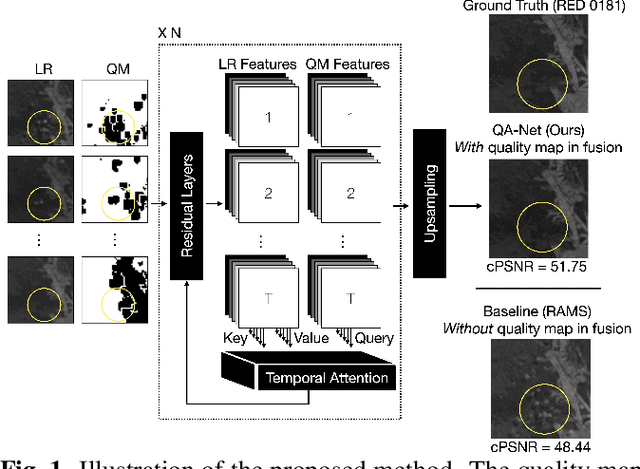

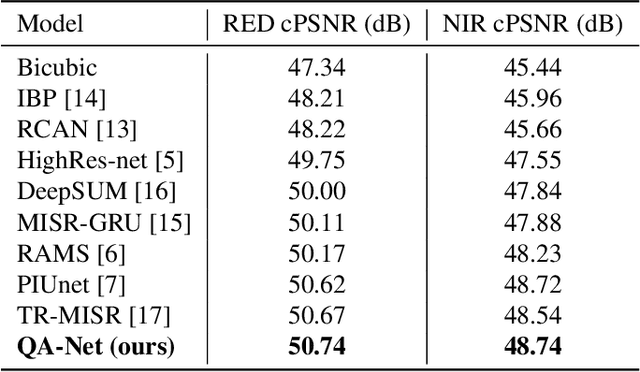
With the rising interest in deep learning-based methods in remote sensing, neural networks have made remarkable advancements in multi-image fusion and super-resolution. To fully exploit the advantages of multi-image super-resolution, temporal attention is crucial as it allows a model to focus on reliable features rather than noises. Despite the presence of quality maps (QMs) that indicate noises in images, most of the methods tested in the PROBA-V dataset have not been used QMs for temporal attention. We present a quality map associated temporal attention network (QA-Net), a novel method that incorporates QMs into both feature representation and fusion processes for the first time. Low-resolution features are temporally attended by QM features in repeated multi-head attention modules. The proposed method achieved state-of-the-art results in the PROBA-V dataset.