 Add to Chrome
 Add to Firefox
 Add to Edge
CoE: Collaborative Entropy for Uncertainty Quantification in Agentic Multi-LLM Systems
Mar 30, 2026
Uncertainty estimation in multi-LLM systems remains largely single-model-centric: existing methods quantify uncertainty within each model but do not adequately capture semantic disagreement across models. To address this gap, we propose Collaborative Entropy (CoE), a unified information-theoretic metric for semantic uncertainty in multi-LLM collaboration. CoE is defined on a shared semantic cluster space and combines two components: intra-model semantic entropy and inter-model divergence to the ensemble mean. CoE is not a weighted ensemble predictor; it is a system-level uncertainty measure that characterizes collaborative confidence and disagreement. We analyze several core properties of CoE, including non-negativity, zero-value certainty under perfect semantic consensus, and the behavior of CoE when individual models collapse to delta distributions. These results clarify when reducing per-model uncertainty is sufficient and when residual inter-model disagreement remains. We also present a simple CoE-guided, training-free post-hoc coordination heuristic as a practical application of the metric. Experiments on \textit{TriviaQA} and \textit{SQuAD} with LLaMA-3.1-8B-Instruct, Qwen-2.5-7B-Instruct, and Mistral-7B-Instruct show that CoE provides stronger uncertainty estimation than standard entropy- and divergence-based baselines, with gains becoming larger as additional heterogeneous models are introduced. Overall, CoE offers a useful uncertainty-aware perspective on multi-LLM collaboration.

Toward the Tradeoffs between Privacy, Fairness and Utility in Federated Learning
Nov 30, 2023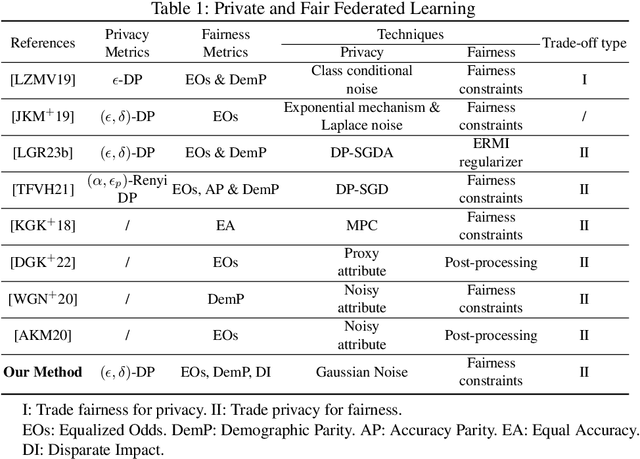
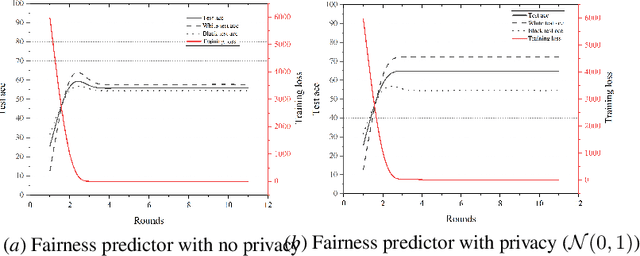
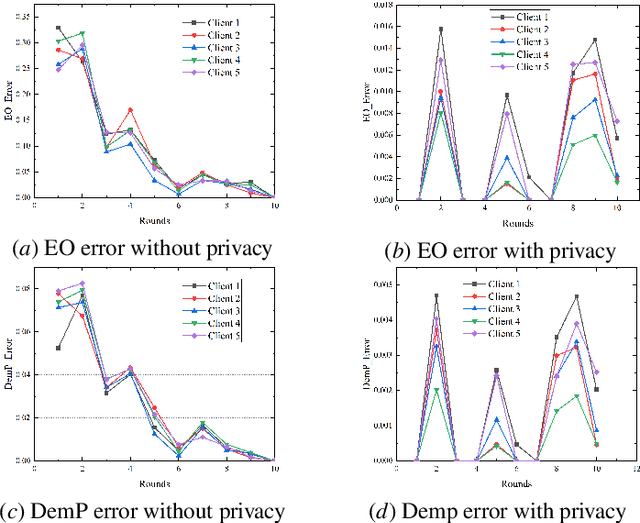
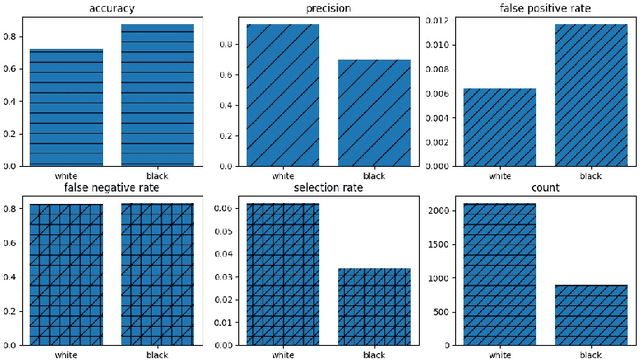
Federated Learning (FL) is a novel privacy-protection distributed machine learning paradigm that guarantees user privacy and prevents the risk of data leakage due to the advantage of the client's local training. Researchers have struggled to design fair FL systems that ensure fairness of results. However, the interplay between fairness and privacy has been less studied. Increasing the fairness of FL systems can have an impact on user privacy, while an increase in user privacy can affect fairness. In this work, on the client side, we use fairness metrics, such as Demographic Parity (DemP), Equalized Odds (EOs), and Disparate Impact (DI), to construct the local fair model. To protect the privacy of the client model, we propose a privacy-protection fairness FL method. The results show that the accuracy of the fair model with privacy increases because privacy breaks the constraints of the fairness metrics. In our experiments, we conclude the relationship between privacy, fairness and utility, and there is a tradeoff between these.