 Add to Chrome
 Add to Firefox
 Add to Edge
Facial Expression Recognition Using Disentangled Adversarial Learning
Sep 28, 2019
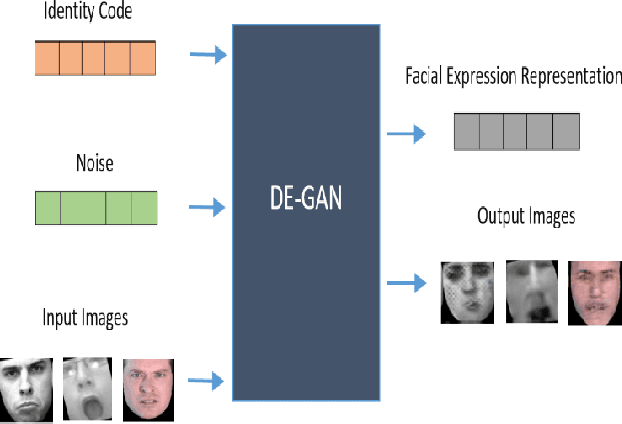
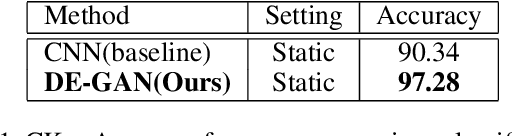
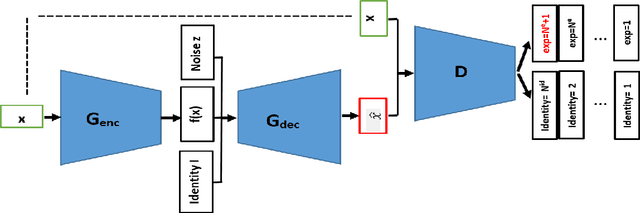
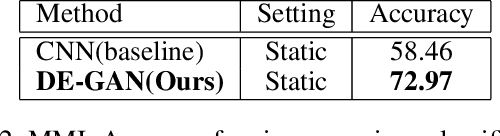
The representation used for Facial Expression Recognition (FER) usually contain expression information along with other variations such as identity and illumination. In this paper, we propose a novel Disentangled Expression learning-Generative Adversarial Network (DE-GAN) to explicitly disentangle facial expression representation from identity information. In this learning by reconstruction method, facial expression representation is learned by reconstructing an expression image employing an encoder-decoder based generator. This expression representation is disentangled from identity component by explicitly providing the identity code to the decoder part of DE-GAN. The process of expression image reconstruction and disentangled expression representation learning is improved by performing expression and identity classification in the discriminator of DE-GAN. The disentangled facial expression representation is then used for facial expression recognition employing simple classifiers like SVM or MLP. The experiments are performed on publicly available and widely used face expression databases (CK+, MMI, Oulu-CASIA). The experimental results show that the proposed technique produces comparable results with state-of-the-art methods.

Brain MRI Segmentation using Rule-Based Hybrid Approach
Feb 12, 2019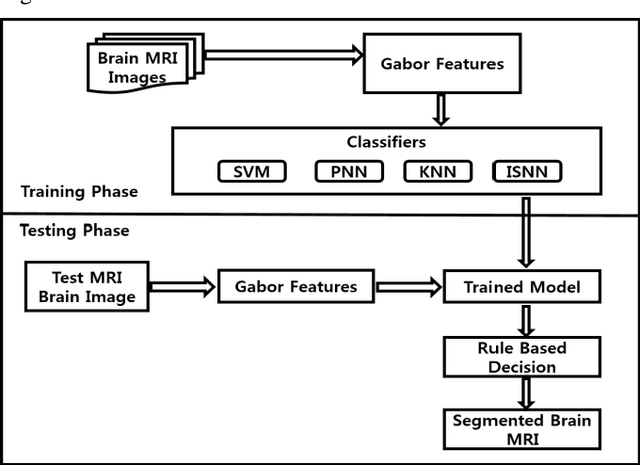
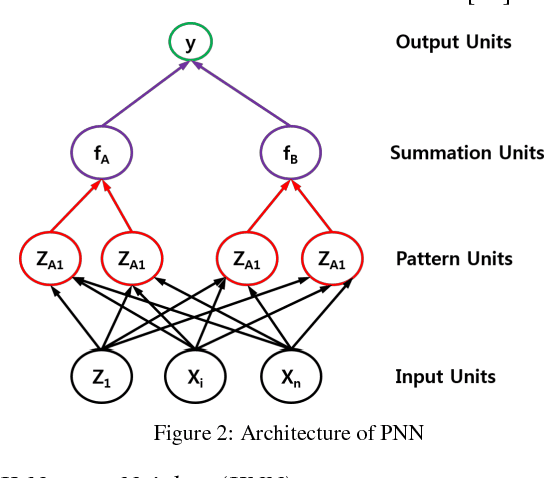
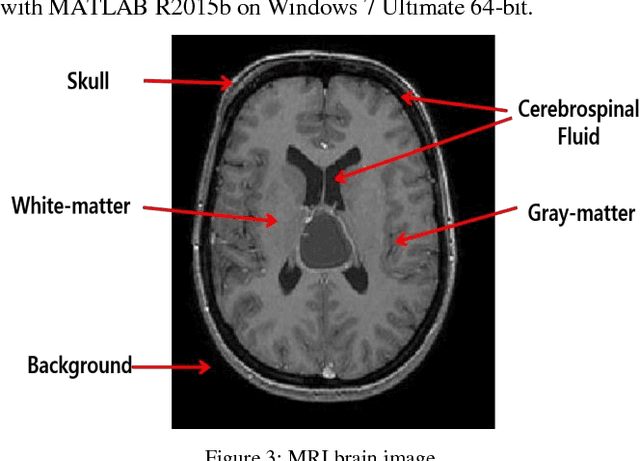
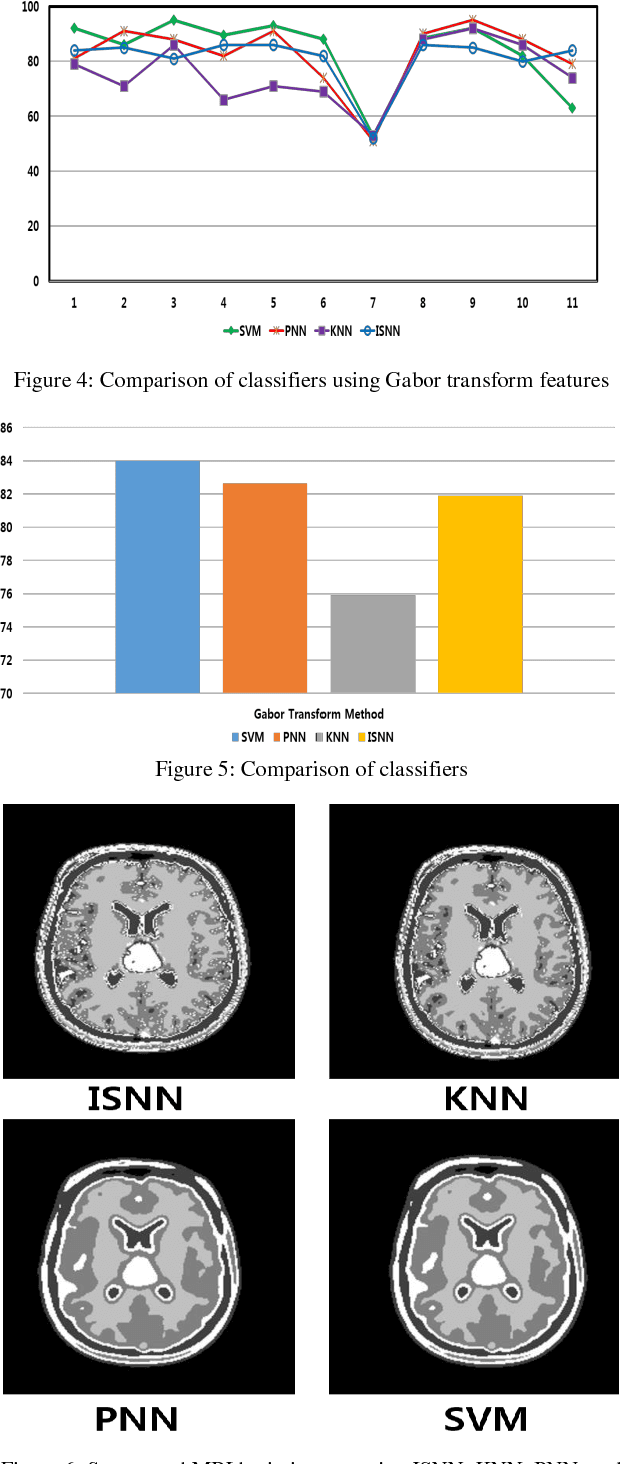
Medical image segmentation being a substantial component of image processing plays a significant role to analyze gross anatomy, to locate an infirmity and to plan the surgical procedures. Segmentation of brain Magnetic Resonance Imaging (MRI) is of considerable importance for the accurate diagnosis. However, precise and accurate segmentation of brain MRI is a challenging task. Here, we present an efficient framework for segmentation of brain MR images. For this purpose, Gabor transform method is used to compute features of brain MRI. Then, these features are classified by using four different classifiers i.e., Incremental Supervised Neural Network (ISNN), K-Nearest Neighbor (KNN), Probabilistic Neural Network (PNN), and Support Vector Machine (SVM). Performance of these classifiers is investigated over different images of brain MRI and the variation in the performance of these classifiers is observed for different brain tissues. Thus, we proposed a rule-based hybrid approach to segment brain MRI. Experimental results show that the performance of these classifiers varies over each tissue MRI and the proposed rule-based hybrid approach exhibits better segmentation of brain MRI tissues.