 Add to Chrome
 Add to Firefox
 Add to Edge
From Artefact to Insight: Efficient Low-Rank Adaptation of BrushNet for Scanning Probe Microscopy Image Restoration
Mar 16, 2026
Scanning Probe Microscopy or SPM offers nanoscale resolution but is frequently marred by structured artefacts such as line scan dropout, gain induced noise, tip convolution, and phase hops. While most available methods treat SPM artefact removal as isolated denoising or interpolation tasks, the generative inpainting perspective remains largely unexplored. In this work, we introduce a diffusion based inpainting framework tailored to scientific grayscale imagery. By fine tuning less than 0.2 percent of BrushNet weights with rank constrained low rank adaptation (LoRA), we adapt a pretrained diffusion model using only 7390 artefact, clean pairs distilled from 739 experimental scans. On our forthcoming public SPM InpBench benchmark, the LoRA enhanced model lifts the Peak Signal to Noise Ratio or PSNR by 6.61 dB and halves the Learned Perceptual Image Patch Similarity or LPIPS relative to zero-shot inference, while matching or slightly surpassing the accuracy of full retraining, trainable on a single GPU instead of four high-memory cards. The approach generalizes across various SPM image channels including height, amplitude and phase, faithfully restores subtle structural details, and suppresses hallucination artefacts inherited from natural image priors. This lightweight framework enables efficient, scalable recovery of irreplaceable SPM images and paves the way for a broader diffusion model adoption in nanoscopic imaging analysis.

PICTS: A Novel Deep Reinforcement Learning Approach for Dynamic P-I Control in Scanning Probe Microscopy
Feb 11, 2025We have developed a Parallel Integrated Control and Training System, leveraging the deep reinforcement learning to dynamically adjust the control strategies in real time for scanning probe microscopy techniques.
Adaptive Prompt Learning with SAM for Few-shot Scanning Probe Microscope Image Segmentation
Oct 16, 2024

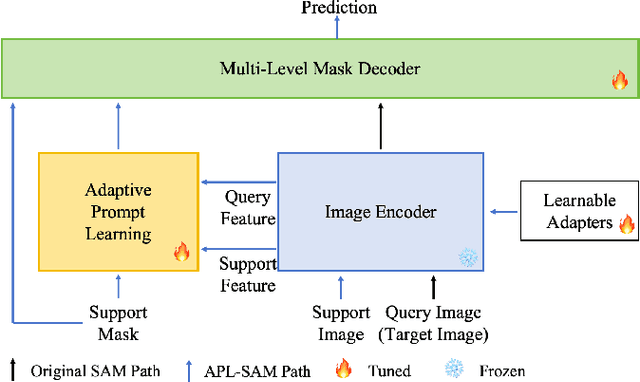

The Segment Anything Model (SAM) has demonstrated strong performance in image segmentation of natural scene images. However, its effectiveness diminishes markedly when applied to specific scientific domains, such as Scanning Probe Microscope (SPM) images. This decline in accuracy can be attributed to the distinct data distribution and limited availability of the data inherent in the scientific images. On the other hand, the acquisition of adequate SPM datasets is both time-intensive and laborious as well as skill-dependent. To address these challenges, we propose an Adaptive Prompt Learning with SAM (APL-SAM) framework tailored for few-shot SPM image segmentation. Our approach incorporates two key innovations to enhance SAM: 1) An Adaptive Prompt Learning module leverages few-shot embeddings derived from limited support set to learn adaptively central representatives, serving as visual prompts. This innovation eliminates the need for time-consuming online user interactions for providing prompts, such as exhaustively marking points and bounding boxes slice by slice; 2) A multi-source, multi-level mask decoder specifically designed for few-shot SPM image segmentation is introduced, which can effectively capture the correspondence between the support and query images. To facilitate comprehensive training and evaluation, we introduce a new dataset, SPM-Seg, curated for SPM image segmentation. Extensive experiments on this dataset reveal that the proposed APL-SAM framework significantly outperforms the original SAM, achieving over a 30% improvement in terms of Dice Similarity Coefficient with only one-shot guidance. Moreover, APL-SAM surpasses state-of-the-art few-shot segmentation methods and even fully supervised approaches in performance. Code and dataset used in this study will be made available upon acceptance.