 Add to Chrome
 Add to Firefox
 Add to Edge
GroundVTS: Visual Token Sampling in Multimodal Large Language Models for Video Temporal Grounding
Apr 02, 2026
Video temporal grounding (VTG) is a critical task in video understanding and a key capability for extending video large language models (Vid-LLMs) to broader applications. However, existing Vid-LLMs rely on uniform frame sampling to extract video information, resulting in a sparse distribution of key frames and the loss of crucial temporal cues. To address this limitation, we propose Grounded Visual Token Sampling (GroundVTS), a Vid-LLM architecture that focuses on the most informative temporal segments. GroundVTS employs a fine-grained, query-guided mechanism to filter visual tokens before feeding them into the LLM, thereby preserving essential spatio-temporal information and maintaining temporal coherence. Futhermore, we introduce a progressive optimization strategy that enables the LLM to effectively adapt to the non-uniform distribution of visual features, enhancing its ability to model temporal dependencies and achieve precise video localization. We comprehensively evaluate GroundVTS on three standard VTG benchmarks, where it outperforms existing methods, achieving a 7.7-point improvement in mIoU for moment retrieval and 12.0-point improvement in mAP for highlight detection. Code is available at https://github.com/Florence365/GroundVTS.

Realizing Text-Driven Motion Generation on NAO Robot: A Reinforcement Learning-Optimized Control Pipeline
Jun 05, 2025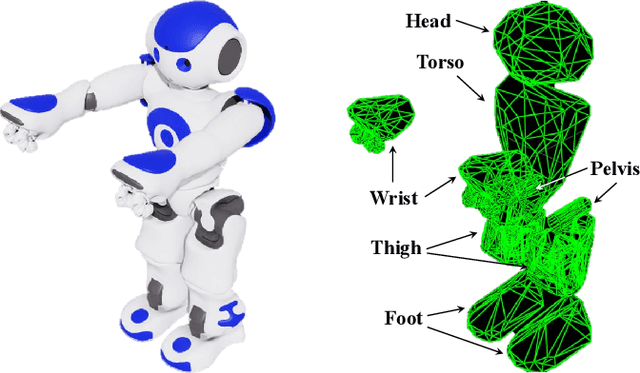
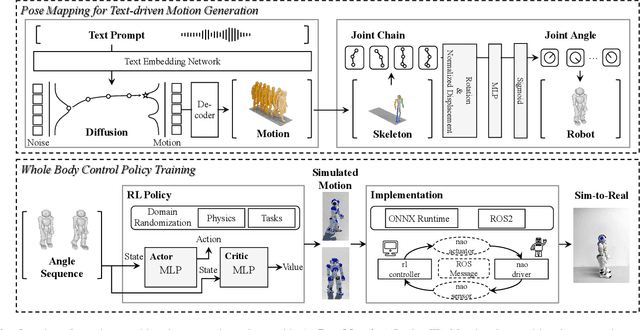
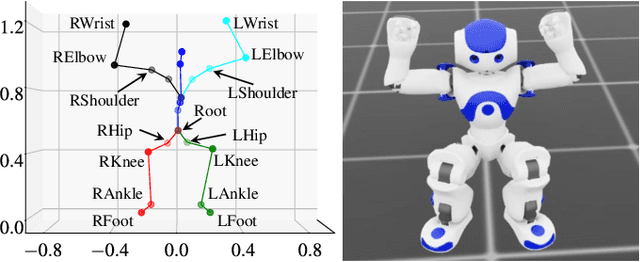
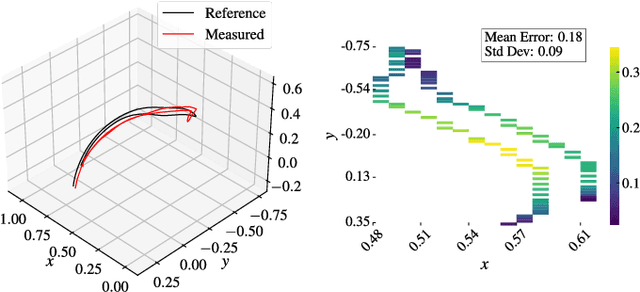
Human motion retargeting for humanoid robots, transferring human motion data to robots for imitation, presents significant challenges but offers considerable potential for real-world applications. Traditionally, this process relies on human demonstrations captured through pose estimation or motion capture systems. In this paper, we explore a text-driven approach to mapping human motion to humanoids. To address the inherent discrepancies between the generated motion representations and the kinematic constraints of humanoid robots, we propose an angle signal network based on norm-position and rotation loss (NPR Loss). It generates joint angles, which serve as inputs to a reinforcement learning-based whole-body joint motion control policy. The policy ensures tracking of the generated motions while maintaining the robot's stability during execution. Our experimental results demonstrate the efficacy of this approach, successfully transferring text-driven human motion to a real humanoid robot NAO.