 Add to Chrome
 Add to Firefox
 Add to Edge
An Asymptotic Theory of Chain-of-Thought in In-Context Learning
Jun 02, 2026
Chain-of-thought (CoT) reasoning has become a widely used mechanism for eliciting multi-step reasoning in large language models by generating intermediate reasoning steps at inference time. Yet the scaling behavior of generalization with CoT depth remains poorly understood. To address this question, we study a theoretically solvable model of CoT for in-context weight prediction in linear regression, where test-time reasoning is represented as an iterative refinement of the weight-parameter estimate. Using tools from random matrix theory under high-dimensional asymptotics, we derive an exact formula for the generalization error as a function of reasoning depth, pretraining data amount, and context length. Our analysis reveals a sharp phase transition separating exponential and polynomial improvement, saturation, and overthinking, and characterizes how the optimal reasoning depth scales. We further show that deeper reasoning is most effective with sufficiently rich pretraining and in-context information, whereas limited pretraining or context makes longer reasoning prone to error amplification or saturation. We also validate these predictions through experiments on fully learned linear attention and softmax attention models. Our results provide a unified theoretical account of how test-time CoT depth affects generalization.

Learning Linear Regression with Low-Rank Tasks in-Context
Oct 06, 2025

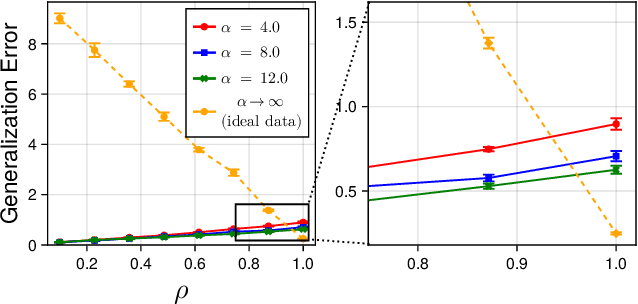
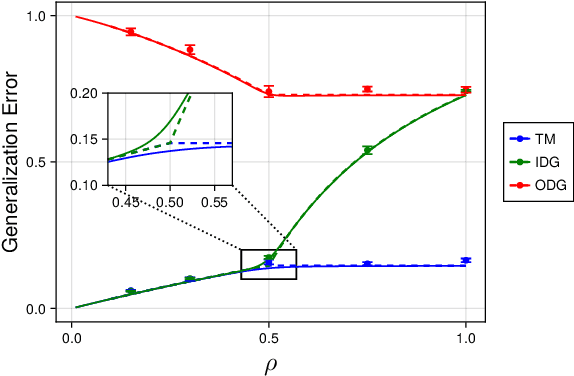
In-context learning (ICL) is a key building block of modern large language models, yet its theoretical mechanisms remain poorly understood. It is particularly mysterious how ICL operates in real-world applications where tasks have a common structure. In this work, we address this problem by analyzing a linear attention model trained on low-rank regression tasks. Within this setting, we precisely characterize the distribution of predictions and the generalization error in the high-dimensional limit. Moreover, we find that statistical fluctuations in finite pre-training data induce an implicit regularization. Finally, we identify a sharp phase transition of the generalization error governed by task structure. These results provide a framework for understanding how transformers learn to learn the task structure.
The Effect of Optimal Self-Distillation in Noisy Gaussian Mixture Model
Jan 27, 2025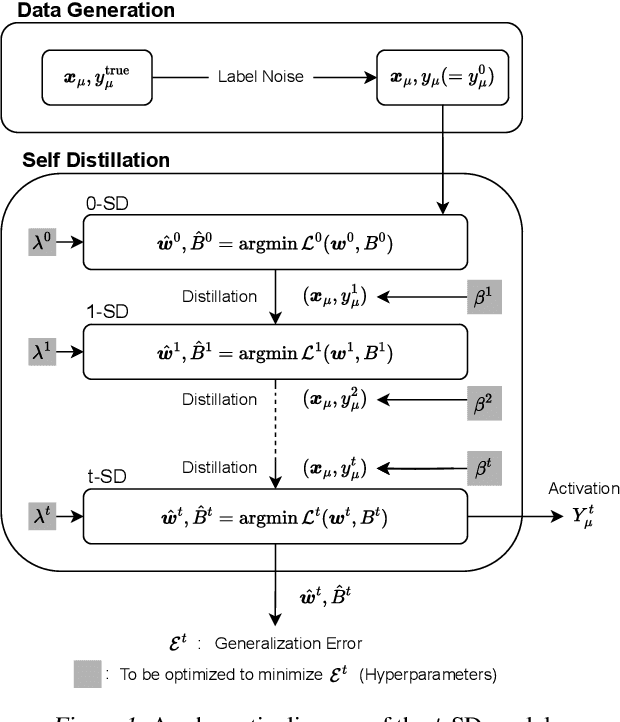
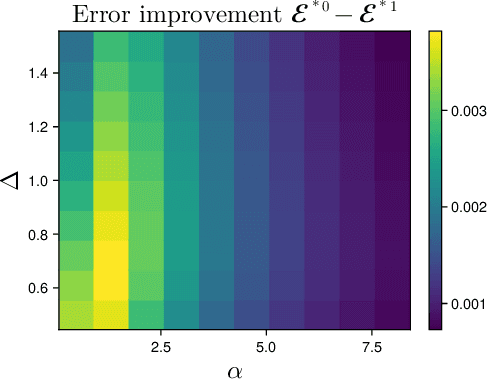
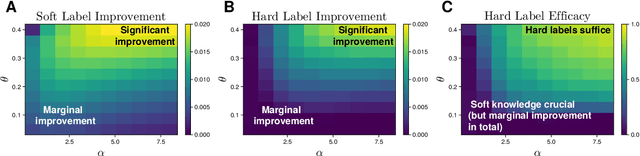
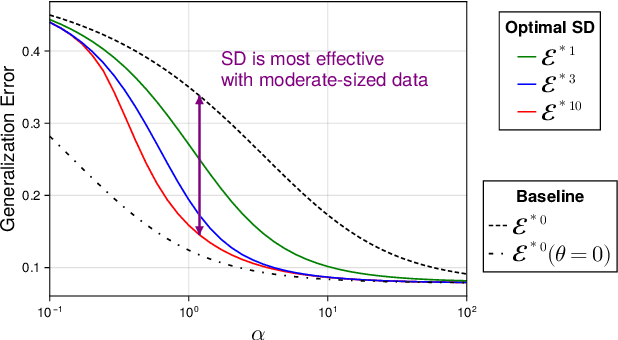
Self-distillation (SD), a technique where a model refines itself from its own predictions, has garnered attention as a simple yet powerful approach in machine learning. Despite its widespread use, the mechanisms underlying its effectiveness remain unclear. In this study, we investigate the efficacy of hyperparameter-tuned multi-stage SD in binary classification tasks with noisy labeled Gaussian mixture data, utilizing a replica theory. Our findings reveals that the primary driver of SD's performance improvement is denoising through hard pseudo-labels, with the most notable gains observed in moderately sized datasets. We also demonstrate the efficacy of practical heuristics, such as early stopping for extracting meaningful signal and bias fixation for imbalanced data. These results provide both theoretical guarantees and practical insights, advancing our understanding and application of SD in noisy settings.