 Add to Chrome
 Add to Firefox
 Add to Edge
Beyond Waypoints: Dual-Heatmap Grounding for Cross-Embodiment Semantic Navigation
May 19, 2026
Grounding open-ended semantic instructions into physically executable local goals is a fundamental challenge in human-robot interaction. While existing navigation frameworks often regress deterministic waypoints, this rigid formulation collapses spatial uncertainty and frequently targets non-traversable object centers, leading to severe execution failures. In this work, we focus on the practical setting of in-FOV semantic navigation, where a robot receives concise, interleaved multimodal (text and image) prompts. To bridge the gap between abstract semantic intent and physical reachability, we propose a unified Vision-Language framework that abandons single-point regression in favor of a Dual-Heatmap representation. Our framework predicts a navigation affordance heatmap that captures continuous reachable regions, coupled with a facing heatmap for orientation constraints. These dense outputs inherently function as a differentiable semantic potential field, integrating seamlessly with downstream local planners. To support this paradigm, we build a fully automated, foundation-model-assisted synthetic data pipeline and establish a comprehensive simulation benchmark. Extensive experiments demonstrate that our framework achieves state-of-the-art performance among comparable 8B baselines. Crucially, a feature-fusion study and simulation studies across diverse robot embodiments (Jetbot, H1, Aliengo) reveal that explicit heatmap prediction drastically improves the Affordance Rate (AR). By placing targets reliably in executable free space, our framework effectively mitigates the brittleness of point regression, offering a transferable path toward safe cross-embodiment semantic navigation.

Neural-Network-Driven Reward Prediction as a Heuristic: Advancing Q-Learning for Mobile Robot Path Planning
Dec 17, 2024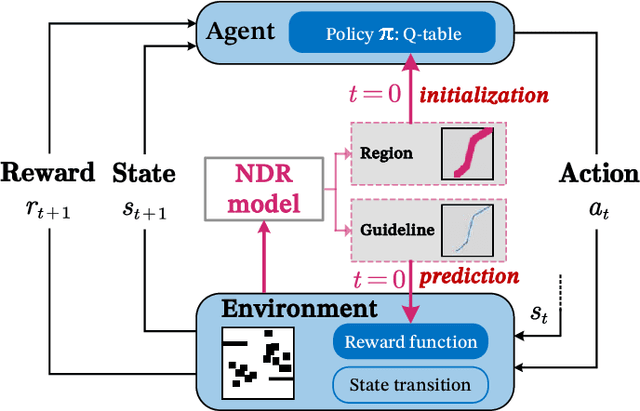
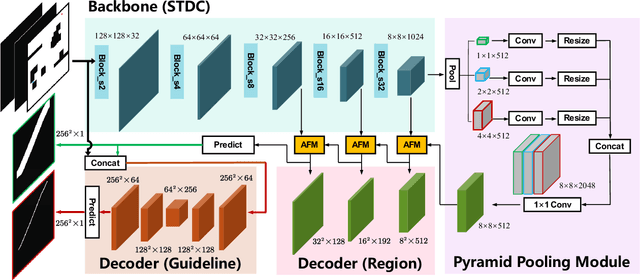
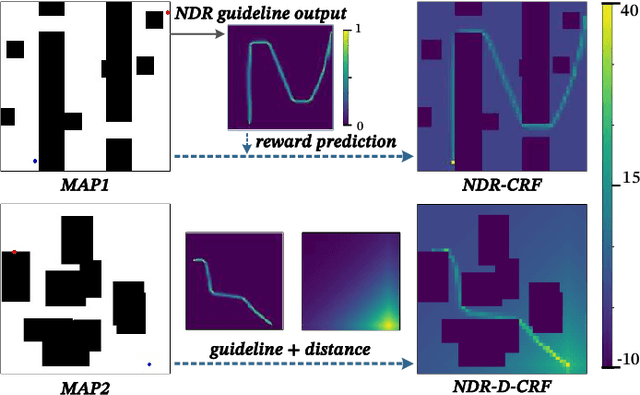
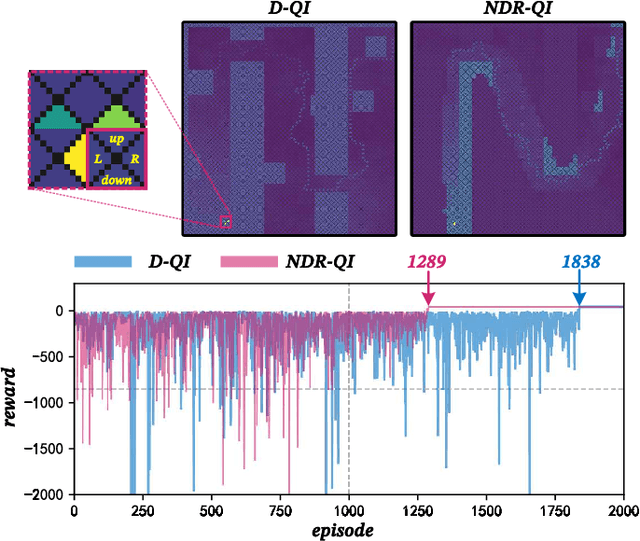
Q-learning is a widely used reinforcement learning technique for solving path planning problems. It primarily involves the interaction between an agent and its environment, enabling the agent to learn an optimal strategy that maximizes cumulative rewards. Although many studies have reported the effectiveness of Q-learning, it still faces slow convergence issues in practical applications. To address this issue, we propose the NDR-QL method, which utilizes neural network outputs as heuristic information to accelerate the convergence process of Q-learning. Specifically, we improved the dual-output neural network model by introducing a start-end channel separation mechanism and enhancing the feature fusion process. After training, the proposed NDR model can output a narrowly focused optimal probability distribution, referred to as the guideline, and a broadly distributed suboptimal distribution, referred to as the region. Subsequently, based on the guideline prediction, we calculate the continuous reward function for the Q-learning method, and based on the region prediction, we initialize the Q-table with a bias. We conducted training, validation, and path planning simulation experiments on public datasets. The results indicate that the NDR model outperforms previous methods by up to 5\% in prediction accuracy. Furthermore, the proposed NDR-QL method improves the convergence speed of the baseline Q-learning method by 90\% and also surpasses the previously improved Q-learning methods in path quality metrics.