 Add to Chrome
 Add to Firefox
 Add to Edge
Progress-conditioned Group Policy Optimization for Long-Horizon Agentic Tasks
Jul 22, 2026
Group-based policy optimization has been increasingly used to train large language model (LLM) agents from sparse outcome rewards by comparing trajectories or steps within a group. However, on difficult long-horizon tasks, this comparison can suffer from a sampling imbalance: repeated or low-effect actions dominate the high-probability region of the policy while useful state-changing actions remain under-sampled. This imbalance produces many all-failed rollout groups, where outcome rewards provide no direction for correcting the policy. Together, these effects can form a self-reinforcing credit trap: failure-dominated sampling yields no outcome-based correction, allowing repeated low-effect actions to persist. To break this loop, we propose Progress-conditioned Group Policy Optimization (ProGPO), which uses first-visit observation coverage only when all samples in a group receive zero outcome reward. Specifically, within such groups, ProGPO assigns higher relative advantages to trajectories or steps that visit more new states since reaching new observations is a prerequisite for task success. Experiments on two challenging agentic benchmarks, ALFWorld and WebShop with Qwen2.5-1.5/7B-Instruct, show that ProGPO consistently improves over group-based baselines, with particularly large gains on hard tasks.

Beyond Next-Observation Prediction: Agent-Authored World Modeling for Sequential Decision Making
Jun 24, 2026Recent studies on world modeling for Large Language Model (LLM) agents typically formulate the learning objective as next-observation prediction. However, this objective ties supervision to what a transition happens to reveal, which may omit the dynamics most relevant to the agent's current decision. To bridge this gap, we propose Agent-Authored World Modeling (AAWM), a training procedure that constructs supervision from the policy's own decision needs. Specifically, at each state, the agent identifies what it needs to understand about the environment before acting. These needs drive the retrieval of relevant transition evidence across trajectories, which is then synthesized into training targets that capture decision-oriented dynamics instead of reconstructing the next observation. This aligns the training objective with the dynamics the policy needs before acting, not with the contents of the next observation. Experimental results validate the effectiveness of AAWM across multiple environments and training settings. These results show that decision-aware world-model targets provide a more effective learning signal than next-observation prediction.
LASOR: Learning Accurate 3D Human Pose and Shape Via Synthetic Occlusion-Aware Data and Neural Mesh Rendering
Aug 01, 2021

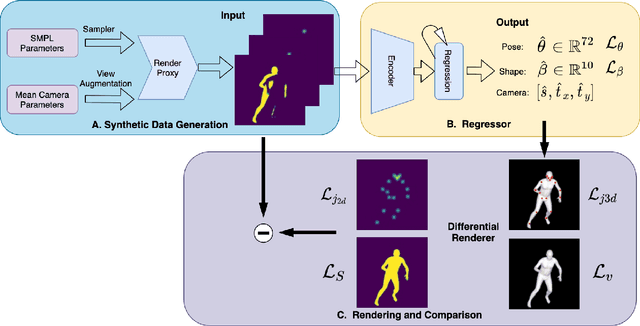
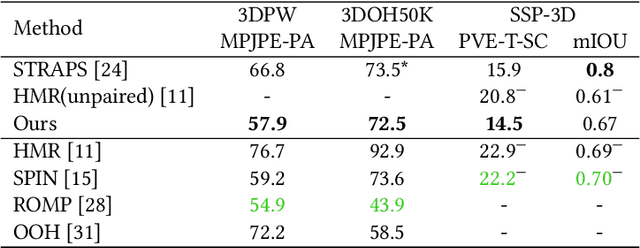
A key challenge in the task of human pose and shape estimation is occlusion, including self-occlusions, object-human occlusions, and inter-person occlusions. The lack of diverse and accurate pose and shape training data becomes a major bottleneck, especially for scenes with occlusions in the wild. In this paper, we focus on the estimation of human pose and shape in the case of inter-person occlusions, while also handling object-human occlusions and self-occlusion. We propose a framework that synthesizes occlusion-aware silhouette and 2D keypoints data and directly regress to the SMPL pose and shape parameters. A neural 3D mesh renderer is exploited to enable silhouette supervision on the fly, which contributes to great improvements in shape estimation. In addition, keypoints-and-silhouette-driven training data in panoramic viewpoints are synthesized to compensate for the lack of viewpoint diversity in any existing dataset. Experimental results show that we are among state-of-the-art on the 3DPW dataset in terms of pose accuracy and evidently outperform the rank-1 method in terms of shape accuracy. Top performance is also achieved on SSP-3D in terms of shape prediction accuracy.