 Add to Chrome
 Add to Firefox
 Add to Edge
Geometric-Photometric Event-based 3D Gaussian Ray Tracing
Dec 21, 2025
Event cameras offer a high temporal resolution over traditional frame-based cameras, which makes them suitable for motion and structure estimation. However, it has been unclear how event-based 3D Gaussian Splatting (3DGS) approaches could leverage fine-grained temporal information of sparse events. This work proposes a framework to address the trade-off between accuracy and temporal resolution in event-based 3DGS. Our key idea is to decouple the rendering into two branches: event-by-event geometry (depth) rendering and snapshot-based radiance (intensity) rendering, by using ray-tracing and the image of warped events. The extensive evaluation shows that our method achieves state-of-the-art performance on the real-world datasets and competitive performance on the synthetic dataset. Also, the proposed method works without prior information (e.g., pretrained image reconstruction models) or COLMAP-based initialization, is more flexible in the event selection number, and achieves sharp reconstruction on scene edges with fast training time. We hope that this work deepens our understanding of the sparse nature of events for 3D reconstruction. The code will be released.

3D Human Scan With A Moving Event Camera
Apr 12, 2024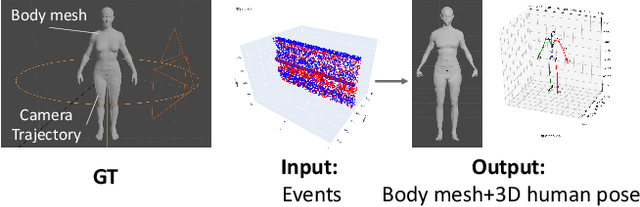
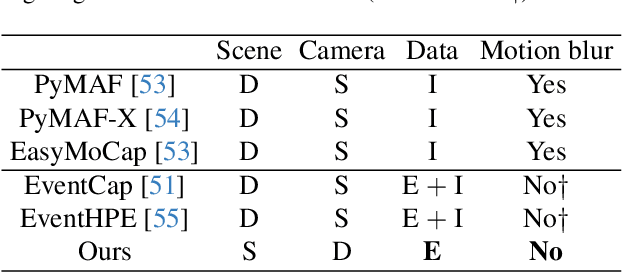
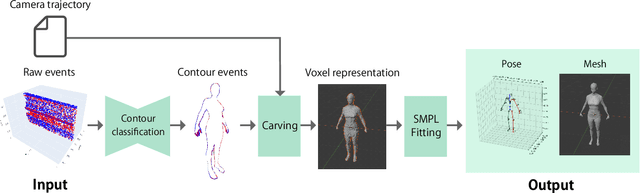
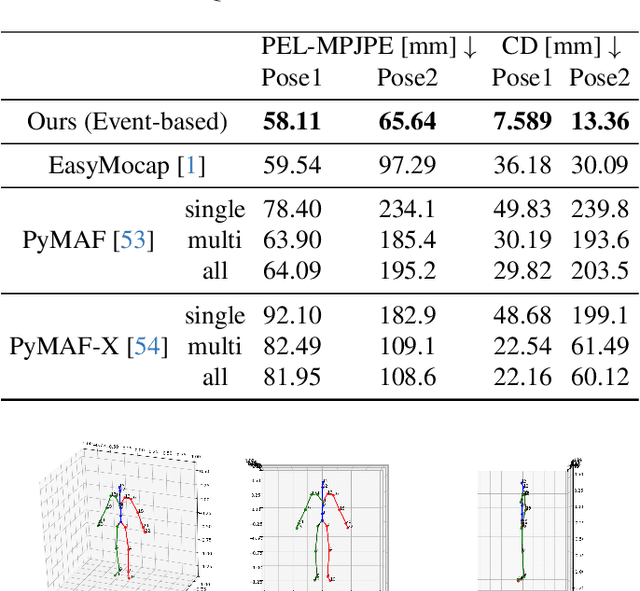
Capturing the 3D human body is one of the important tasks in computer vision with a wide range of applications such as virtual reality and sports analysis. However, conventional frame cameras are limited by their temporal resolution and dynamic range, which imposes constraints in real-world application setups. Event cameras have the advantages of high temporal resolution and high dynamic range (HDR), but the development of event-based methods is necessary to handle data with different characteristics. This paper proposes a novel event-based method for 3D pose estimation and human mesh recovery. Prior work on event-based human mesh recovery require frames (images) as well as event data. The proposed method solely relies on events; it carves 3D voxels by moving the event camera around a stationary body, reconstructs the human pose and mesh by attenuated rays, and fit statistical body models, preserving high-frequency details. The experimental results show that the proposed method outperforms conventional frame-based methods in the estimation accuracy of both pose and body mesh. We also demonstrate results in challenging situations where a conventional camera has motion blur. This is the first to demonstrate event-only human mesh recovery, and we hope that it is the first step toward achieving robust and accurate 3D human body scanning from vision sensors.