 Add to Chrome
 Add to Firefox
 Add to Edge
Towards Metric-Faithful Neural Graph Matching
May 07, 2026
Graph Edit Distance (GED) is a fundamental, albeit NP-hard, metric for structural graph similarity. Recent neural graph matching architectures approximate GED by first encoding graphs with a Graph Neural Network (GNN) and then applying either a graph-level regression head or a matching-based alignment module. Despite substantial architectural progress, the role of encoder geometry in neural GED estimation remains poorly understood. In this paper, we develop a theoretical framework that connects encoder geometry to GED estimation quality for two broad classes of neural GED estimators: graph similarity predictors and alignment-based methods. On fixed graph collections, where the doubly-stochastic metric $d_{\mathrm{DS}}$ is comparable to GED, we show that graph-level bi-Lipschitz encoders yield controlled GED surrogates and improved ranking stability; for matching-based estimators, node-level bi-Lipschitz geometry propagates to encoder-induced alignment costs and the resulting optimized alignment objective. We instantiate this perspective using FSW-GNN, a bi-Lipschitz WL-equivalent encoder, as a drop-in replacement in representative neural GED architectures. Across representative baselines and benchmark datasets, the resulting geometry-aware variants significantly improve GED prediction and ranking metrics. A faithfulness case study of untrained encoders, together with ablations and transfer experiments, supports the view that these gains arise from improved representation geometry, positioning encoder geometry as a useful design principle for neural graph matching.

Graph Reconstruction from Differentially Private GNN Explanations
May 05, 2026Regulatory frameworks such as GDPR increasingly require that ML predictions be accompanied by post-hoc explanations, even when raw data and trained models cannot be released. Differential privacy (DP) is the standard mitigation for the residual privacy risk of releasing these explanations. We show that DP is not sufficient: an adversary observing only DP-perturbed GNN explanations can reconstruct hidden graph structure with high accuracy. Our attack, PRIVX, exploits the fact that the Gaussian DP mechanism is a single DDPM forward step at known noise level σ(ε), recasting reconstruction as reverse diffusion conditioned on the corrupted signal, a principled Bayesian denoiser under known DP corruption. We formalise a stratified adversary model parameterised by (M, \hatε, \hatδ, S, ρ) that interpolates between oblivious and oracle attackers, and derive endpoint-matched two-sided bounds on reconstruction AUC. For practitioners, we provide regime-stratified guidance on explainer choice: on homophilic graphs, neighbourhood-aggregating explainers (GraphLIME, GNNExplainer) leak more structure than per-node gradient explainers under the same DP budget; on strongly heterophilic graphs the ordering reverses. We introduce PRIVF as an auxiliary diagnostic sharing the same diffusion backbone to decompose leakage into explainer-induced and intrinsic graph-distribution components. Experiments across seven benchmarks, three DP mechanisms, and three GNN backbones show PRIVX achieves AUC above 0.7 at ε = 5 on five of seven datasets, with the attack succeeding well within typically deployed privacy budgets.
Tirtha -- An Automated Platform to Crowdsource Images and Create 3D Models of Heritage Sites
Aug 15, 2023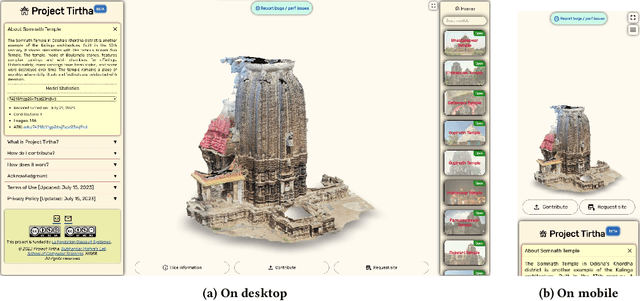
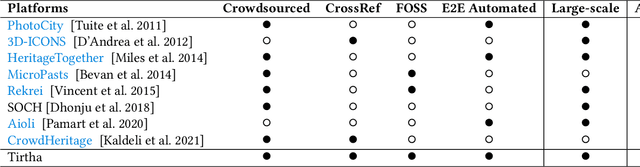
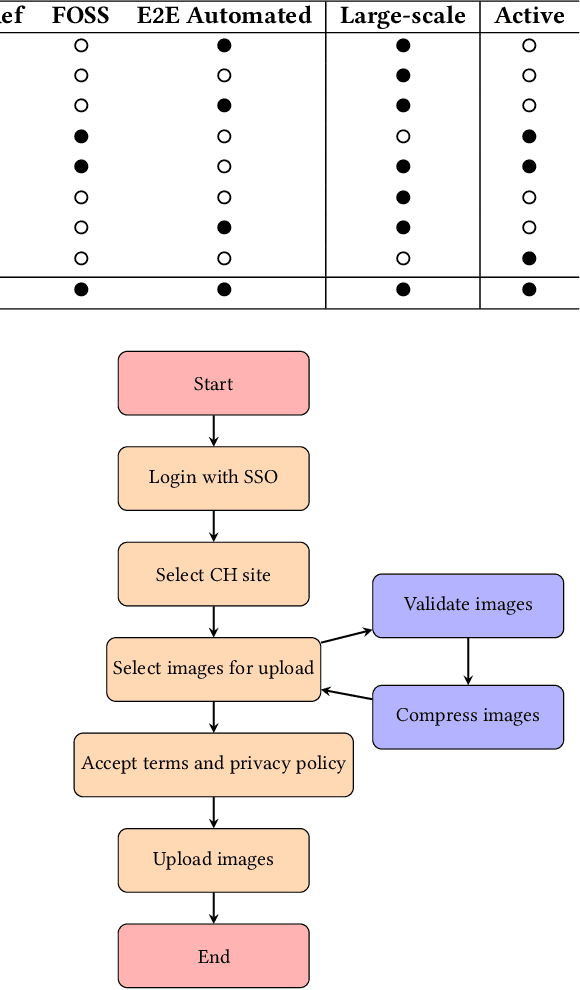
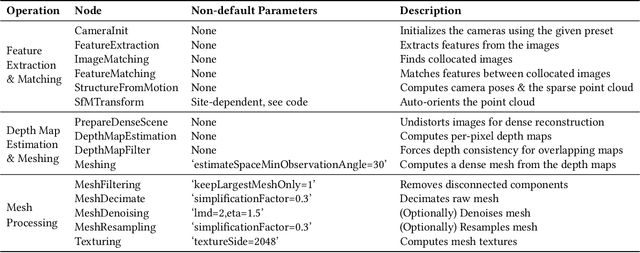
Digital preservation of Cultural Heritage (CH) sites is crucial to protect them against damage from natural disasters or human activities. Creating 3D models of CH sites has become a popular method of digital preservation thanks to advancements in computer vision and photogrammetry. However, the process is time-consuming, expensive, and typically requires specialized equipment and expertise, posing challenges in resource-limited developing countries. Additionally, the lack of an open repository for 3D models hinders research and public engagement with their heritage. To address these issues, we propose Tirtha, a web platform for crowdsourcing images of CH sites and creating their 3D models. Tirtha utilizes state-of-the-art Structure from Motion (SfM) and Multi-View Stereo (MVS) techniques. It is modular, extensible and cost-effective, allowing for the incorporation of new techniques as photogrammetry advances. Tirtha is accessible through a web interface at https://tirtha.niser.ac.in and can be deployed on-premise or in a cloud environment. In our case studies, we demonstrate the pipeline's effectiveness by creating 3D models of temples in Odisha, India, using crowdsourced images. These models are available for viewing, interaction, and download on the Tirtha website. Our work aims to provide a dataset of crowdsourced images and 3D reconstructions for research in computer vision, heritage conservation, and related domains. Overall, Tirtha is a step towards democratizing digital preservation, primarily in resource-limited developing countries.