 Add to Chrome
 Add to Firefox
 Add to Edge
Attacking Graph Foundation Models Through Their Shared Representation
Jul 20, 2026
A graph foundation model generalizes across graph domains by mapping every input into one shared representation before any task reasoning. We call this map the alignment layer, the component that separates a graph foundation model from a graph neural network, and we show it is a distinct attack surface that prior work has not studied. We attack it at inference time, with no access to training, on six public models spanning spectral tokenizers, text embedding spaces, and a discrete codebook. A directed representation-space perturbation collapses every model, but at a budget comparable to the representation norm a plain graph network also needs, with one exception: OpenGraph, whose spectral tokenizer collapses at a fifth of that budget, an alignment-specific fragility a plain network does not share and which a same-representation control traces to the tokenizer rather than the decoder. A realizable input-space attack that edits edges, features, or text removes at least half the correct predictions on three of the six models at peak. How much of this fragility an input-access attacker realizes tracks how directly the decoder reads the representation, and not the clean accuracy a task leaves; we measure this carrier gain structurally from the decoder's local Lipschitz sensitivity, and report clean-accuracy headroom as a within-model ordering heuristic that does not survive on realizable attacks.

Towards Metric-Faithful Neural Graph Matching
May 07, 2026Graph Edit Distance (GED) is a fundamental, albeit NP-hard, metric for structural graph similarity. Recent neural graph matching architectures approximate GED by first encoding graphs with a Graph Neural Network (GNN) and then applying either a graph-level regression head or a matching-based alignment module. Despite substantial architectural progress, the role of encoder geometry in neural GED estimation remains poorly understood. In this paper, we develop a theoretical framework that connects encoder geometry to GED estimation quality for two broad classes of neural GED estimators: graph similarity predictors and alignment-based methods. On fixed graph collections, where the doubly-stochastic metric $d_{\mathrm{DS}}$ is comparable to GED, we show that graph-level bi-Lipschitz encoders yield controlled GED surrogates and improved ranking stability; for matching-based estimators, node-level bi-Lipschitz geometry propagates to encoder-induced alignment costs and the resulting optimized alignment objective. We instantiate this perspective using FSW-GNN, a bi-Lipschitz WL-equivalent encoder, as a drop-in replacement in representative neural GED architectures. Across representative baselines and benchmark datasets, the resulting geometry-aware variants significantly improve GED prediction and ranking metrics. A faithfulness case study of untrained encoders, together with ablations and transfer experiments, supports the view that these gains arise from improved representation geometry, positioning encoder geometry as a useful design principle for neural graph matching.
Graph Reconstruction from Differentially Private GNN Explanations
May 05, 2026Regulatory frameworks such as GDPR increasingly require that ML predictions be accompanied by post-hoc explanations, even when raw data and trained models cannot be released. Differential privacy (DP) is the standard mitigation for the residual privacy risk of releasing these explanations. We show that DP is not sufficient: an adversary observing only DP-perturbed GNN explanations can reconstruct hidden graph structure with high accuracy. Our attack, PRIVX, exploits the fact that the Gaussian DP mechanism is a single DDPM forward step at known noise level σ(ε), recasting reconstruction as reverse diffusion conditioned on the corrupted signal, a principled Bayesian denoiser under known DP corruption. We formalise a stratified adversary model parameterised by (M, \hatε, \hatδ, S, ρ) that interpolates between oblivious and oracle attackers, and derive endpoint-matched two-sided bounds on reconstruction AUC. For practitioners, we provide regime-stratified guidance on explainer choice: on homophilic graphs, neighbourhood-aggregating explainers (GraphLIME, GNNExplainer) leak more structure than per-node gradient explainers under the same DP budget; on strongly heterophilic graphs the ordering reverses. We introduce PRIVF as an auxiliary diagnostic sharing the same diffusion backbone to decompose leakage into explainer-induced and intrinsic graph-distribution components. Experiments across seven benchmarks, three DP mechanisms, and three GNN backbones show PRIVX achieves AUC above 0.7 at ε = 5 on five of seven datasets, with the attack succeeding well within typically deployed privacy budgets.
GRAFT: Auditing Graph Neural Networks via Global Feature Attribution
May 05, 2026Graph Neural Networks (GNNs) achieve strong performance on node classification tasks but remain difficult to interpret, particularly with respect to which input features drive their predictions. Existing global GNN explainers operate at the structural level identifying recurring subgraph motifs, but none explain model behaviour globally at the level of input node attributes. We propose GRAFT, a posthoc global explanation framework that identifies class-level feature importance profiles for GNNs. The method combines diversity-guided exemplar selection, Integrated Gradients-based attribution, and aggregation to construct a global view of feature influence for each class, which can be further expressed as concise natural language rules using a large language model with self-refinement. We evaluate GRAFT across multiple datasets, architectures, and experimental settings, demonstrating its effectiveness in capturing model-relevant features, supporting bias analysis, and enabling feature-efficient transfer learning. In addition, we introduce a structured human evaluation protocol to assess the interpretability of generated rules along dimensions such as accuracy and usefulness. Our results suggest that GRAFT provides a practical and interpretable approach for analysing feature-level behaviour in GNNs, bridging quantitative attribution with human-understandable explanations.
mHC-GNN: Manifold-Constrained Hyper-Connections for Graph Neural Networks
Jan 05, 2026Graph Neural Networks (GNNs) suffer from over-smoothing in deep architectures and expressiveness bounded by the 1-Weisfeiler-Leman (1-WL) test. We adapt Manifold-Constrained Hyper-Connections (\mhc)~\citep{xie2025mhc}, recently proposed for Transformers, to graph neural networks. Our method, mHC-GNN, expands node representations across $n$ parallel streams and constrains stream-mixing matrices to the Birkhoff polytope via Sinkhorn-Knopp normalization. We prove that mHC-GNN exhibits exponentially slower over-smoothing (rate $(1-γ)^{L/n}$ vs.\ $(1-γ)^L$) and can distinguish graphs beyond 1-WL. Experiments on 10 datasets with 4 GNN architectures show consistent improvements. Depth experiments from 2 to 128 layers reveal that standard GNNs collapse to near-random performance beyond 16 layers, while mHC-GNN maintains over 74\% accuracy even at 128 layers, with improvements exceeding 50 percentage points at extreme depths. Ablations confirm that the manifold constraint is essential: removing it causes up to 82\% performance degradation. Code is available at \href{https://github.com/smlab-niser/mhc-gnn}{https://github.com/smlab-niser/mhc-gnn}
Clean-GS: Semantic Mask-Guided Pruning for 3D Gaussian Splatting
Jan 01, 20263D Gaussian Splatting produces high-quality scene reconstructions but generates hundreds of thousands of spurious Gaussians (floaters) scattered throughout the environment. These artifacts obscure objects of interest and inflate model sizes, hindering deployment in bandwidth-constrained applications. We present Clean-GS, a method for removing background clutter and floaters from 3DGS reconstructions using sparse semantic masks. Our approach combines whitelist-based spatial filtering with color-guided validation and outlier removal to achieve 60-80\% model compression while preserving object quality. Unlike existing 3DGS pruning methods that rely on global importance metrics, Clean-GS uses semantic information from as few as 3 segmentation masks (1\% of views) to identify and remove Gaussians not belonging to the target object. Our multi-stage approach consisting of (1) whitelist filtering via projection to masked regions, (2) depth-buffered color validation, and (3) neighbor-based outlier removal isolates monuments and objects from complex outdoor scenes. Experiments on Tanks and Temples show that Clean-GS reduces file sizes from 125MB to 47MB while maintaining rendering quality, making 3DGS models practical for web deployment and AR/VR applications. Our code is available at https://github.com/smlab-niser/clean-gs
Robustness in Large Language Models: A Survey of Mitigation Strategies and Evaluation Metrics
May 24, 2025Large Language Models (LLMs) have emerged as a promising cornerstone for the development of natural language processing (NLP) and artificial intelligence (AI). However, ensuring the robustness of LLMs remains a critical challenge. To address these challenges and advance the field, this survey provides a comprehensive overview of current studies in this area. First, we systematically examine the nature of robustness in LLMs, including its conceptual foundations, the importance of consistent performance across diverse inputs, and the implications of failure modes in real-world applications. Next, we analyze the sources of non-robustness, categorizing intrinsic model limitations, data-driven vulnerabilities, and external adversarial factors that compromise reliability. Following this, we review state-of-the-art mitigation strategies, and then we discuss widely adopted benchmarks, emerging metrics, and persistent gaps in assessing real-world reliability. Finally, we synthesize findings from existing surveys and interdisciplinary studies to highlight trends, unresolved issues, and pathways for future research.
Retinal Fundus Multi-Disease Image Classification using Hybrid CNN-Transformer-Ensemble Architectures
Mar 27, 2025Our research is motivated by the urgent global issue of a large population affected by retinal diseases, which are evenly distributed but underserved by specialized medical expertise, particularly in non-urban areas. Our primary objective is to bridge this healthcare gap by developing a comprehensive diagnostic system capable of accurately predicting retinal diseases solely from fundus images. However, we faced significant challenges due to limited, diverse datasets and imbalanced class distributions. To overcome these issues, we have devised innovative strategies. Our research introduces novel approaches, utilizing hybrid models combining deeper Convolutional Neural Networks (CNNs), Transformer encoders, and ensemble architectures sequentially and in parallel to classify retinal fundus images into 20 disease labels. Our overarching goal is to assess these advanced models' potential in practical applications, with a strong focus on enhancing retinal disease diagnosis accuracy across a broader spectrum of conditions. Importantly, our efforts have surpassed baseline model results, with the C-Tran ensemble model emerging as the leader, achieving a remarkable model score of 0.9166, surpassing the baseline score of 0.9. Additionally, experiments with the IEViT model showcased equally promising outcomes with improved computational efficiency. We've also demonstrated the effectiveness of dynamic patch extraction and the integration of domain knowledge in computer vision tasks. In summary, our research strives to contribute significantly to retinal disease diagnosis, addressing the critical need for accessible healthcare solutions in underserved regions while aiming for comprehensive and accurate disease prediction.
* 17 pages, 3 figures, 7 tables. Conference paper presented at the International Health Informatics Conference (IHIC 2023)
Graph Neural Networks at a Fraction
Feb 10, 2025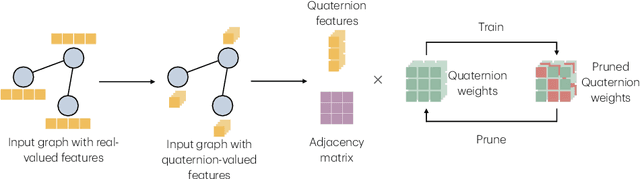
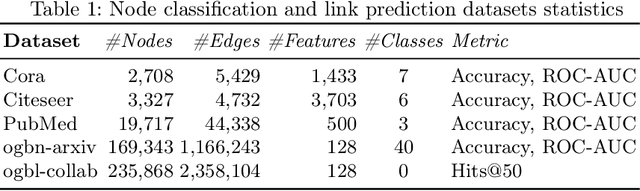
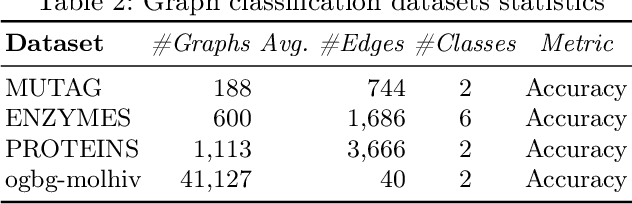
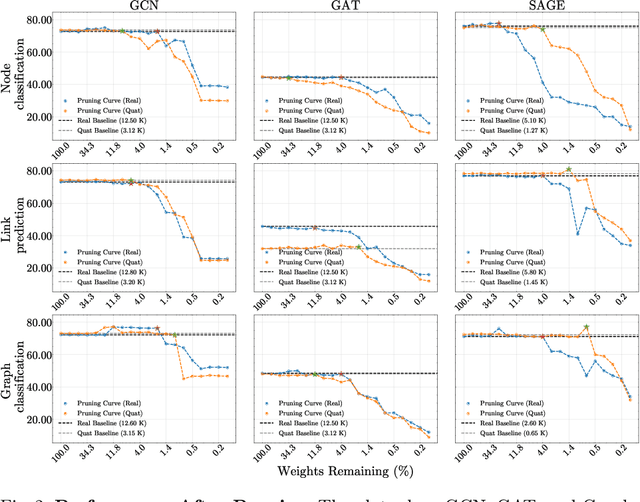
Graph Neural Networks (GNNs) have emerged as powerful tools for learning representations of graph-structured data. In addition to real-valued GNNs, quaternion GNNs also perform well on tasks on graph-structured data. With the aim of reducing the energy footprint, we reduce the model size while maintaining accuracy comparable to that of the original-sized GNNs. This paper introduces Quaternion Message Passing Neural Networks (QMPNNs), a framework that leverages quaternion space to compute node representations. Our approach offers a generalizable method for incorporating quaternion representations into GNN architectures at one-fourth of the original parameter count. Furthermore, we present a novel perspective on Graph Lottery Tickets, redefining their applicability within the context of GNNs and QMPNNs. We specifically aim to find the initialization lottery from the subnetwork of the GNNs that can achieve comparable performance to the original GNN upon training. Thereby reducing the trainable model parameters even further. To validate the effectiveness of our proposed QMPNN framework and LTH for both GNNs and QMPNNs, we evaluate their performance on real-world datasets across three fundamental graph-based tasks: node classification, link prediction, and graph classification.
A Survey on Robotic Prosthetics: Neuroprosthetics, Soft Actuators, and Control Strategies
Aug 03, 2024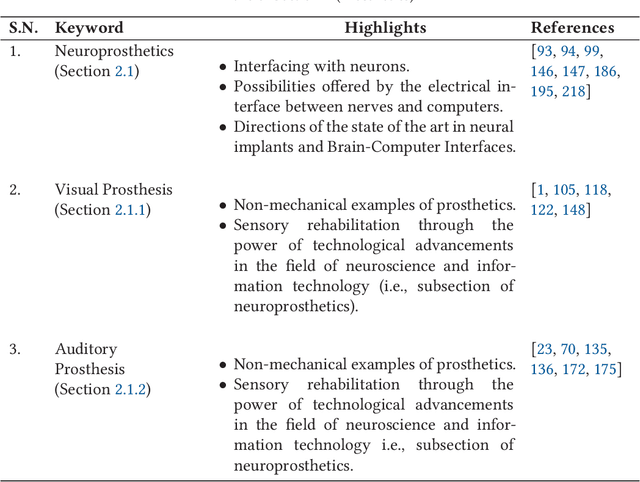
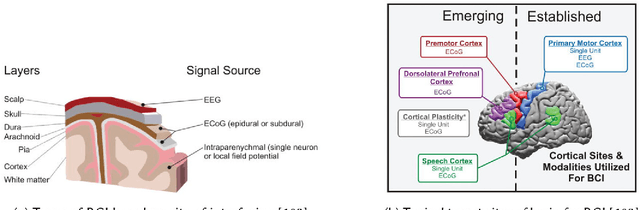
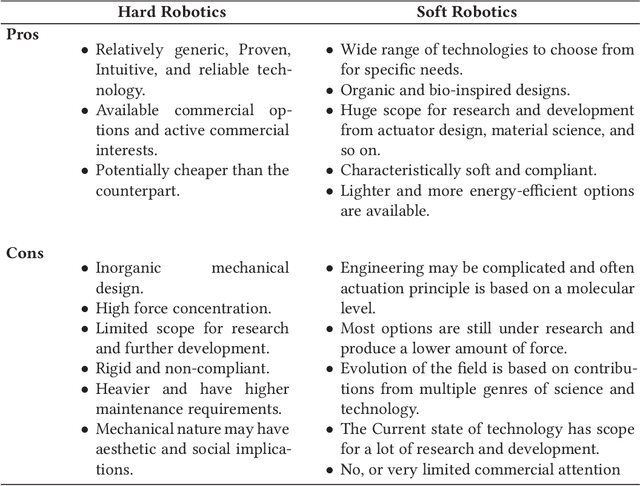
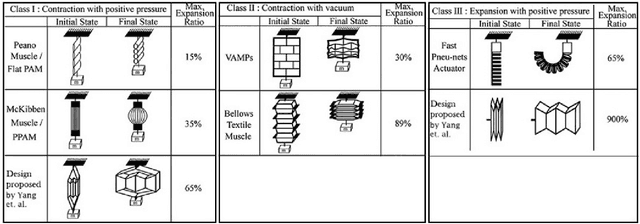
The field of robotics is a quickly evolving feat of technology that accepts contributions from various genres of science. Neuroscience, Physiology, Chemistry, Material science, Computer science, and the wide umbrella of mechatronics have all simultaneously contributed to many innovations in the prosthetic applications of robotics. This review begins with a discussion of the scope of the term robotic prosthetics and discusses the evolving domain of Neuroprosthetics. The discussion is then constrained to focus on various actuation and control strategies for robotic prosthetic limbs. This review discusses various soft robotic actuators such as EAP, SMA, FFA, etc., and the merits of such actuators over conventional hard robotic actuators. Options in control strategies for robotic prosthetics, that are in various states of research and development, are reviewed. This paper concludes the discussion with an analysis regarding the prospective direction in which this field of robotic prosthetics is evolving in terms of actuation, control, and other features relevant to artificial limbs. This paper intends to review some of the emerging research and development trends in the field of robotic prosthetics and summarize many tangents that are represented under this broad domain in an approachable manner.