 Add to Chrome
 Add to Firefox
 Add to Edge
Intertemporal Preference Steering in Qwen3 via Contrastive Activation Addition
Aug 04, 2026
We study linear representations of temporal horizon in the large language model Qwen3-32B and use them to change the model's time-related preferences, recommendations, and capabilities. We train contrastive linear probes on teacher-forced temporal-choice answers to find a short-term versus long-term direction in the model's residual stream, and evaluate contrastive activation-addition steering on a held-out binary temporal-choice task, an out-of-distribution monetary intertemporal-choice task, and a TravelPlanner capability benchmark. The central result is that temporal-horizon directions can be identified with simple contrastive linear probes and then used for steering to induce large, bidirectional preference changes. On an out-of-distribution monetary choice task that varies reward size and delay, steering strongly shifts the model's indifference threshold between smaller-sooner and larger-later rewards in both directions. We further show improvements on a planning-related capability metric under moderate temporal steering. These results suggest that model intertemporal preferences are measurable and steerable, which is relevant for AI systems that give advice involving delayed costs and benefits, and for safety questions about long-horizon planning.

Creative Collision: Directorial Persona Steering and Competition in Large Language Models
Jun 15, 2026Activation steering has emerged as a powerful tool for shaping the behaviour of large language models at inference time, yet most prior work injects a \emph{single} semantic direction into the residual stream. We study the richer setting in which two semantically opposing steering vectors are superimposed -- a regime we call \textbf{Creative Collision}. Concretely, we construct directorial persona vectors for Steven Spielberg (optimistic, redemptive moral valence) and Martin Scorsese (dark, morally ambiguous) via mean-difference activation contrast on curated screenplay-derived corpora, then interpolate between them with a scalar mixing parameter $α\in [0,1]$ and a steering coefficient $λ$. Across five evaluation axes -- moral valence, generation coherence, surface style, directional dominance, and vector geometry -- three principal findings emerge: (i)~Spielberg's representational signature exhibits robust \emph{directional dominance}, suppressing Scorsese's moral influence across almost the entire interpolation range; (ii)~intermediate collision points paradoxically \emph{improve} generation coherence relative to pure single-director steering at high $λ$; and (iii)~both personas localise maximally to layer~28 of a 40-layer decoder-only transformer, revealing a shared \emph{moral-tone substrate}. These results illuminate the geometry of competing semantic directions in transformer residual streams and have direct implications for controllable creative generation and value-aligned narrative synthesis.
Size Matters
Feb 09, 2021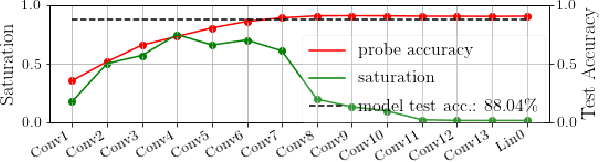
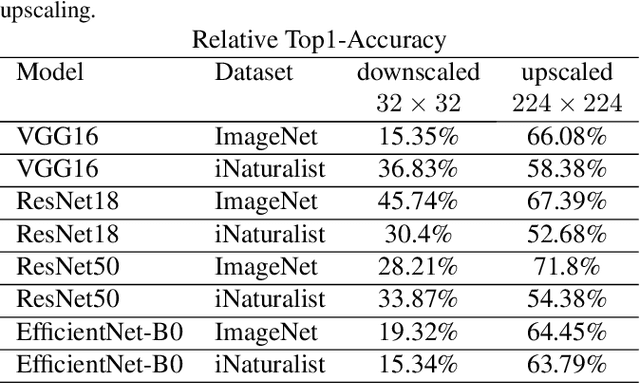
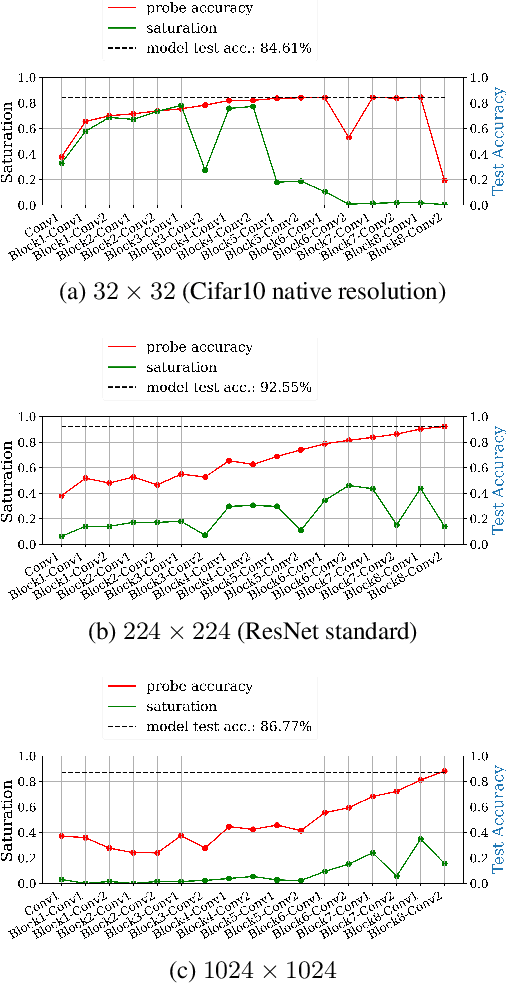
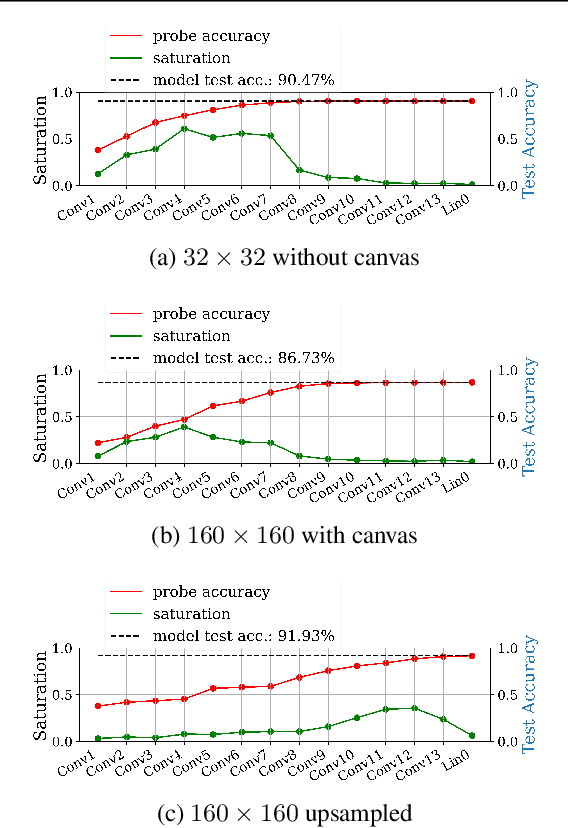
Fully convolutional neural networks can process input of arbitrary size by applying a combination of downsampling and pooling. However, we find that fully convolutional image classifiers are not agnostic to the input size but rather show significant differences in performance: presenting the same image at different scales can result in different outcomes. A closer look reveals that there is no simple relationship between input size and model performance (no `bigger is better'), but that each each network has a preferred input size, for which it shows best results. We investigate this phenomenon by applying different methods, including spectral analysis of layer activations and probe classifiers, showing that there are characteristic features depending on the network architecture. From this we find that the size of discriminatory features is critically influencing how the inference process is distributed among the layers.
Feature Space Saturation during Training
Jun 18, 2020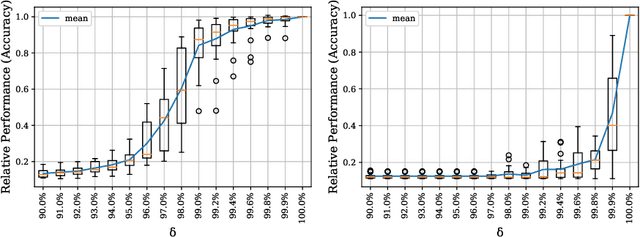
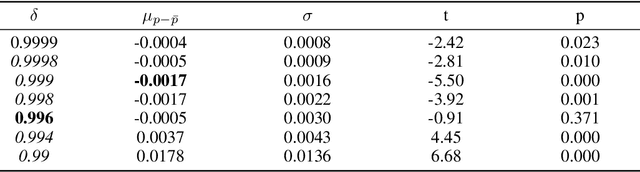
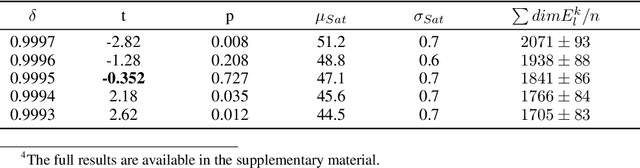
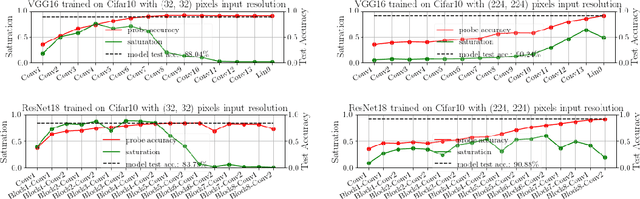
We propose layer saturation - a simple, online-computable method for analyzing the information processing in neural networks. First, we show that a layer's output can be restricted to the eigenspace of its variance matrix without performance loss. We propose a computationally lightweight method for approximating the variance matrix during training. From the dimension of its lossless eigenspace we derive layer saturation - the ratio between the eigenspace dimension and layer width. We show that saturation seems to indicate which layers contribute to network performance. We demonstrate how to alter layer saturation in a neural network by changing network depth, filter sizes and input resolution. Furthermore, we show that well-chosen input resolution increases network performance by distributing the inference process more evenly across the network.
Spectral Analysis of Latent Representations
Jul 19, 2019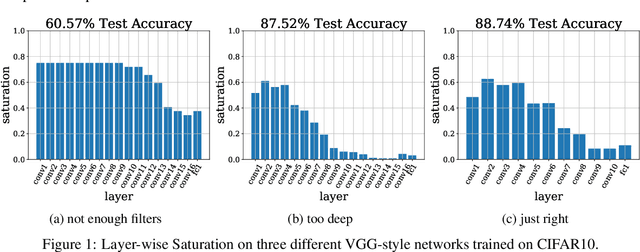
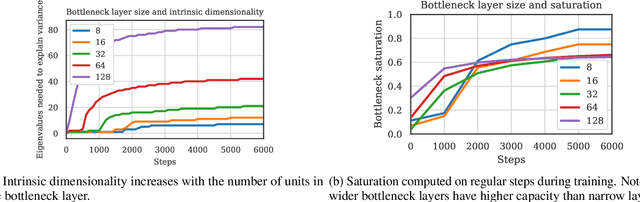
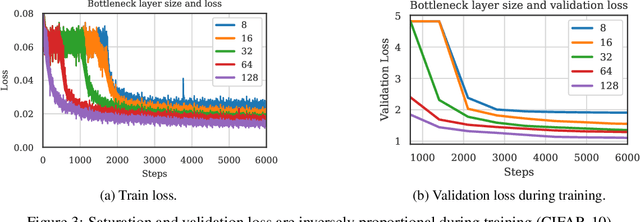
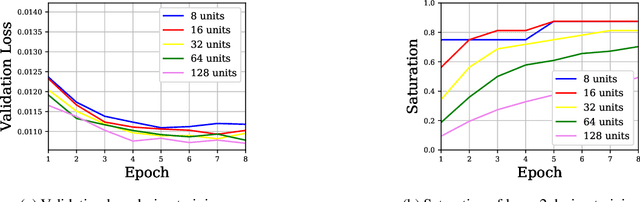
We propose a metric, Layer Saturation, defined as the proportion of the number of eigenvalues needed to explain 99% of the variance of the latent representations, for analyzing the learned representations of neural network layers. Saturation is based on spectral analysis and can be computed efficiently, making live analysis of the representations practical during training. We provide an outlook for future applications of this metric by outlining the behaviour of layer saturation in different neural architectures and problems. We further show that saturation is related to the generalization and predictive performance of neural networks.