 Add to Chrome
 Add to Firefox
 Add to Edge
Evidence-Grounded Verified Agentic Reasoning: A Path Toward Eliminating LLM Hallucination in Empirical Inference via Tool-Attested Kernel Proofs
Jul 14, 2026
Tool access alone does not make LLM empirical reasoning governable: accepted outputs need not descend from attested evidence, and accepted deductions need not hold up under formal scrutiny. We present EG-VAR (Evidence-Grounded Verified Agentic Reasoning), a Lean 4-based tool-calling architecture in which the Lean kernel is the sole minter of Verified claims via tool-attestation axioms and declared source lifts. Every verified output structurally descends from an attested tool call (Thm. 3.1) and a kernel-checked chain of valid inference (Thm. 3.2); residual outputs are honest Abstain with a replayable audit trail. On a subcollection of TableBench numerical reasoning (n=120), EG-VAR attains 120/120 versus a 95% same-tool baseline; on counterfactual stress tests (5 domains x 2 models), EG-VAR stays 100% source-faithful while same-tool drops to 80-90% (no-tool 50-80%). With the LLM as deployment-time formalizer, residual semantic-formalization error is 3.3% on Sonnet and 1.7% on Opus. We position EG-VAR as a technical-governance interface for high-stakes empirical claims: a formal sidecar makes the target proposition, source scope, evidence boundary, proof obligation, and abstention condition auditable, eliminating unsupported Verified outputs today while turning formalization errors, lift and source-authority disputes, ambiguities, and abstentions into explicit audit targets. Over time, typed sidecars in datasets, APIs, public records, and AI-generated documents can amortize this formalization burden into reusable infrastructure.

Low-dimensional topology of deep neural networks
Jun 30, 2026We study layered models, including feedforward networks, ResNets, and transformers, by limiting each layer to a width of $d = 3$, i.e., $\mathbb{R}^3$ as representation space. This allows us to track how a neural network changes low-dimensional topological invariants through its layers. Just about any topological structure may be simplified or even trivialized by simply increasing dimension; e.g., any knot is equivalent to an unknot in $\mathbb{R}^4$. By restricting to $\mathbb{R}^3$, we not only isolate the effects of activation and depth from that of width, we work in a space that lends itself to easy visualization. We focus on linking number here, deferring other invariants like link groups, Milnor's $\barμ$-invariants, knot types, ambient cobordisms, to a sequel. We provide full proofs and empirical experiments to justify the following insights: When measured by their power to effect changes in linking numbers, the layer-skipping feature in ResNets is as powerful as the attention mechanism in transformers; both ResNets and transformers are strictly more powerful than feedforward neural networks with monotonic activations, which are in turn more powerful than invertible and flow-based models; but replacing monotonic activation with a nonmonotonic one elevates a feedforward network into the same expressivity class as ResNets and transformers. These results suggest that low-dimensional topology can be a useful tool to guide designs of AI architectures. We also generalize our results from $d = 3$ to arbitrary $d > 3$.
Optimization Dynamics Imprint Semantic Specificity in Contrastive Embedding Norms
Jun 29, 2026Contrastive embedding models trained with scale-invariant losses are typically paired with distance metrics like cosine similarity, effectively ignoring embedding magnitudes. However, surprisingly, empirical studies reveal that despite this, these "discarded" norms seem to correlate with semantic properties such as concept specificity, token frequency, and human uncertainty. In this work, we provide a formal theoretical framework explaining this phenomenon. By analyzing the optimization dynamics, we derive an analytic formula demonstrating that embedding length naturally encodes this information as a byproduct of the training process. We also show how this gives rise to signals that can serve as "free" calibration tools in specific models and retrieval tasks, providing a grounded explanation for a previously heuristic observation.
Domain-Aware Hierarchical Contrastive Learning for Semi-Supervised Generalization Fault Diagnosis
Apr 22, 2026Fault diagnosis under unseen operating conditions remains highly challenging when labeled data are scarce. Semi-supervised domain generalization fault diagnosis (SSDGFD) provides a practical solution by jointly exploiting labeled and unlabeled source domains. However, existing methods still suffer from two coupled limitations. First, pseudo-labels for unlabeled domains are typically generated primarily from knowledge learned on the labeled source domain, which neglects domain-specific geometric discrepancies and thus induces systematic cross-domain pseudo-label bias. Second, unlabeled samples are commonly handled with a hard accept-or-discard strategy, where rigid thresholding causes imbalanced sample utilization across domains, while hard-label assignment for uncertain samples can easily introduce additional noise. To address these issues, we propose a unified framework termed domain-aware hierarchical contrastive learning (DAHCL) for SSDGFD. Specifically, DAHCL introduces a domain-aware learning (DAL) module to explicitly capture source-domain geometric characteristics and calibrate pseudo-label predictions across heterogeneous source domains, thereby mitigating cross-domain bias in pseudo-label generation. In addition, DAHCL develops a hierarchical contrastive learning (HCL) module that combines dynamic confidence stratification with fuzzy contrastive supervision, enabling uncertain samples to contribute to representation learning without relying on unreliable hard labels. In this way, DAHCL jointly improves the quality of supervision and the utilization of unlabeled samples. Furthermore, to better reflect practical industrial scenarios, we incorporate engineering noise into the SSDGFD evaluation protocol. Extensive experiments on three benchmark datasets demonstrate that...
Scaling Multiagent Systems with Process Rewards
Jan 30, 2026While multiagent systems have shown promise for tackling complex tasks via specialization, finetuning multiple agents simultaneously faces two key challenges: (1) credit assignment across agents, and (2) sample efficiency of expensive multiagent rollouts. In this work, we propose finetuning multiagent systems with per-action process rewards from AI feedback (MAPPA) to address both. Through assigning credit to individual agent actions rather than only at task completion, MAPPA enables fine-grained supervision without ground truth labels while extracting maximal training signal from each rollout. We demonstrate our approach on competition math problems and tool-augmented data analysis tasks. On unseen math problems, MAPPA achieves +5.0--17.5pp on AIME and +7.8--17.2pp on AMC. For data analysis tasks, our method improves success rate by +12.5pp while quality metrics improve by up to 30%, validating that per-action supervision can lead to improvements across different multiagent system on various domains. By addressing these challenges, our work takes a first step toward scaling multiagent systems for complex, long-horizon tasks with minimal human supervision.
Pre-Training and Prompting for Few-Shot Node Classification on Text-Attributed Graphs
Jul 22, 2024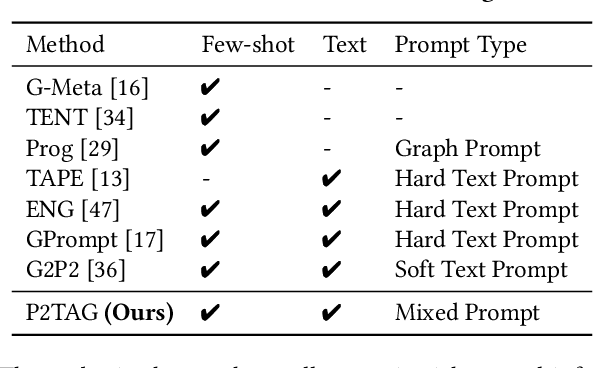
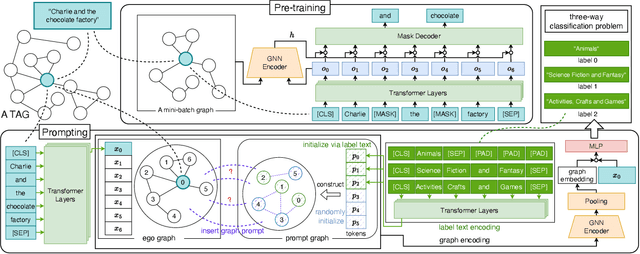
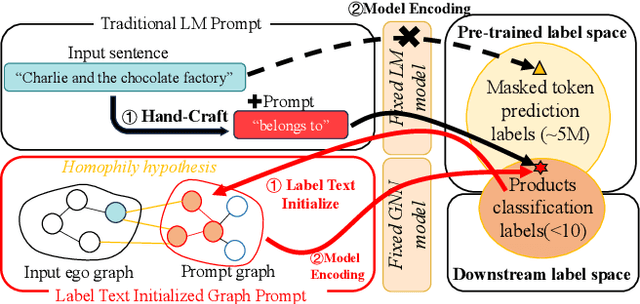
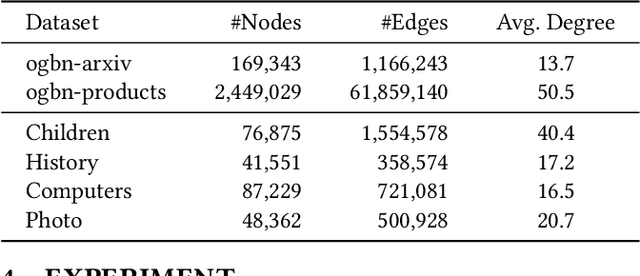
The text-attributed graph (TAG) is one kind of important real-world graph-structured data with each node associated with raw texts. For TAGs, traditional few-shot node classification methods directly conduct training on the pre-processed node features and do not consider the raw texts. The performance is highly dependent on the choice of the feature pre-processing method. In this paper, we propose P2TAG, a framework designed for few-shot node classification on TAGs with graph pre-training and prompting. P2TAG first pre-trains the language model (LM) and graph neural network (GNN) on TAGs with self-supervised loss. To fully utilize the ability of language models, we adapt the masked language modeling objective for our framework. The pre-trained model is then used for the few-shot node classification with a mixed prompt method, which simultaneously considers both text and graph information. We conduct experiments on six real-world TAGs, including paper citation networks and product co-purchasing networks. Experimental results demonstrate that our proposed framework outperforms existing graph few-shot learning methods on these datasets with +18.98% ~ +35.98% improvements.