 Add to Chrome
 Add to Firefox
 Add to Edge
Adaptive Multi-Scale Forecasting and Gate-Localized Conformal Prediction for Multivariate Nonstationary Time Series
Jul 25, 2026
We propose ABF-T-GLCP, a model-agnostic framework for forecasting and uncertainty quantification in nonstationary multivariate time series. The central idea is to learn an adaptive predictive state representation for point forecasting and reuse it for conformal calibration. The forecasting module combines horizon-specific temporal experts through a learned gate and refines predictions using sparse predictive transfer across related series. The uncertainty module, Gate-Localized Conformal Prediction (GLCP), uses the learned gate state, together with temporal recency, to select locally relevant calibration residuals, thereby coupling uncertainty calibration to the predictive regimes used by the forecasting model. This shared representation allows point forecasts and prediction intervals to adapt consistently under evolving temporal dynamics while retaining the model-agnostic nature of conformal prediction and yielding approximate local coverage under mild stability conditions. Experiments on a large-scale high-frequency commodity forecasting benchmark show consistent gains in point forecasting accuracy and substantially narrower prediction intervals with empirical coverage close to the nominal level. Additional results indicate that the framework extends beyond the motivating financial application.

Learning Effective Representations for Person-Job Fit by Feature Fusion
Jun 12, 2020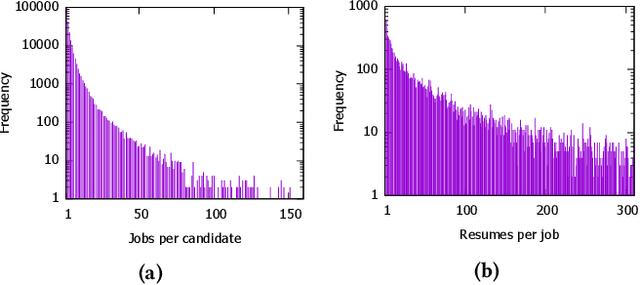
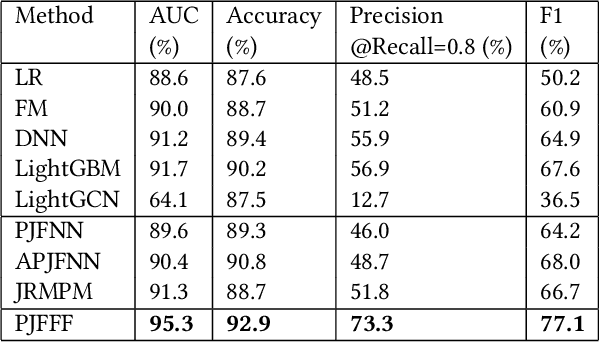
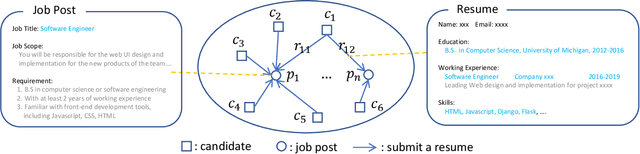
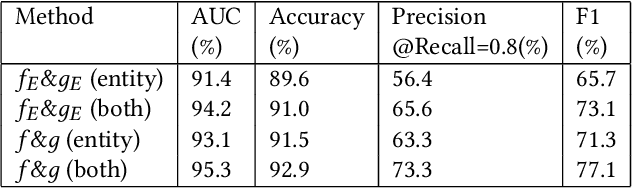
Person-job fit is to match candidates and job posts on online recruitment platforms using machine learning algorithms. The effectiveness of matching algorithms heavily depends on the learned representations for the candidates and job posts. In this paper, we propose to learn comprehensive and effective representations of the candidates and job posts via feature fusion. First, in addition to applying deep learning models for processing the free text in resumes and job posts, which is adopted by existing methods, we extract semantic entities from the whole resume (and job post) and then learn features for them. By fusing the features from the free text and the entities, we get a comprehensive representation for the information explicitly stated in the resume and job post. Second, however, some information of a candidate or a job may not be explicitly captured in the resume or job post. Nonetheless, the historical applications including accepted and rejected cases can reveal some implicit intentions of the candidates or recruiters. Therefore, we propose to learn the representations of implicit intentions by processing the historical applications using LSTM. Last, by fusing the representations for the explicit and implicit intentions, we get a more comprehensive and effective representation for person-job fit. Experiments over 10 months real data show that our solution outperforms existing methods with a large margin. Ablation studies confirm the contribution of each component of the fused representation. The extracted semantic entities help interpret the matching results during the case study.