 Add to Chrome
 Add to Firefox
 Add to Edge
LibraSpec: Dynamic Diffusion-Based Speculative Decoding via Marginal-Gain-Driven Optimization
Aug 09, 2026
Speculative decoding accelerates large language model inference by drafting multiple tokens for parallel verification, with efficiency critically determined by the speculative length selected at each decoding round. Existing dynamic speculation methods select the speculation length by estimating how many tokens will be accepted, which is reasonable for autoregressive drafters that generates tokens sequentially. The recent wave of diffusion-based drafters, however, generates candidate blocks in parallel at substantially lower drafting cost, shifting the key question from how many tokens to generate to how many generated tokens are worth verifying. We therefore reformulate dynamic speculative-length selection as expected-speedup optimization and derive a marginal criterion that extends the speculative sequence only when its acceptance gain outweighs the additional verification cost. Building on this criterion, we develop \textit{LibraSpec}, a training-free and plug-and-play algorithm that iteratively determines the speculative length using drafter confidence scores. Theoretically, we prove that LibraSpec monotonically converges toward the optimal speculative length. Experiments across six target models, three diffusion-based speculative decoding methods, and math, coding, and chat benchmarks show consistent improvements under both greedy and sampling settings, achieving a further $0.5\sim1.5\times$ improvement over baselines and up to $8.49\times$ speedup over autoregressive decoding.

Identify Critical KV Cache in LLM Inference from an Output Perturbation Perspective
Feb 06, 2025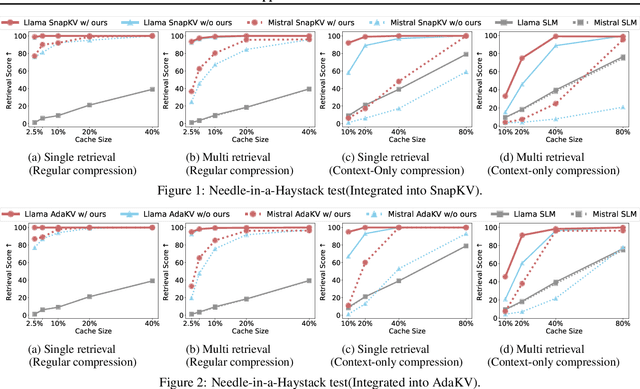
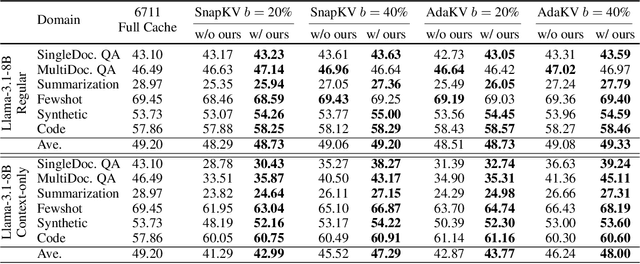
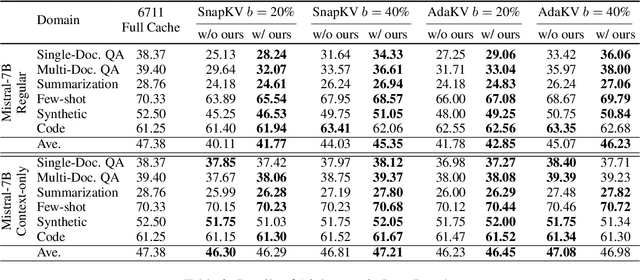
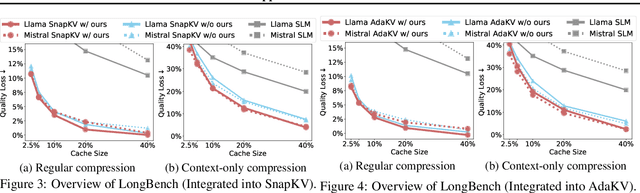
Large language models have revolutionized natural language processing but face significant challenges of high storage and runtime costs, due to the transformer architecture's reliance on self-attention, particularly the large Key-Value (KV) cache for long-sequence inference. Recent efforts to reduce KV cache size by pruning less critical entries based on attention weights remain empirical and lack formal grounding. This paper presents a formal study on identifying critical KV cache entries by analyzing attention output perturbation. Our analysis reveals that, beyond attention weights, the value states within KV entries and pretrained parameter matrices are also crucial. Based on this, we propose a perturbation-constrained selection algorithm that optimizes the worst-case output perturbation to identify critical entries. Evaluations on the Needle-in-a-Haystack test and Longbench benchmark show our algorithm enhances state-of-the-art cache eviction methods. Further empirical analysis confirms that our algorithm achieves lower output perturbations in over 92% attention heads in Llama model, thereby providing a significant improvement over existing methods.
Optimizing KV Cache Eviction in LLMs: Adaptive Allocation for Enhanced Budget Utilization
Jul 16, 2024
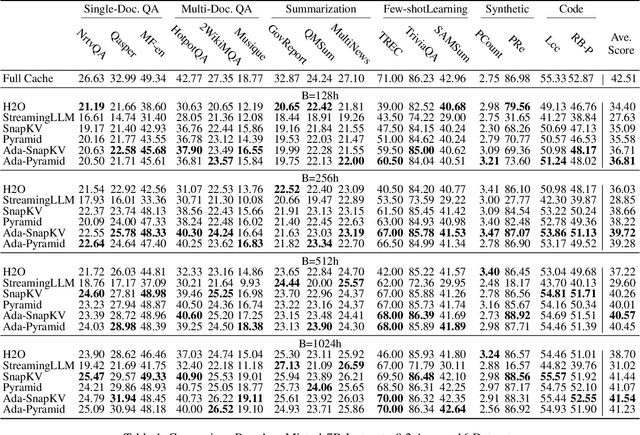
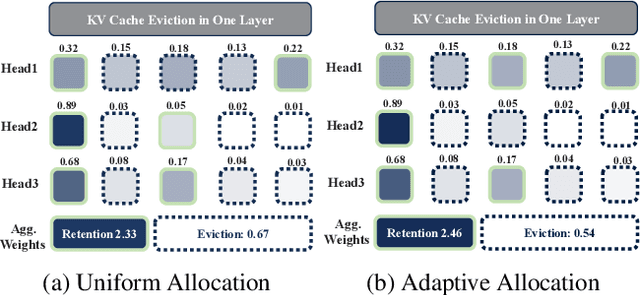
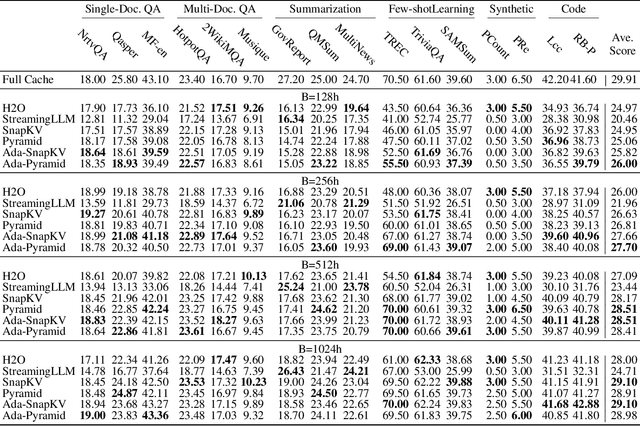
Large Language Models have excelled in various fields but encounter efficiency limitations due to the extensive KV cache required for long sequences inference. Many efforts try to evict non-critical cache elements during runtime, thereby reducing cache size within a given memory budget while preserving generation quality. Our reexamination of their underlying principles discerns that prevailing strategies essentially aim to minimize an upper bound of eviction loss within a specific budget allocation. However, we observe that the current practice of uniformly allocating budgets across different attention heads during the eviction procedure tends to degrade the quality of generation posten-eviction. In light of these findings, we propose a simple yet effective adaptive allocation algorithm that not only theoretically ensures its loss upper bound does not exceed that of previous uniform allocation methods, but also effectively aligns with the characteristics of the self-attention mechanism, thus practically reducing the upper bound. Further, integrating this algorithm with two of the most advanced methods yields Ada-SnapKV and Ada-Pyramid. Extensive experimental validation across 16 datasets and the Needle-in-a-Haystack test confirm that Ada-SnapKV and Ada-Pyramid achieve further enhancements, establishing new benchmarks in state-of-the-art performance.