 Add to Chrome
 Add to Firefox
 Add to Edge
PoLAR: Factorizing Extent and Mode in Latent Actions for Robot Policy Learning
Jun 19, 2026
Latent action pretraining learns representations of visual change from pairs of observations, but existing methods typically encode each transition as a single unstructured representation that entangles transition extent and transition mode. We introduce Polar Latent Actions with Radial structure (PoLAR), which imposes a radial-direction structure on latent actions, encouraging radius to encode transition extent and direction to retain transition mode. PoLAR uses temporal offset between two observations as a weak proxy for transition extent, encouraging latent action from observation pairs separated by larger temporal gaps to occupy larger radii. We instantiate this structure in hyperbolic space, whose expanding volume with radius offers a natural fit for more diverse transition modes at larger extents. Across in-task and large-scale pretraining settings, PoLAR improves downstream policy performance in simulation and real-world robot experiments, outperforming latent action baselines and strong pretrained VLAs. These results suggest that the geometry of the latent action space is an important design choice for transferring visual pretraining to downstream robot policy learning.

Uncovering Vulnerability of Vision-Language-Action Models under Joint-Level Physical Faults
Jun 09, 2026Deploying Vision-Language-Action (VLA) models in real robotic systems requires robustness not only to semantic and perceptual variations, but also to embodiment-side faults that change how actions are physically realized. Real robots can experience joint-level changes caused by actuator degradation, hardware faults, safety limits, collision damage, or wear-induced friction. These faults are critical because they alter the action-to-motion interface of a policy, disrupting the learned closed-loop relationship between commanded actions, realized motion, and subsequent observations. In this work, we study realistic joint-level physical faults and show that VLA models are vulnerable when predicted actions are executed through a perturbed robot body. Our analysis reveals joint-dependent effects, with heterogeneous degradation in task success across affected joints. We also show that performance drops cannot be attributed solely to physical infeasibility, since feasible faults such as increased joint friction can still substantially reduce success rates and induce closed-loop execution mismatch. Motivated by these findings, we propose Joint-level Physical-fault Aware Residual Calibrator (J-PARC), a lightweight residual calibration framework built on top of a frozen VLA policy. J-PARC infers a latent joint-fault regime from recent joint dynamics and conditions a shared residual calibrator on this regime, enabling adaptive action correction across faulty joints. Experiments show that J-PARC improves robustness under joint-level faults while preserving fault-free environment performance.
Learning to Act Robustly with View-Invariant Latent Actions
Jan 06, 2026Vision-based robotic policies often struggle with even minor viewpoint changes, underscoring the need for view-invariant visual representations. This challenge becomes more pronounced in real-world settings, where viewpoint variability is unavoidable and can significantly disrupt policy performance. Existing methods typically learn invariance from multi-view observations at the scene level, but such approaches rely on visual appearance and fail to incorporate the physical dynamics essential for robust generalization. We propose View-Invariant Latent Action (VILA), which models a latent action capturing transition patterns across trajectories to learn view-invariant representations grounded in physical dynamics. VILA aligns these latent actions across viewpoints using an action-guided objective based on ground-truth action sequences. Experiments in both simulation and the real world show that VILA-based policies generalize effectively to unseen viewpoints and transfer well to new tasks, establishing VILA as a strong pretraining framework that improves robustness and downstream learning performance.
Object-Centric World Model for Language-Guided Manipulation
Mar 08, 2025A world model is essential for an agent to predict the future and plan in domains such as autonomous driving and robotics. To achieve this, recent advancements have focused on video generation, which has gained significant attention due to the impressive success of diffusion models. However, these models require substantial computational resources. To address these challenges, we propose a world model leveraging object-centric representation space using slot attention, guided by language instructions. Our model perceives the current state as an object-centric representation and predicts future states in this representation space conditioned on natural language instructions. This approach results in a more compact and computationally efficient model compared to diffusion-based generative alternatives. Furthermore, it flexibly predicts future states based on language instructions, and offers a significant advantage in manipulation tasks where object recognition is crucial. In this paper, we demonstrate that our latent predictive world model surpasses generative world models in visuo-linguo-motor control tasks, achieving superior sample and computation efficiency. We also investigate the generalization performance of the proposed method and explore various strategies for predicting actions using object-centric representations.
Spatial Semantic Embedding Network: Fast 3D Instance Segmentation with Deep Metric Learning
Jul 07, 2020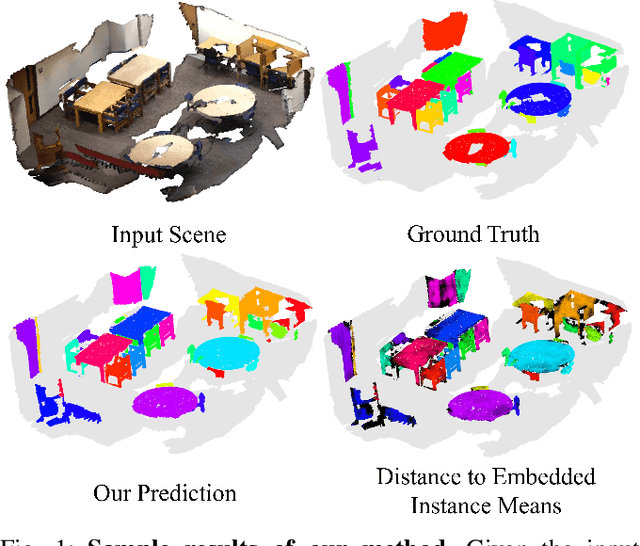
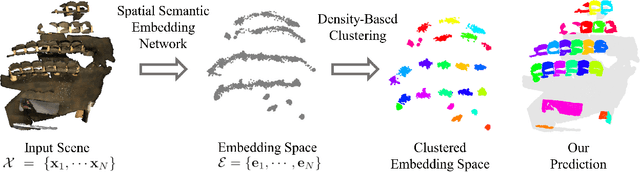
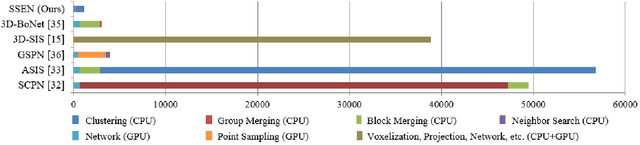
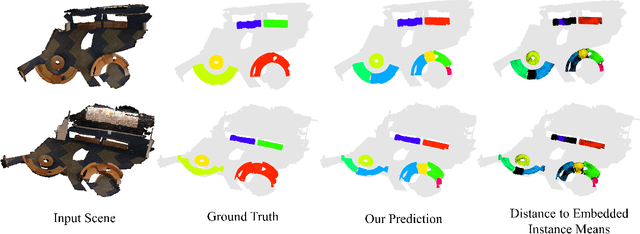
We propose spatial semantic embedding network (SSEN), a simple, yet efficient algorithm for 3D instance segmentation using deep metric learning. The raw 3D reconstruction of an indoor environment suffers from occlusions, noise, and is produced without any meaningful distinction between individual entities. For high-level intelligent tasks from a large scale scene, 3D instance segmentation recognizes individual instances of objects. We approach the instance segmentation by simply learning the correct embedding space that maps individual instances of objects into distinct clusters that reflect both spatial and semantic information. Unlike previous approaches that require complex pre-processing or post-processing, our implementation is compact and fast with competitive performance, maintaining scalability on large scenes with high resolution voxels. We demonstrate the state-of-the-art performance of our algorithm in the ScanNet 3D instance segmentation benchmark on AP score.