 Add to Chrome
 Add to Firefox
 Add to Edge
Geometric Reconstruction of Extrinsic Contact Trajectories using Tactile Sensing and Proprioception for Tool Manipulation
Jun 20, 2026
Tactile sensing enables robots to perceive rich contact information at the grasp, supporting tasks such as object recognition, in-hand pose estimation, and slip detection. However, in many tool-mediated manipulation tasks, the interaction that determines task success occurs at the tool tip, away from the tactile sensor, making direct sensing of tool-environment contact difficult, particularly when the contact moves during interaction. In this work, we reconstruct the trajectory of extrinsic tool-tip contact using tactile sensing and robot proprioception. We formulate tool-tip trajectory reconstruction as a geometric inference problem under a single-point contact assumption. Our method first estimates the global tool-tip contact location from a calibration segment designed to approximate fixed-point behavior, and then reconstructs the full trajectory by composing relative tool motion estimated from tactile marker observations under continuous contact. Across n=51 trials with multiple trajectories, tools, wrist poses, and grasp configurations, the proposed pipeline achieves a trajectory RMSE of 8.59 +/- 2.41 mm in the world frame and a shape RMSE of 5.96 +/- 1.16 mm, while operating online at 14.00 +/- 4.11 Hz. Overall, the results show that extrinsic tool-tip trajectory geometry can be recovered consistently from grasp-level tactile sensing, with trajectory shape remaining stable across variations in tools, wrist poses, and grasp configurations.

EIT-Pneumatic Hybrid Robotic Skin for Practical and Accurate Force Map Reconstruction
May 27, 2026We present a hybrid robotic skin that combines electrical impedance tomography (EIT) with pneumatic tactile sensing to improve force reconstruction capability. The developed robotic skin is fabricated entirely by 3D printing and spray coating, making it affordable and easy to build. A Tikhonov-regularized inverse reconstruction, paired with per-pad pneumatic calibration, enables accurate large-area tactile sensing with a simple measurement scheme. For validation, we conducted load-cell indentation experiments; the results showed consistent force reconstruction across locations within a pad. Compared with an EIT-only baseline, sensitivity non-uniformity was also reduced, with the coefficient of variation decreasing from 0.31 to 0.14, indicating that the proposed approach addresses a longstanding limitation of EIT. We further demonstrated chest-mounted integration on a humanoid robot and found that the pneumatic signals remained reliable across diverse contact scenarios, including multiple simultaneous contacts on the same sensing pad. These results indicate a practical path toward accurate, scalable whole-body tactile sensing in real robotic systems.
Unsupervised Sim-to-Real Adaptation of Soft Robot Proprioception using a Dual Cross-modal Autoencoder
Oct 21, 2023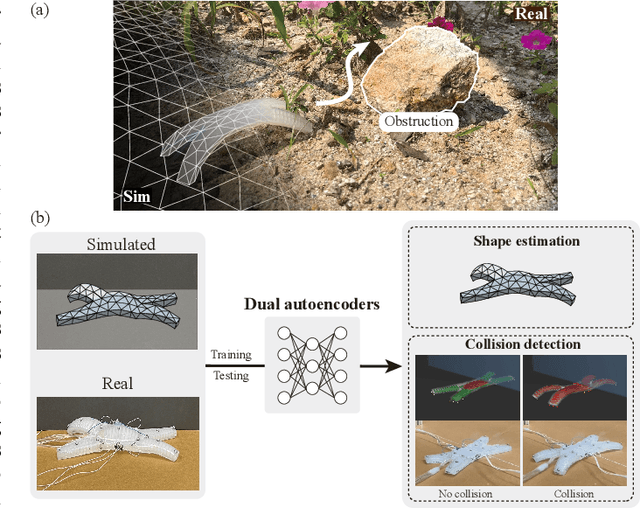
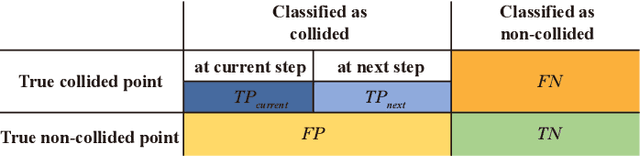
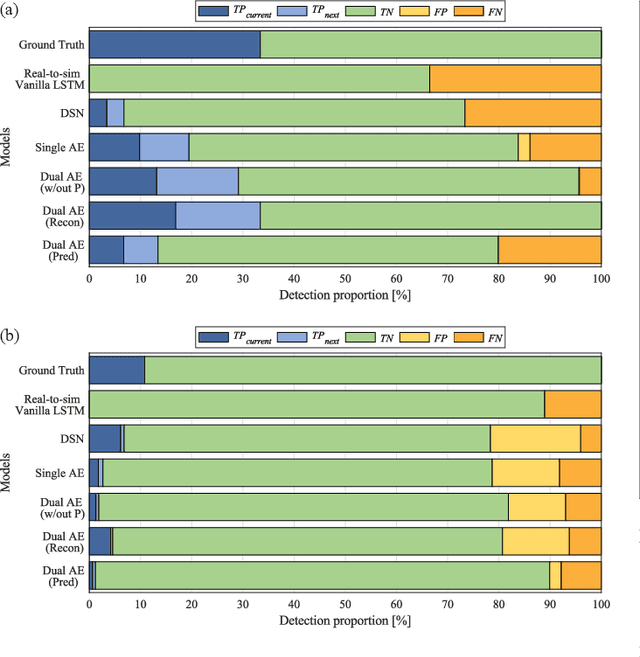
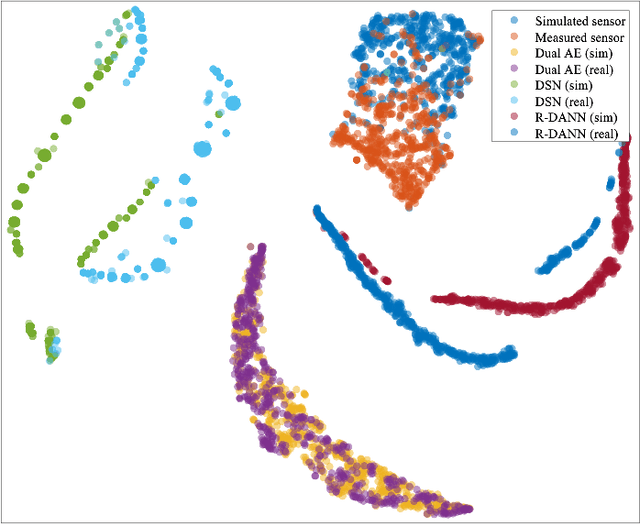
Soft robotics is a modern robotic paradigm for performing dexterous interactions with the surroundings via morphological flexibility. The desire for autonomous operation requires soft robots to be capable of proprioception and makes it necessary to devise a calibration process. These requirements can be greatly benefited by adopting numerical simulation for computational efficiency. However, the gap between the simulated and real domains limits the accurate, generalized application of the approach. Herein, we propose an unsupervised domain adaptation framework as a data-efficient, generalized alignment of these heterogeneous sensor domains. A dual cross-modal autoencoder was designed to match the sensor domains at a feature level without any extensive labeling process, facilitating the computationally efficient transferability to various tasks. As a proof-of-concept, the methodology was adopted to the famous soft robot design, a multigait soft robot, and two fundamental perception tasks for autonomous robot operation, involving high-fidelity shape estimation and collision detection. The resulting perception demonstrates the digital-twinned calibration process in both the simulated and real domains. The proposed design outperforms the existing prevalent benchmarks for both perception tasks. This unsupervised framework envisions a new approach to imparting embodied intelligence to soft robotic systems via blending simulation.