 Add to Chrome
 Add to Firefox
 Add to Edge
Preserving Long-Tailed Expert Information in Mixture-of-Experts Tuning
Apr 24, 2026
Despite MoE models leading many benchmarks, supervised fine-tuning (SFT) for the MoE architectures remains difficult because its router layers are fragile. Methods such as DenseMixer and ESFT mitigate router collapse with dense mixing or auxiliary load-balancing losses, but these introduce noisy gradients that often degrade performance. In preliminary experiments, we systematically pruned experts and observed that while certain super experts are activated far more frequently, discarding less used experts still leads to notable performance degradation. This suggests that even rarely activated experts encode non-trivial knowledge useful for downstream tasks. Motivated by this, we propose an auxiliary-loss-free MoE SFT framework that combines bias-driven sparsification with always-active gated condenser experts. Rather than enforcing balanced activation across all experts, our method encourages task-relevant experts to remain active while pushing long-tailed experts toward inactivity. The condenser experts provide a persistent, learnable pathway that alleviates gradient starvation and facilitates consolidation of information that would otherwise remain fragmented across sparsely activated experts. Analysis further suggest that this design better preserves long-tailed expert information under sparse routing. Experiments on large-scale MoE models demonstrate that our approach outperforms state-of-the-art SFT baselines such as DenseMixer and ESFT, achieving average gain of 2.5%+ on both mathematical reasoning and commonsenseQA benchmarks.

Sparse Matrix in Large Language Model Fine-tuning
May 30, 2024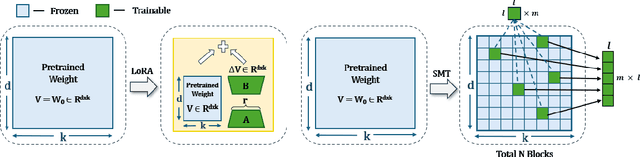
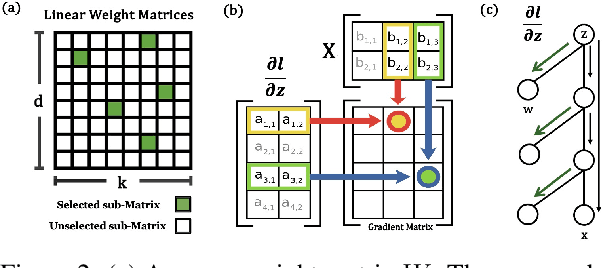
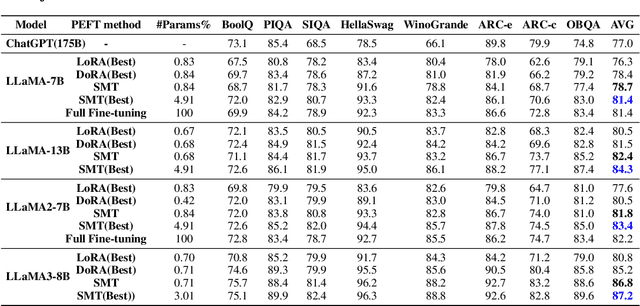
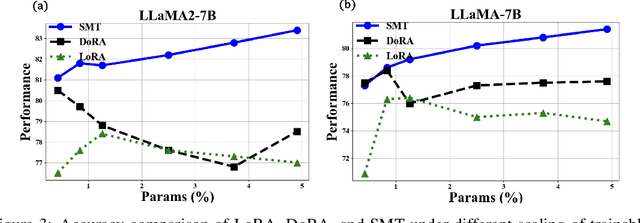
LoRA and its variants have become popular parameter-efficient fine-tuning (PEFT) methods due to their ability to avoid excessive computational costs. However, an accuracy gap often exists between PEFT methods and full fine-tuning (FT), and this gap has yet to be systematically studied. In this work, we introduce a method for selecting sparse sub-matrices that aim to minimize the performance gap between PEFT vs. full fine-tuning (FT) while also reducing both fine-tuning computational cost and memory cost. Our Sparse Matrix Tuning (SMT) method begins by identifying the most significant sub-matrices in the gradient update, updating only these blocks during the fine-tuning process. In our experiments, we demonstrate that SMT consistently surpasses other PEFT baseline (e.g. LoRA and DoRA) in fine-tuning popular large language models such as LLaMA across a broad spectrum of tasks, while reducing the GPU memory footprint by 67% compared to FT. We also examine how the performance of LoRA and DoRA tends to plateau and decline as the number of trainable parameters increases, in contrast, our SMT method does not suffer from such issue.