 Add to Chrome
 Add to Firefox
 Add to Edge
Manipulation-Proof Oblivious Audits against Deceptive Model Providers
Aug 05, 2026
Audits have emerged as a critical instrument for algorithmic governance, providing a mechanism for external scrutiny and governance of machine learning models. However, ensuring the integrity of such assessments remains a challenging issue. For instance in regulatory contexts, audits are typically declared or easily detected, thus enabling model providers to manipulate the process, whether intentionally or inadvertently. This vulnerability is particularly acute in the context of fairness evaluations, in which providers can often infer sensitive attributes and strategically equalize allocation rates between groups to satisfy fairness metrics. In this paper, we introduce a novel audit protocol designed to significantly increase the post-audit detectability of such manipulations by enabling the auditor to query the model in an oblivious manner. Our approach leverages a Private Information Retrieval mechanism to require the provider to label a large set of instances, while preventing it from knowing which subset will ultimately be used for the audit. The protocol is efficient, imposes minimal overhead on the auditor, and requires no modification to the audited model, its training procedure, or its inference pipeline. We provide theoretical guarantees showing that, under this protocol, a provider attempting to hide unfairness must falsify a significantly larger number of responses, thereby increasing both the difficulty and the likelihood of detection of manipulation. Experimental results across representative audit scenarios confirm the effectiveness and practicality of our approach.

Trustworthy Machine Learning through the Lens of Combinatorial Optimization: Survey and Research Perspectives
Jul 08, 2026Modern machine learning (ML) increasingly relies on complex models whose behavior is difficult to characterize beyond empirical performance metrics. Across a wide range of tasks, including prediction, generation, and decision-making, models with similar empirical performance can exhibit markedly different properties in terms of their transparency, interpretability, robustness, fairness, privacy, and certifiability. This survey highlights how optimization- and certification-oriented reasoning can provide a useful framework for reasoning about such differences, supporting tasks ranging from model training and selection to auditing and certification. We review and synthesize recent advances at the intersection of combinatorial optimization (CO) and trustworthy ML, covering both training and post-training tasks, including interpretable model learning, explanation generation, robustness analysis, fairness auditing, model compression, and privacy attacks and protections. Across these domains, CO formulations offer additional capabilities over purely heuristic approaches, e.g., gradient-based ones, notably global guarantees, formal certificates, and explicit treatment of trade-offs. While scalability remains an important challenge, continued progress in solvers and hybrid algorithms suggests a growing role for CO in the design and deployment of trustworthy ML systems.
When Interpretability Is Unequally Distributed: Fairness in Hybrid Interpretable Models
May 27, 2026Hybrid interpretable models combine a transparent component with a black-box model by assigning some examples to the former and deferring the rest to the latter. While this design enables flexible tradeoffs between accuracy and interpretability, it also raises a distinct procedural fairness concern: some demographic groups may systematically receive interpretable decisions, while others are disproportionately routed to a black box. We formalize this issue as Interpretability Coverage Disparity (ICD), a demographic-parity-style measure applied to the routing decision of hybrid interpretable models. Using tools from predictive multiplicity, we study ICD across four hybrid interpretable learning methods, three standard fairness benchmark datasets, and multiple sensitive attributes. Our experiments reveal substantial ICD in intermediate transparency regimes, where both the interpretable and black-box components are actively used. We further show that simple coverage-disparity constraints can significantly reduce ICD in exact hybrid learning methods, with marginal impact on accuracy and sparsity. In several settings, ICD mitigation also improves standard algorithmic fairness metrics. These results show that hybrid interpretable models should be audited not only for predictive fairness, but also for how they allocate interpretability across individuals and groups.
Optimal Counterfactual Search in Tree Ensembles: A Study Across Modeling and Solution Paradigms
May 07, 2026Trust in counterfactual explanations depends critically on whether their recommended changes are truly minimal: suboptimal explanations may vastly overshoot the actual changes needed to alter a decision, and heuristic errors can affect individuals unevenly, giving some users relevant recourse while assigning others unnecessarily costly recommendations. Consequently, we study the problem of computing optimal counterfactual explanations for tree ensembles under plausibility and actionability constraints. This is a combinatorial problem: for a fixed model, counterfactual search boils down to selecting consistent branching decisions and threshold-defined regions under a distance objective. We exploit this structure through CPCF, a constraint programming (CP) formulation in which numerical features are encoded as interval domains induced by split thresholds, while discrete features retain native finite-domain representations. This yields a compact finite-domain formulation that supports multiple distance objectives without continuous split-boundary search. We then place CPCF in a broader comparison across mathematical programming paradigms: we extend a maximum Boolean satisfiability (MaxSAT) formulation, originally designed for hard-voting random forests, to soft-voting ensembles, and compare against the current state-of-the-art mixed-integer linear programming (MILP) optimal approach. Across ten datasets and three types of tree ensembles, we analyze scalability, anytime performance, and sensitivity to distance metrics. We observe that CP achieves the best overall performance. More importantly, our results identify regimes in which the specific strengths of each paradigm make it best suited: CP is most versatile overall, MaxSAT handles hard-voting ensembles particularly well, and MILP remains competitive in amortized inference settings with a moderate number of split levels.
PACE: Prune-And-Compress Ensemble Models
May 07, 2026Ensemble models achieve state-of-the-art performance on prediction tasks, but usually require aggregating a large number of weak learners. This can hinder deployment, interpretability, and downstream tasks such as robustness verification. Remedies to this issue fall into two main camps: pruning, which discards redundant learners, and compression, which generates new ones from scratch. We introduce PACE, a framework that interleaves these paradigms in a two-phase strategy. First, new learners are actively generated via a theoretically grounded procedure to enhance the diversity of the initial ensemble. When no more relevant learners can be found, a second phase of pruning is performed on this enriched ensemble. During both operations, PACE allows fine control on the faithfulness to the original ensemble. Experiments show that our method outperforms prior pruning and compression methods while offering principled control of faithfulness guarantees.
Counterfactual Maps: What They Are and How to Find Them
Feb 09, 2026Counterfactual explanations are a central tool in interpretable machine learning, yet computing them exactly for complex models remains challenging. For tree ensembles, predictions are piecewise constant over a large collection of axis-aligned hyperrectangles, implying that an optimal counterfactual for a point corresponds to its projection onto the nearest rectangle with an alternative label under a chosen metric. Existing methods largely overlook this geometric structure, relying either on heuristics with no optimality guarantees or on mixed-integer programming formulations that do not scale to interactive use. In this work, we revisit counterfactual generation through the lens of nearest-region search and introduce counterfactual maps, a global representation of recourse for tree ensembles. Leveraging the fact that any tree ensemble can be compressed into an equivalent partition of labeled hyperrectangles, we cast counterfactual search as the problem of identifying the generalized Voronoi cell associated with the nearest rectangle of an alternative label. This leads to an exact, amortized algorithm based on volumetric k-dimensional (KD) trees, which performs branch-and-bound nearest-region queries with explicit optimality certificates and sublinear average query time after a one-time preprocessing phase. Our experimental analyses on several real datasets drawn from high-stakes application domains show that this approach delivers globally optimal counterfactual explanations with millisecond-level latency, achieving query times that are orders of magnitude faster than existing exact, cold-start optimization methods.
Fairness and Sparsity within Rashomon sets: Enumeration-Free Exploration and Characterization
Feb 07, 2025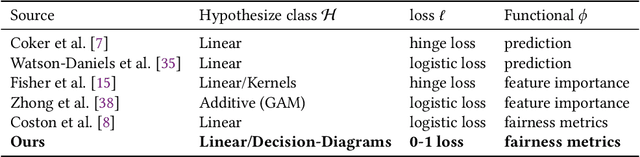
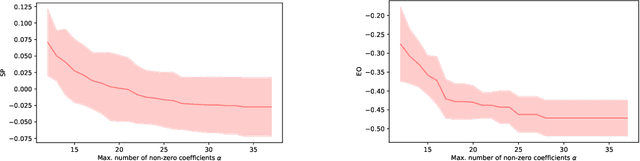
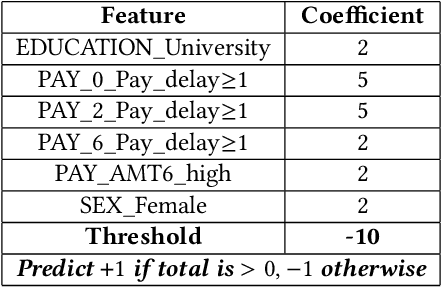
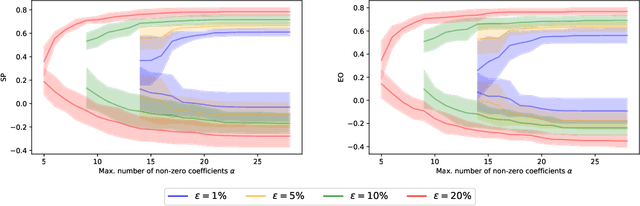
We introduce an enumeration-free method based on mathematical programming to precisely characterize various properties such as fairness or sparsity within the set of "good models", known as Rashomon set. This approach is generically applicable to any hypothesis class, provided that a mathematical formulation of the model learning task exists. It offers a structured framework to define the notion of business necessity and evaluate how fairness can be improved or degraded towards a specific protected group, while remaining within the Rashomon set and maintaining any desired sparsity level. We apply our approach to two hypothesis classes: scoring systems and decision diagrams, leveraging recent mathematical programming formulations for training such models. As seen in our experiments, the method comprehensively and certifiably quantifies trade-offs between predictive performance, sparsity, and fairness. We observe that a wide range of fairness values are attainable, ranging from highly favorable to significantly unfavorable for a protected group, while staying within less than 1% of the best possible training accuracy for the hypothesis class. Additionally, we observe that sparsity constraints limit these trade-offs and may disproportionately harm specific subgroups. As we evidenced, thoroughly characterizing the tensions between these key aspects is critical for an informed and accountable selection of models.
From Counterfactuals to Trees: Competitive Analysis of Model Extraction Attacks
Feb 07, 2025The advent of Machine Learning as a Service (MLaaS) has heightened the trade-off between model explainability and security. In particular, explainability techniques, such as counterfactual explanations, inadvertently increase the risk of model extraction attacks, enabling unauthorized replication of proprietary models. In this paper, we formalize and characterize the risks and inherent complexity of model reconstruction, focusing on the "oracle'' queries required for faithfully inferring the underlying prediction function. We present the first formal analysis of model extraction attacks through the lens of competitive analysis, establishing a foundational framework to evaluate their efficiency. Focusing on models based on additive decision trees (e.g., decision trees, gradient boosting, and random forests), we introduce novel reconstruction algorithms that achieve provably perfect fidelity while demonstrating strong anytime performance. Our framework provides theoretical bounds on the query complexity for extracting tree-based model, offering new insights into the security vulnerabilities of their deployment.
Training Set Reconstruction from Differentially Private Forests: How Effective is DP?
Feb 07, 2025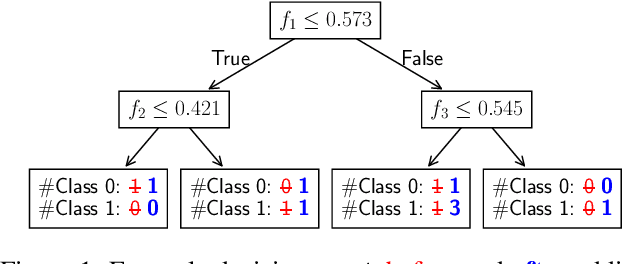
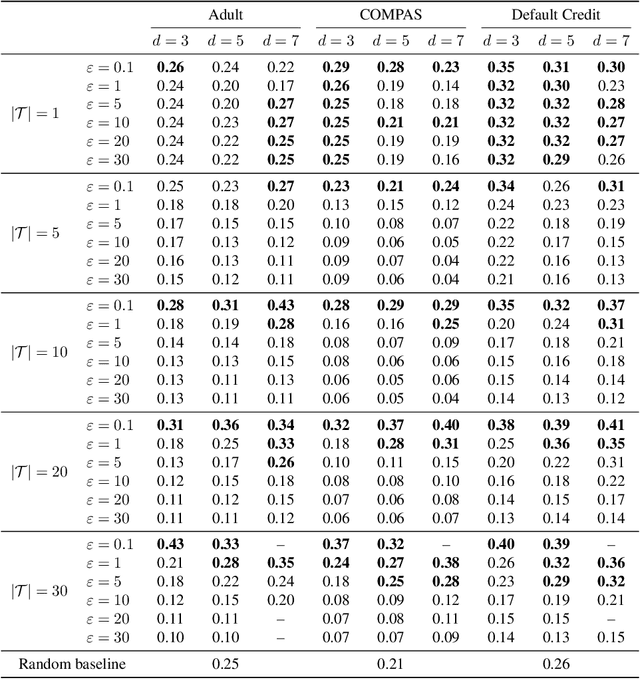
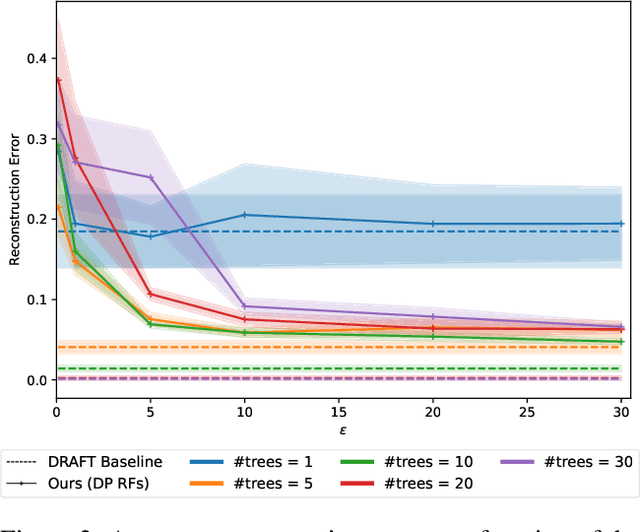
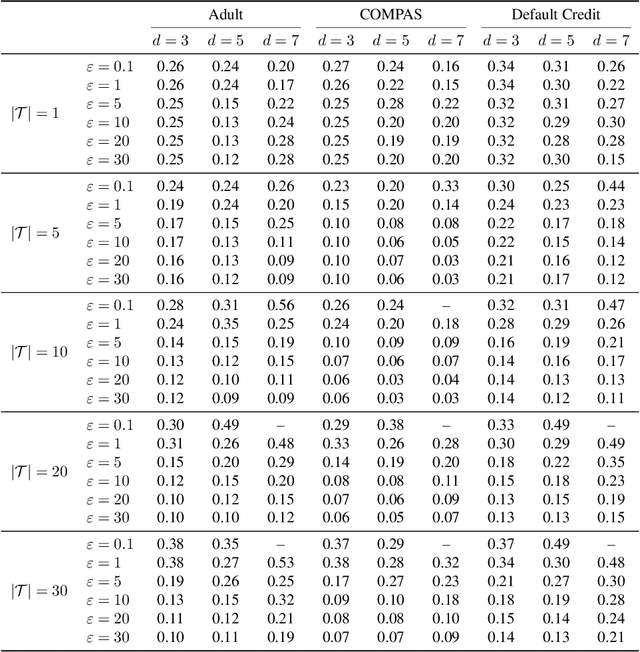
Recent research has shown that machine learning models are vulnerable to privacy attacks targeting their training data. Differential privacy (DP) has become a widely adopted countermeasure, as it offers rigorous privacy protections. In this paper, we introduce a reconstruction attack targeting state-of-the-art $\varepsilon$-DP random forests. By leveraging a constraint programming model that incorporates knowledge of the forest's structure and DP mechanism characteristics, our approach formally reconstructs the most likely dataset that could have produced a given forest. Through extensive computational experiments, we examine the interplay between model utility, privacy guarantees, and reconstruction accuracy across various configurations. Our results reveal that random forests trained with meaningful DP guarantees can still leak substantial portions of their training data. Specifically, while DP reduces the success of reconstruction attacks, the only forests fully robust to our attack exhibit predictive performance no better than a constant classifier. Building on these insights, we provide practical recommendations for the construction of DP random forests that are more resilient to reconstruction attacks and maintain non-trivial predictive performance.
Smooth Sensitivity for Learning Differentially-Private yet Accurate Rule Lists
Mar 18, 2024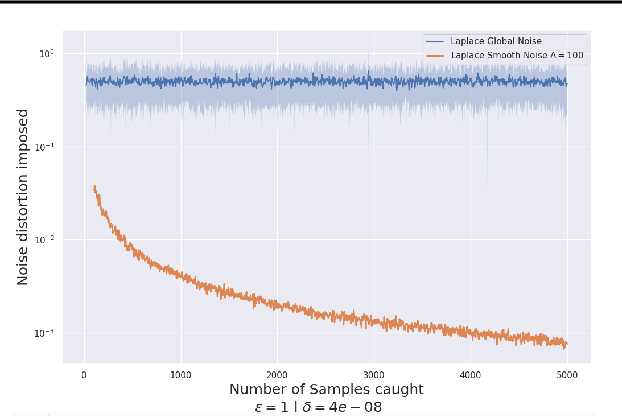
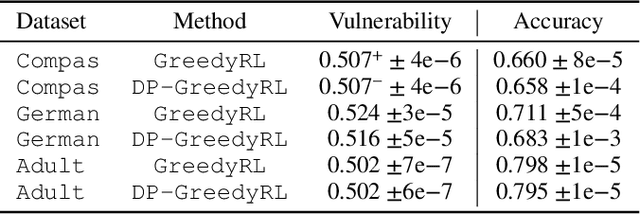
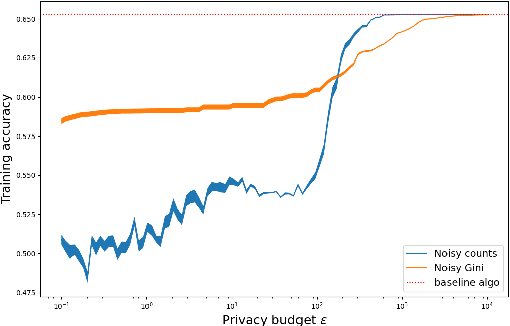
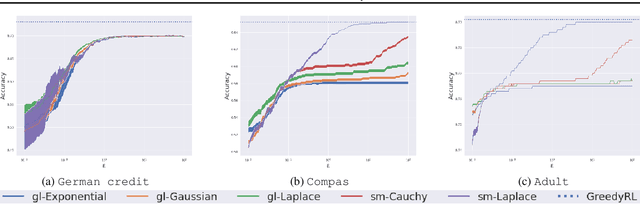
Differentially-private (DP) mechanisms can be embedded into the design of a machine learningalgorithm to protect the resulting model against privacy leakage, although this often comes with asignificant loss of accuracy. In this paper, we aim at improving this trade-off for rule lists modelsby establishing the smooth sensitivity of the Gini impurity and leveraging it to propose a DP greedyrule list algorithm. In particular, our theoretical analysis and experimental results demonstrate thatthe DP rule lists models integrating smooth sensitivity have higher accuracy that those using otherDP frameworks based on global sensitivity.