 Add to Chrome
 Add to Firefox
 Add to Edge
Dense Soft Weighting for Radar Ego-Velocity Estimation
Jul 29, 2026
Sensing ego-velocity estimation is fundamental to state estimation in visually degraded environments, where camera- and LiDAR-based pipelines can become unreliable. Millimetre-wave radar is well suited to these conditions because it provides direct Doppler velocity sensing and remains robust to poor illumination, textureless scenes, and airborne particulates. However, conventional radar ego-velocity pipelines typically apply constant false alarm rate (CFAR) thresholding to convert dense radar spectra into sparse point clouds, prematurely discarding sub-threshold returns that may still retain useful Doppler motion cues. We present Dense Soft Weighting, an analytic radar front-end that maps every range-Doppler cell to a continuous confidence metric rather than enforcing a binary detection threshold. Ego-velocity is then estimated using a deterministic robust weighted least-squares formulation, while the same weighted measurements provide a closed-form, measurement-derived velocity covariance for integration with a shared inertial back-end. The method requires no platform-specific training data or learning-based uncertainty model, supporting transfer across single-chip radar configurations. Across two public datasets and one self-collected dataset, Dense Soft Weighting reduces mean absolute pose error by 31-45% relative to the strongest CFAR point-cloud baseline under an identical inertial back-end, while running in real time on embedded hardware.

Dual-Security for Indoor OFDM-ISAC Systems via Temporal Artificial Noise
Jul 17, 2026With the rapid development of integrated sensing and communication (ISAC) as a key enabler for future wireless networks, ensuring the security of both communication and sensing functions has become increasingly important. Current secure ISAC studies focus restrictively either on the communication or the sensing security, but not both. To bridge this gap, this paper investigates security for both, i.e., dual-security, in indoor orthogonal frequency division multiplexing (OFDM) based ISAC systems. Specifically, we consider a scenario in which a sensing user (SU) is authorised for sensing but may eavesdrop on communication data, while a communication user (CU) is authorised for communication but may perform unauthorised sensing. We chose this scenario as the pathological case where an authorised eavesdropper has more information and is more effective than an unauthorised one. To address this case, we propose the use of temporal artificial noise (AN) to prevent malicious CU sensing by enlarging its time-domain sensing error, and simultaneously degrade SU data eavesdropping by reducing its frequency-domain signal-to-noise-plus-interference ratio (SINR) with standard OFDM receiver processing. Meanwhile, our proposed scheme guarantees the sensing performance of the SU and the communication performance of the CU. We present numerical results that demonstrate AN can effectively provide dual protection for sensing and communication in OFDM-ISAC systems while guaranteeing the performance of legitimate users.
GenHPE: Generative Counterfactuals for 3D Human Pose Estimation with Radio Frequency Signals
Mar 12, 2025
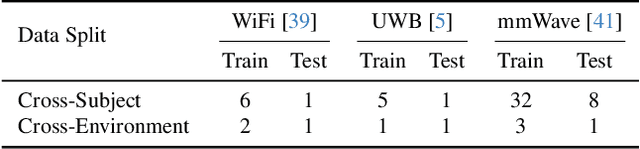
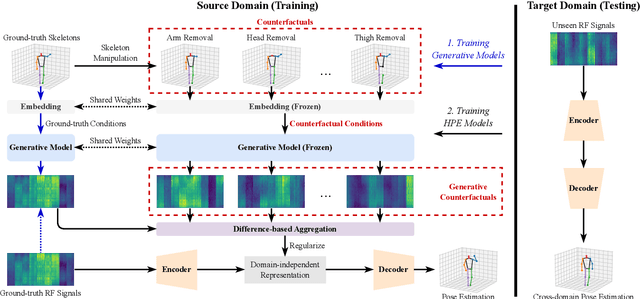
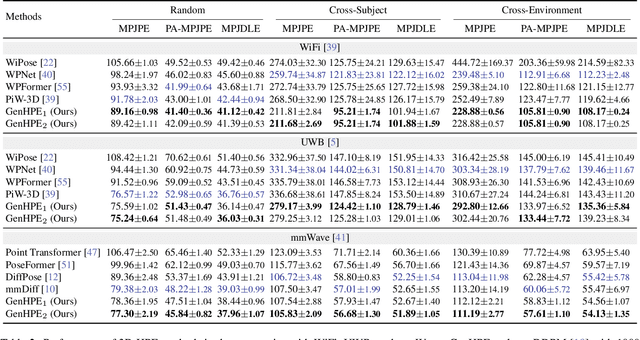
Human pose estimation (HPE) detects the positions of human body joints for various applications. Compared to using cameras, HPE using radio frequency (RF) signals is non-intrusive and more robust to adverse conditions, exploiting the signal variations caused by human interference. However, existing studies focus on single-domain HPE confined by domain-specific confounders, which cannot generalize to new domains and result in diminished HPE performance. Specifically, the signal variations caused by different human body parts are entangled, containing subject-specific confounders. RF signals are also intertwined with environmental noise, involving environment-specific confounders. In this paper, we propose GenHPE, a 3D HPE approach that generates counterfactual RF signals to eliminate domain-specific confounders. GenHPE trains generative models conditioned on human skeleton labels, learning how human body parts and confounders interfere with RF signals. We manipulate skeleton labels (i.e., removing body parts) as counterfactual conditions for generative models to synthesize counterfactual RF signals. The differences between counterfactual signals approximately eliminate domain-specific confounders and regularize an encoder-decoder model to learn domain-independent representations. Such representations help GenHPE generalize to new subjects/environments for cross-domain 3D HPE. We evaluate GenHPE on three public datasets from WiFi, ultra-wideband, and millimeter wave. Experimental results show that GenHPE outperforms state-of-the-art methods and reduces estimation errors by up to 52.2mm for cross-subject HPE and 10.6mm for cross-environment HPE.
RFTacho: Non-intrusive RF monitoring of rotating machines
Feb 20, 2022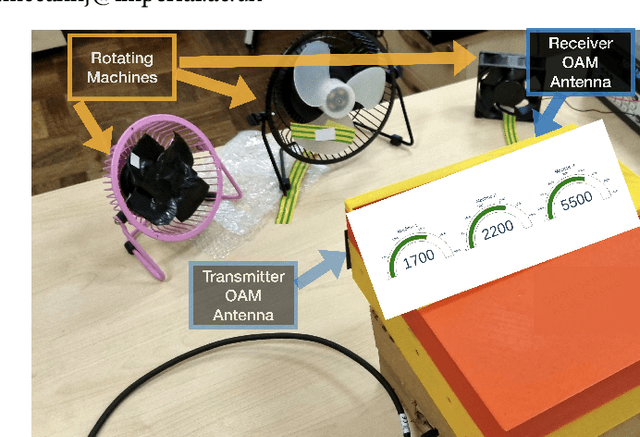
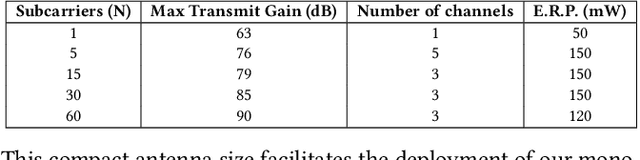
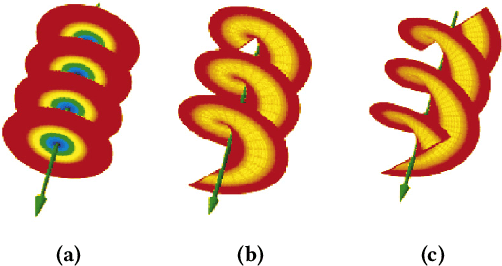
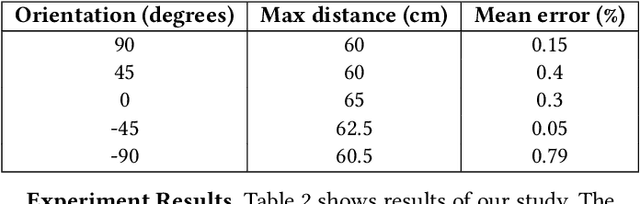
Measuring rotation speed is essential to many engineering applications; it elicits faults undetectable by vibration monitoring alone and enhances the vibration signal analysis of rotating machines. Optical, magnetic or mechanical Tachometers are currently state-of-art. Their limitations are they require line-of-sight, direct access to the rotating object. This paper proposes RFTacho, a rotation speed measurement \emph{system} that leverages novel hardware and signal processing algorithms to produce highly accurate readings conveniently. RFTacho uses RF Orbital Angular Momentum (OAM) waves to measure rotation speed of multiple machines simultaneously with no requirements from the machine's properties. OAM antennas allow it to operate in high-scattering environments, commonly found in industries, as they are resilient to de-polarization compared to linearly polarized antennas. RFTacho achieves this by using two novel signal processing algorithms to extract the rotation speed of several rotating objects simultaneously amidst noise arising from high-scattering environments, non-line-of-sight scenarios and dynamic environmental conditions with a resolution of $1 rpm$. We test RFTacho on several real-world machines like fans, motors, air conditioners. Results show that RFTacho has avg. error of $<0.5\%$ compared to ground truth. We demonstrate RFTacho's simultaneous multiple-object measurement capability that other tachometers do not have. Initial experiments show that RFTacho can measure speeds as high as 7000 rpm (theoretically 60000 rpm) with high resiliency at different coverage distances and orientation angles, requiring only 150 mW transmit power while operating in the 5 GHz license-exempt band. RFTacho is the first RF-based sensing system that combines OAM waves and novel processing approaches to measure the rotation speed of multiple machines simultaneously in a non-intrusive way.
Resource Allocation for NOMA-based LPWA Networks Powered by Energy Harvesting
Dec 29, 2020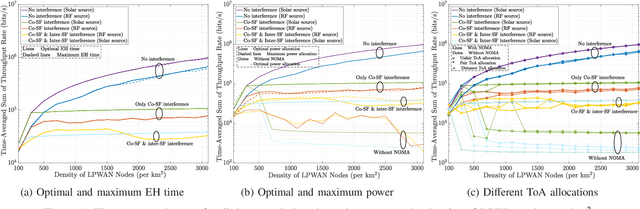
In this paper, we explore perpetual, scalable, Low-powered Wide-area networks (LPWA). Specifically we focus on the uplink transmissions of non-orthogonal multiple access (NOMA)-based LPWA networks consisting of multiple self-powered nodes and a NOMA-based single gateway. The self-powered LPWA nodes use the "harvest-then-transmit" protocol where they harvest energy from ambient sources (solar and radio frequency signals), then transmit their signals. The main features of the studied LPWA network are different transmission times-on-air, multiple uplink transmission attempts, and duty cycle restrictions. The aim of this work is to maximize the time-averaged sum of the uplink transmission rates by optimizing the transmission time-on-air allocation, the energy harvesting time allocation and the power allocation; subject to a maximum transmit power and to the availability of the harvested energy. We propose a low complex solution which decouples the optimization problem into three sub-problems: we assign the LPWA node transmission times (using either the fair or unfair approaches), we optimize the energy harvesting (EH) times using a one-dimensional search method, and optimize the transmit powers using a concave-convex (CCCP) procedure. In the simulation results, we focus on Long Range (LoRa) networks as a practical example LPWA network. We validate our proposed solution and we observe a $15\%$ performance improvement when using NOMA.