 Add to Chrome
 Add to Firefox
 Add to Edge
OncoSynth: Synthetic data generation for treatment effect estimation in oncology
Jun 24, 2026
In oncology, access to patient-level data is often restricted. Synthetic data provides an alternative for analyzing treatment effectiveness, but existing methods for synthetic data generation fail to preserve the causal relationships between covariates, treatments, and outcomes, thereby leading to biased estimates of treatment effects. Here, we introduce OncoSynth, a generative, causally-aware machine learning framework designed to produce synthetic cohorts that enable accurate estimation of population- and patient-level treatment effects. OncoSynth uses a diffusion-based sequential approach to model how covariates influence treatment assignment and how treatment affects survival. We evaluate OncoSynth using large lung (N = 37,128) and breast cancer (N = 17,046) cohorts. Our results show that OncoSynth generates high-fidelity synthetic patient cohorts that preserve real-world patient, treatment, and outcome distributions. Notably, OncoSynth improves treatment effect estimation over existing approaches, by reducing population-level treatment effect error by up to 66%, and patient-level treatment effect error by up to 58%. Thereby, OncoSynth supports reliable evidence generation for precision oncology in settings where data sharing is restricted.

Convolutional Differentiable Logic Gate Networks
Nov 07, 2024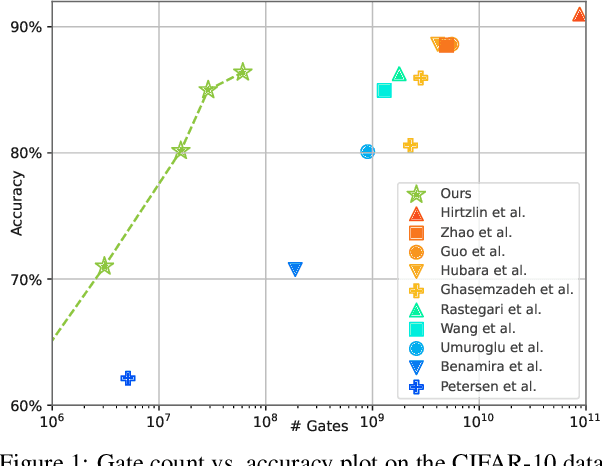


With the increasing inference cost of machine learning models, there is a growing interest in models with fast and efficient inference. Recently, an approach for learning logic gate networks directly via a differentiable relaxation was proposed. Logic gate networks are faster than conventional neural network approaches because their inference only requires logic gate operators such as NAND, OR, and XOR, which are the underlying building blocks of current hardware and can be efficiently executed. We build on this idea, extending it by deep logic gate tree convolutions, logical OR pooling, and residual initializations. This allows scaling logic gate networks up by over one order of magnitude and utilizing the paradigm of convolution. On CIFAR-10, we achieve an accuracy of 86.29% using only 61 million logic gates, which improves over the SOTA while being 29x smaller.