 Add to Chrome
 Add to Firefox
 Add to Edge
Scalable Multi-Agent Maze Traversal with Local Communication
Aug 12, 2026
Cave networks, pipe systems, and similar maze-like environments pose significant challenges for multi-agent navigation in unknown settings with limited communication. We propose a distributed algorithm that enables agents to collectively traverse an unknown, possibly cyclic graph. Agents enter sequentially at a designated start node and are tasked to localize and reach an undisclosed goal while avoiding collisions. They coordinate via local communication using leader-follower relationships and leader switching. At any moment in time, exploration is performed by only one of the agents, which runs a single-agent maze solver. We prove that the algorithm is complete, that its makespan is asymptotically equivalent (in the number of agents) to that of an optimal full-knowledge strategy, and derive its time and space complexity. Simulations with up to $625$ agents show a decreasing average sum-of-fuels as the number of agents increases and demonstrate that the proposed approach outperforms a naïve baseline in which all agents independently execute the single-agent solver.

Design for One, Deploy for Many: Navigating Tree Mazes with Multiple Agents
Oct 30, 2025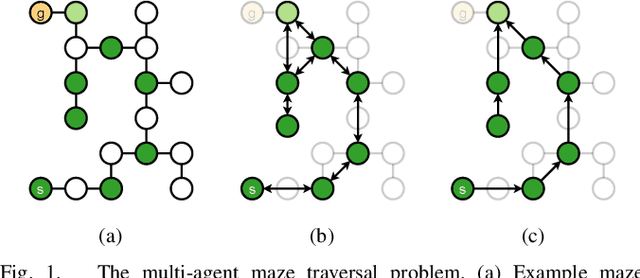
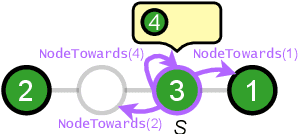
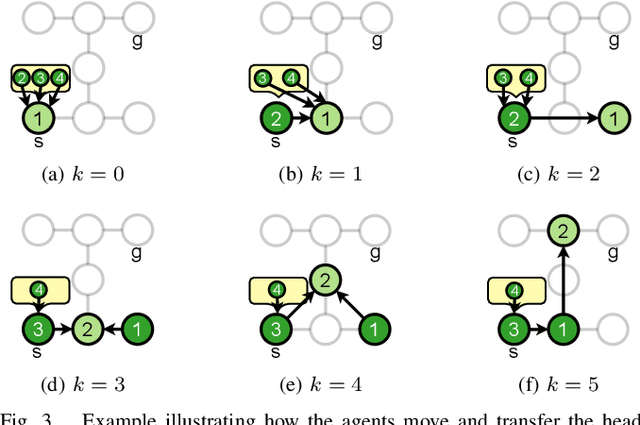
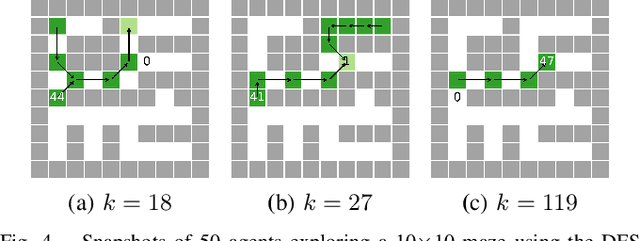
Maze-like environments, such as cave and pipe networks, pose unique challenges for multiple robots to coordinate, including communication constraints and congestion. To address these challenges, we propose a distributed multi-agent maze traversal algorithm for environments that can be represented by acyclic graphs. It uses a leader-switching mechanism where one agent, assuming a head role, employs any single-agent maze solver while the other agents each choose an agent to follow. The head role gets transferred to neighboring agents where necessary, ensuring it follows the same path as a single agent would. The multi-agent maze traversal algorithm is evaluated in simulations with groups of up to 300 agents, various maze sizes, and multiple single-agent maze solvers. It is compared against strategies that are na\"ive, or assume either global communication or full knowledge of the environment. The algorithm outperforms the na\"ive strategy in terms of makespan and sum-of-fuel. It is superior to the global-communication strategy in terms of makespan but is inferior to it in terms of sum-of-fuel. The findings suggest it is asymptotically equivalent to the full-knowledge strategy with respect to either metric. Moreover, real-world experiments with up to 20 Pi-puck robots confirm the feasibility of the approach.