 Add to Chrome
 Add to Firefox
 Add to Edge
PiG-Avatar: Hierarchical Neural-Field-Guided Gaussian Avatars
May 20, 2026
Existing Gaussian avatar methods typically parameterize geometry on a body-template surface, which entangles the avatar's representation space with the template's deformation space and limits the capture of layered, off-body, and non-rigid clothing geometry. We present PiG-Avatar, which addresses this limitation by using the parametric body model solely for kinematic transport, while representing the avatar as Gaussians anchored in a volumetric canonical space governed by a continuous neural field. This decouples representation from template topology, avoiding the geometric constraints of surface-based parameterizations. Kinematic coherence is maintained through 3D barycentric anchor transport, which guides motion without constraining geometry and allows anchors to deviate freely from the template surface, yielding dense, stable temporal surface correspondences by construction. To make this unconstrained formulation tractable, we introduce dual-level spatially coherent optimization, combining Sobolev-preconditioned neural-field updates with a novel KNN-based preconditioning of canonical anchor geometry. Together, these mechanisms induce an emergent self-organization of anchor density: anchors migrate toward regions of high curvature, appearance variation, and non-coherent motion without explicit heuristics. As a result, complex clothing geometry and layered surfaces emerge as natural, high-fidelity outputs. This single representation further supports hierarchical reconstruction across multiple levels of detail, with coarse-level supervision propagating to finer levels through the shared field and coupled anchor graph. On established benchmarks featuring subjects with complex clothing and challenging non-rigid motion, PiG-Avatar achieves state-of-the-art rendering quality, generalizes robustly to imperfect body model initialization, and renders in real time across all detail levels.

Neu-PiG: Neural Preconditioned Grids for Fast Dynamic Surface Reconstruction on Long Sequences
Feb 25, 2026Temporally consistent surface reconstruction of dynamic 3D objects from unstructured point cloud data remains challenging, especially for very long sequences. Existing methods either optimize deformations incrementally, risking drift and requiring long runtimes, or rely on complex learned models that demand category-specific training. We present Neu-PiG, a fast deformation optimization method based on a novel preconditioned latent-grid encoding that distributes spatial features parameterized on the position and normal direction of a keyframe surface. Our method encodes entire deformations across all time steps at various spatial scales into a multi-resolution latent grid, parameterized by the position and normal direction of a reference surface from a single keyframe. This latent representation is then augmented for time modulation and decoded into per-frame 6-DoF deformations via a lightweight multilayer perceptron (MLP). To achieve high-fidelity, drift-free surface reconstructions in seconds, we employ Sobolev preconditioning during gradient-based training of the latent space, completely avoiding the need for any explicit correspondences or further priors. Experiments across diverse human and animal datasets demonstrate that Neu-PiG outperforms state-the-art approaches, offering both superior accuracy and scalability to long sequences while running at least 60x faster than existing training-free methods and achieving inference speeds on the same order as heavy pretrained models.
ROSA: Reconstructing Object Shape and Appearance Textures by Adaptive Detail Transfer
Jan 30, 2025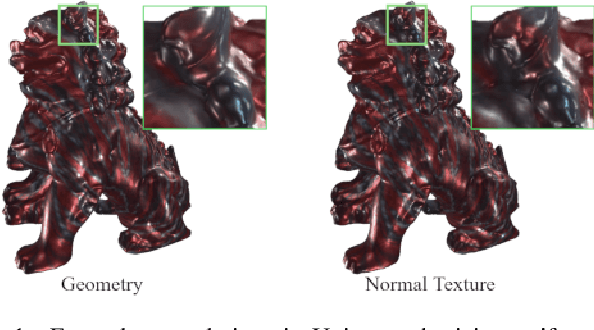
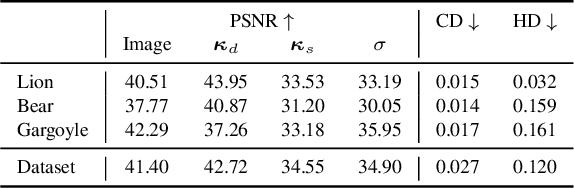
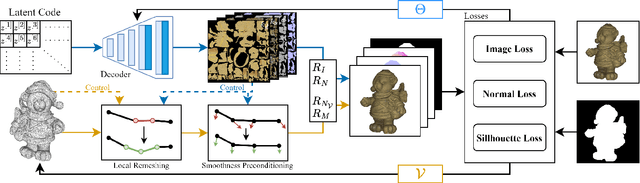
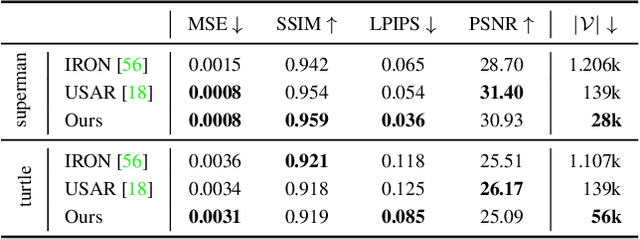
Reconstructing an object's shape and appearance in terms of a mesh textured by a spatially-varying bidirectional reflectance distribution function (SVBRDF) from a limited set of images captured under collocated light is an ill-posed problem. Previous state-of-the-art approaches either aim to reconstruct the appearance directly on the geometry or additionally use texture normals as part of the appearance features. However, this requires detailed but inefficiently large meshes, that would have to be simplified in a post-processing step, or suffers from well-known limitations of normal maps such as missing shadows or incorrect silhouettes. Another limiting factor is the fixed and typically low resolution of the texture estimation resulting in loss of important surface details. To overcome these problems, we present ROSA, an inverse rendering method that directly optimizes mesh geometry with spatially adaptive mesh resolution solely based on the image data. In particular, we refine the mesh and locally condition the surface smoothness based on the estimated normal texture and mesh curvature. In addition, we enable the reconstruction of fine appearance details in high-resolution textures through a pioneering tile-based method that operates on a single pre-trained decoder network but is not limited by the network output resolution.