 Add to Chrome
 Add to Firefox
 Add to Edge
First-Order Trajectory Matching: Fast Ensemble Predictions of Chaotic, Turbulent, Stochastic Systems
Jun 09, 2026
We introduce First-Order Trajectory Matching (FTM), a surrogate-modeling method that learns the first-order local transport of probability mass from trajectories of stochastic systems. By matching the symmetric first-order motion of trajectories, FTM learns the probability current velocity, whose flow preserves time marginals to match ensemble averages, while also capturing current-like trajectory quantities such as fluxes, circulations, and barrier-crossing currents. FTM learns the current velocity directly from trajectories, avoiding drift, diffusion, and score estimation. Our stability analysis separates discretization error from sampling variance and shows that the one-step simulation-free FTM loss is stable when temporal resolution and sample size are properly balanced. Across stochastic dynamical systems and PDE examples, we empirically demonstrate that FTM provides trajectory-aware ensemble predictions at low, deterministic-rollout cost.

Stochastic Lifting for Generating Trajectories of Stochastic Physical Systems
May 28, 2026Many stochastic physical systems evolve smoothly over time in the sense that the distribution of states changes regularly across time steps. The transition from current state to the next state can often be modeled as the combination of a smooth map and an explicit source of randomness. Stochastic Lifting exploits this structure by attaching an independent, high-dimensional random label to each state transition in the training data and fitting a transition map from the current state and label to the next state using a standard regression loss. The labels act as auxiliary coordinates that let the model represent multiple plausible next states from similar current states, avoiding collapse to a mean prediction in the finite-sample size regime. At inference, fresh labels are sampled at each time step and the learned map is rolled forward autoregressively, generating diverse trajectories with a single network evaluation per time step.
Leveraging Gauge Freedom for Learning Non-Gradient Population Dynamics of Stochastic Systems
May 24, 2026Existing work on population dynamics inference often focuses on flows arising from vector fields that are the gradients of scalar potentials. Among all admissible flows that are compatible with the population dynamics, gradient flows are optimal in a specific sense: they minimize kinetic energy. The selection of fields based on different criteria corresponds to a gauge freedom when determining population dynamics, which we leverage in this work. We propose Non-Gradient Inference Flows (NGIF), an algorithm to infer non-gradient population dynamics using a weak formulation of the continuity equation. This allows us to parameterize general vector fields and choose other selection criteria beyond minimal kinetic energy. We demonstrate on a variety of low- and high-dimensional physics problems that this more general approach improves distributional accuracy over gradient-restricted baselines and better captures non-potential transport.
Hankel Singular Value Regularization for Highly Compressible State Space Models
Oct 27, 2025Deep neural networks using state space models as layers are well suited for long-range sequence tasks but can be challenging to compress after training. We use that regularizing the sum of Hankel singular values of state space models leads to a fast decay of these singular values and thus to compressible models. To make the proposed Hankel singular value regularization scalable, we develop an algorithm to efficiently compute the Hankel singular values during training iterations by exploiting the specific block-diagonal structure of the system matrices that is we use in our state space model parametrization. Experiments on Long Range Arena benchmarks demonstrate that the regularized state space layers are up to 10$\times$ more compressible than standard state space layers while maintaining high accuracy.
Parametric model reduction of mean-field and stochastic systems via higher-order action matching
Oct 15, 2024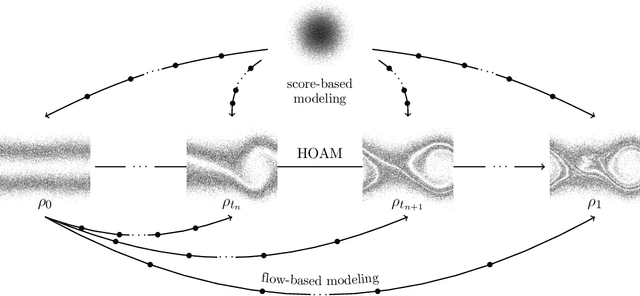
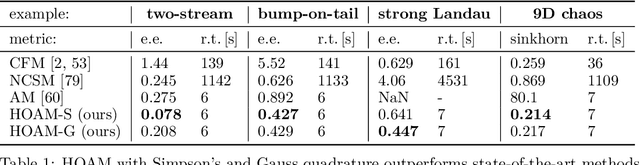
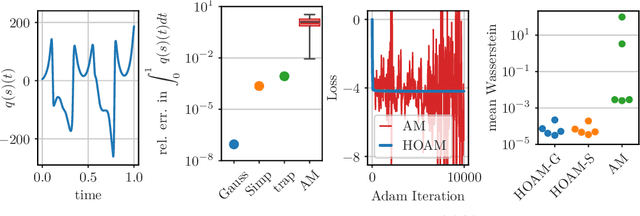
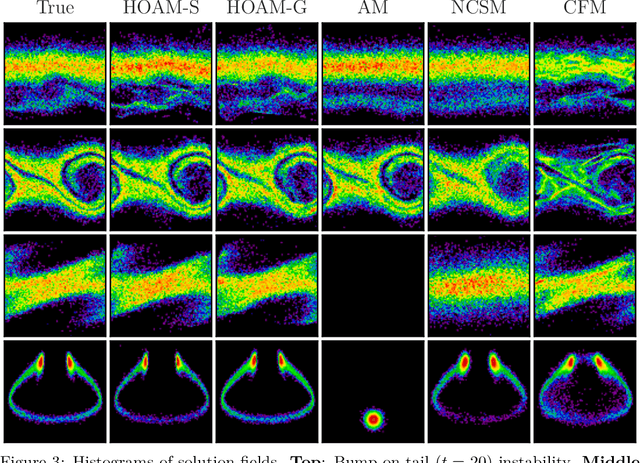
The aim of this work is to learn models of population dynamics of physical systems that feature stochastic and mean-field effects and that depend on physics parameters. The learned models can act as surrogates of classical numerical models to efficiently predict the system behavior over the physics parameters. Building on the Benamou-Brenier formula from optimal transport and action matching, we use a variational problem to infer parameter- and time-dependent gradient fields that represent approximations of the population dynamics. The inferred gradient fields can then be used to rapidly generate sample trajectories that mimic the dynamics of the physical system on a population level over varying physics parameters. We show that combining Monte Carlo sampling with higher-order quadrature rules is critical for accurately estimating the training objective from sample data and for stabilizing the training process. We demonstrate on Vlasov-Poisson instabilities as well as on high-dimensional particle and chaotic systems that our approach accurately predicts population dynamics over a wide range of parameters and outperforms state-of-the-art diffusion-based and flow-based modeling that simply condition on time and physics parameters.
CoLoRA: Continuous low-rank adaptation for reduced implicit neural modeling of parameterized partial differential equations
Feb 22, 2024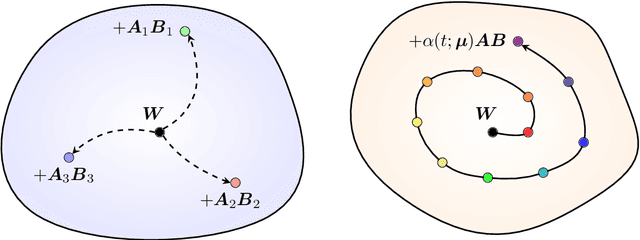
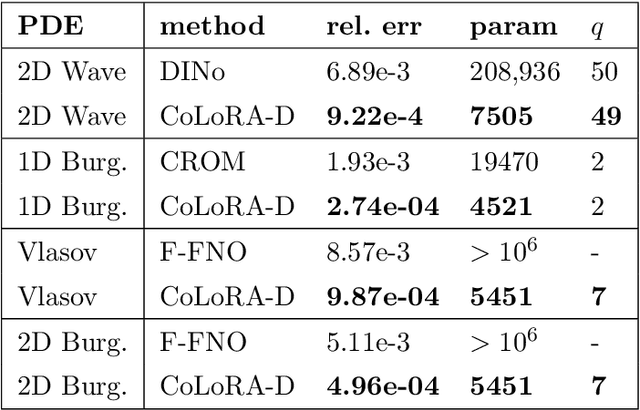

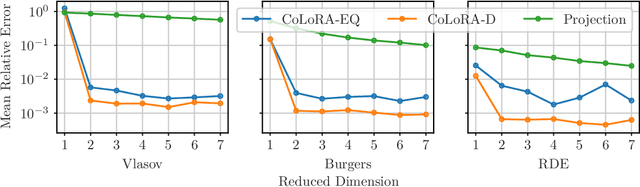
This work introduces reduced models based on Continuous Low Rank Adaptation (CoLoRA) that pre-train neural networks for a given partial differential equation and then continuously adapt low-rank weights in time to rapidly predict the evolution of solution fields at new physics parameters and new initial conditions. The adaptation can be either purely data-driven or via an equation-driven variational approach that provides Galerkin-optimal approximations. Because CoLoRA approximates solution fields locally in time, the rank of the weights can be kept small, which means that only few training trajectories are required offline so that CoLoRA is well suited for data-scarce regimes. Predictions with CoLoRA are orders of magnitude faster than with classical methods and their accuracy and parameter efficiency is higher compared to other neural network approaches.
Neuronal Temporal Filters as Normal Mode Extractors
Jan 06, 2024To generate actions in the face of physiological delays, the brain must predict the future. Here we explore how prediction may lie at the core of brain function by considering a neuron predicting the future of a scalar time series input. Assuming that the dynamics of the lag vector (a vector composed of several consecutive elements of the time series) are locally linear, Normal Mode Decomposition decomposes the dynamics into independently evolving (eigen-)modes allowing for straightforward prediction. We propose that a neuron learns the top mode and projects its input onto the associated subspace. Under this interpretation, the temporal filter of a neuron corresponds to the left eigenvector of a generalized eigenvalue problem. We mathematically analyze the operation of such an algorithm on noisy observations of synthetic data generated by a linear system. Interestingly, the shape of the temporal filter varies with the signal-to-noise ratio (SNR): a noisy input yields a monophasic filter and a growing SNR leads to multiphasic filters with progressively greater number of phases. Such variation in the temporal filter with input SNR resembles that observed experimentally in biological neurons.
Nonlinear embeddings for conserving Hamiltonians and other quantities with Neural Galerkin schemes
Oct 11, 2023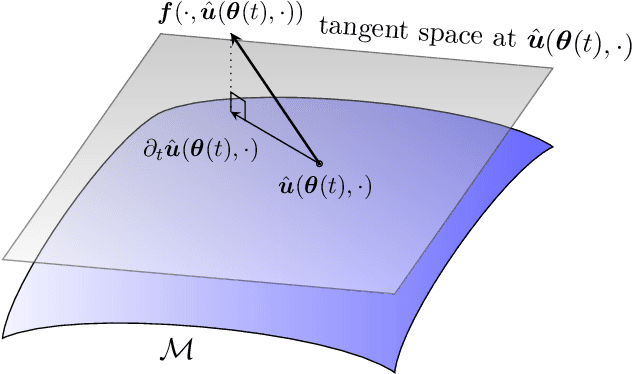
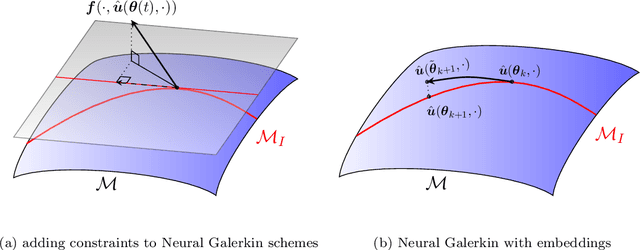
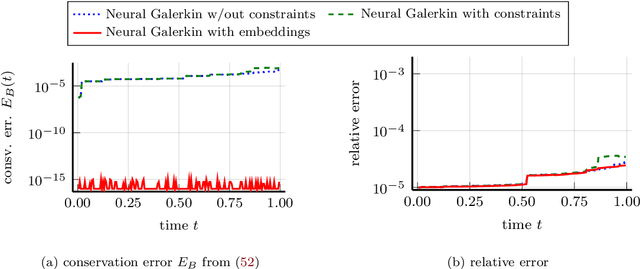
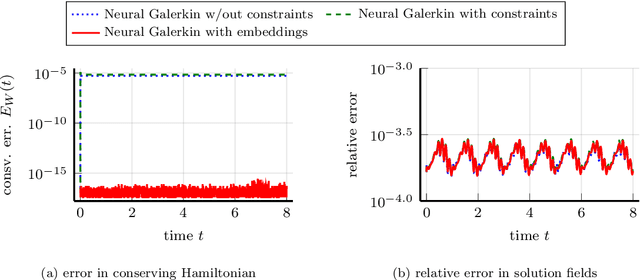
This work focuses on the conservation of quantities such as Hamiltonians, mass, and momentum when solution fields of partial differential equations are approximated with nonlinear parametrizations such as deep networks. The proposed approach builds on Neural Galerkin schemes that are based on the Dirac--Frenkel variational principle to train nonlinear parametrizations sequentially in time. We first show that only adding constraints that aim to conserve quantities in continuous time can be insufficient because the nonlinear dependence on the parameters implies that even quantities that are linear in the solution fields become nonlinear in the parameters and thus are challenging to discretize in time. Instead, we propose Neural Galerkin schemes that compute at each time step an explicit embedding onto the manifold of nonlinearly parametrized solution fields to guarantee conservation of quantities. The embeddings can be combined with standard explicit and implicit time integration schemes. Numerical experiments demonstrate that the proposed approach conserves quantities up to machine precision.
Randomized Sparse Neural Galerkin Schemes for Solving Evolution Equations with Deep Networks
Oct 07, 2023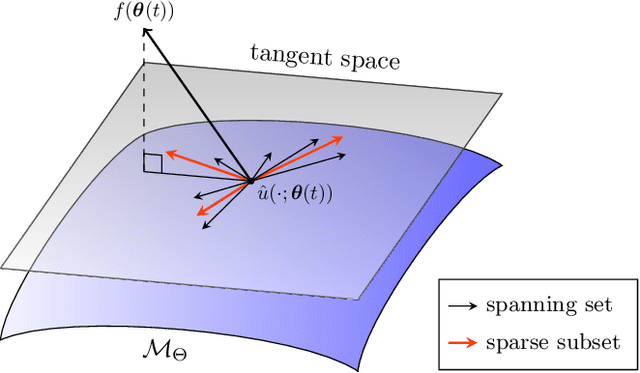
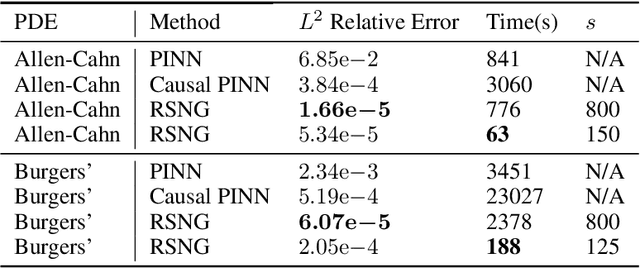
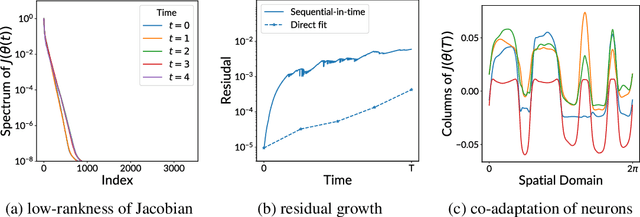
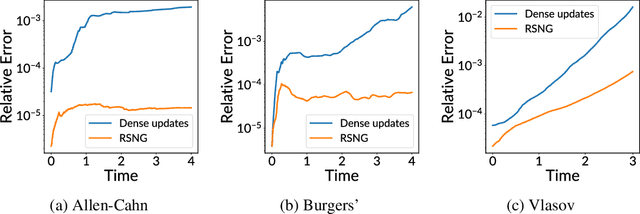
Training neural networks sequentially in time to approximate solution fields of time-dependent partial differential equations can be beneficial for preserving causality and other physics properties; however, the sequential-in-time training is numerically challenging because training errors quickly accumulate and amplify over time. This work introduces Neural Galerkin schemes that update randomized sparse subsets of network parameters at each time step. The randomization avoids overfitting locally in time and so helps prevent the error from accumulating quickly over the sequential-in-time training, which is motivated by dropout that addresses a similar issue of overfitting due to neuron co-adaptation. The sparsity of the update reduces the computational costs of training without losing expressiveness because many of the network parameters are redundant locally at each time step. In numerical experiments with a wide range of evolution equations, the proposed scheme with randomized sparse updates is up to two orders of magnitude more accurate at a fixed computational budget and up to two orders of magnitude faster at a fixed accuracy than schemes with dense updates.
Representational dissimilarity metric spaces for stochastic neural networks
Nov 21, 2022Quantifying similarity between neural representations -- e.g. hidden layer activation vectors -- is a perennial problem in deep learning and neuroscience research. Existing methods compare deterministic responses (e.g. artificial networks that lack stochastic layers) or averaged responses (e.g., trial-averaged firing rates in biological data). However, these measures of deterministic representational similarity ignore the scale and geometric structure of noise, both of which play important roles in neural computation. To rectify this, we generalize previously proposed shape metrics (Williams et al. 2021) to quantify differences in stochastic representations. These new distances satisfy the triangle inequality, and thus can be used as a rigorous basis for many supervised and unsupervised analyses. Leveraging this novel framework, we find that the stochastic geometries of neurobiological representations of oriented visual gratings and naturalistic scenes respectively resemble untrained and trained deep network representations. Further, we are able to more accurately predict certain network attributes (e.g. training hyperparameters) from its position in stochastic (versus deterministic) shape space.