 Add to Chrome
 Add to Firefox
 Add to Edge
Smartphone-based Circular Plot Sampling for Forest Inventory
May 19, 2026
Circular sample plots are a cornerstone of forest inventory, yet accurate measurement of tree diameter at breast height (DBH) and spatial location within such plots remains challenging. Conventional approaches rely either on costly terrestrial LiDAR systems or labor-intensive manual methods involving calipers and compass bearings, limiting their scalability and accessibility in large scale environments. We present a lightweight, smartphone-based pipeline that enables complete plot sampling based tree measurement from a single walkthrough video, requiring no specialized hardware beyond a consumer smartphone mounted on a portable stand. The proposed method integrates pretrained monocular depth estimation and tree instance segmentation with a simultaneous localization and mapping (SLAM) framework to jointly refine camera trajectories and depth across the video sequence. Tree positions and DBH estimates are recovered by fusing SLAM-derived camera poses with segmented depth maps, with absolute real-world scale anchored via a calibrated reference length. The system was evaluated in both managed forest plots and natural forest plot, achieving a mean absolute error of 1.51 cm (MARE 3.98%) and 2.30 cm (MARE 5.69%) respectively, with consistent performance across varying starting directions and positions. Cross-video consistency analysis further demonstrated stable and reproducible tree localization across measurements initiated from different starting positions. The proposed approach achieves accuracy comparable to established field methods while substantially reducing equipment cost and operational complexity, making it accessible to both professional researchers and non-expert forest managers in diverse operational settings.

MIRAGE: A Micro-Interaction Relational Architecture for Grounded Exploration in Multi-Figure Artworks
Apr 26, 2026Appreciating multi-figure paintings requires understanding how characters relate through subtle cues like gaze alignment, gesture, and spatial arrangement. We present MIRAGE, an evidence-centric framework designed to scaffold the exploration of these "micro-interactions" in multi-figure artworks. While such cues are essential for deep narrative appreciation, they are often distributed across complex scenes and difficult for viewers to systematically identify. Existing vision-language models (VLMs) frequently fail to provide reliable assistance, offering ungrounded interpretations that lack traceable visual evidence. MIRAGE addresses this by constructing a structured intermediate representation capturing identities, pose cues, and gaze hypotheses. However, the challenge extends beyond extracting these cues to coordinating them during interpretation. Without an explicit mechanism to organize and reconcile relational evidence, models often collapse multiple interaction hypotheses into a single unstable or weakly grounded narrative, even when low-level signals are available. This representation allows users to verify how high-level interpretations are anchored in low-level visual facts. By separating spatial grounding from narrative generation, MIRAGE enables users to inspect and reason about figure-to-figure relationships through a verifiable evidence layer. We evaluate MIRAGE against painting-only VLM baselines using a blind assessment protocol. Results show that MIRAGE significantly improves identity consistency, reduces relational hallucinations, and increases the coverage of subtle interactions. These findings suggest that structured grounding can serve as a critical interaction control layer, providing the necessary scaffolding for a more reliable, transparent, and human-led understanding of complex visual narratives.
FathomGPT: A Natural Language Interface for Interactively Exploring Ocean Science Data
Dec 03, 2024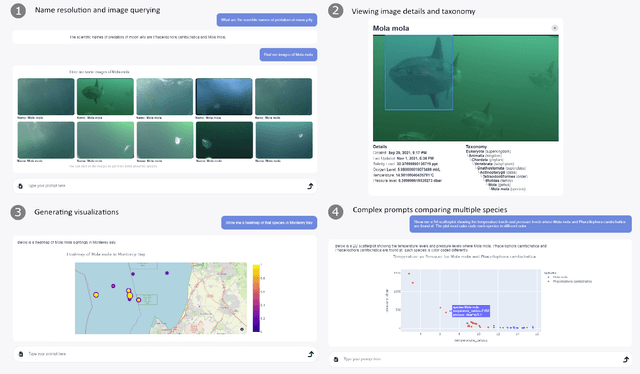
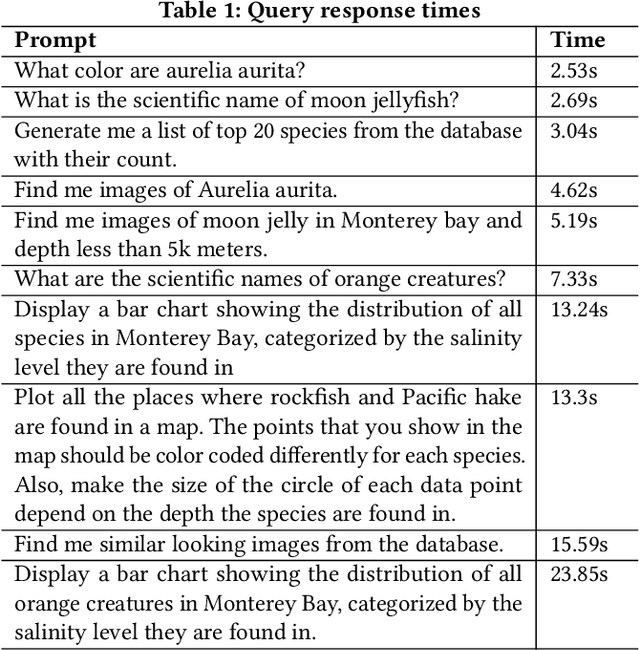
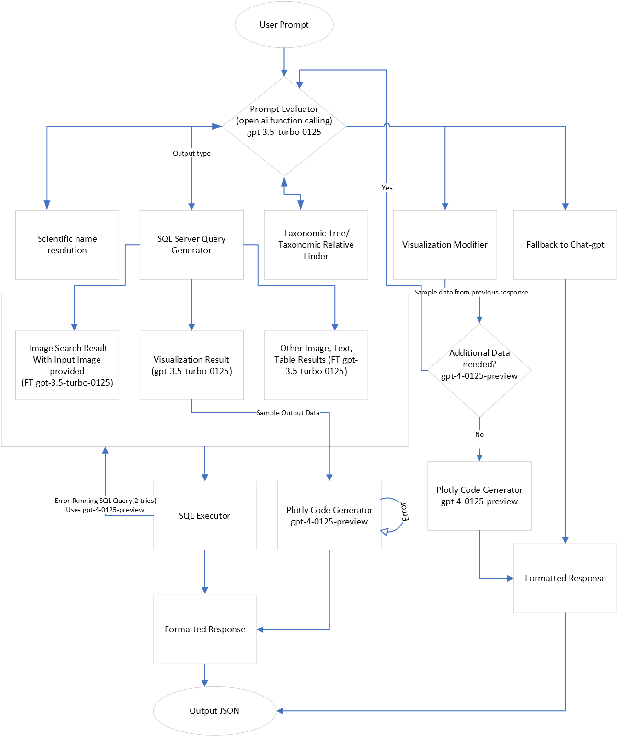
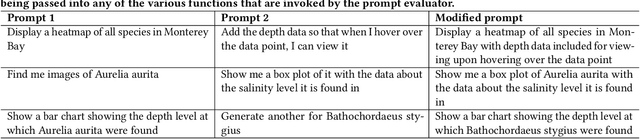
We introduce FathomGPT, an open source system for the interactive investigation of ocean science data via a natural language interface. FathomGPT was developed in close collaboration with marine scientists to enable researchers to explore and analyze the FathomNet image database. FathomGPT provides a custom information retrieval pipeline that leverages OpenAI's large language models to enable: the creation of complex queries to retrieve images, taxonomic information, and scientific measurements; mapping common names and morphological features to scientific names; generating interactive charts on demand; and searching by image or specified patterns within an image. In designing FathomGPT, particular emphasis was placed on enhancing the user's experience by facilitating free-form exploration and optimizing response times. We present an architectural overview and implementation details of FathomGPT, along with a series of ablation studies that demonstrate the effectiveness of our approach to name resolution, fine tuning, and prompt modification. We also present usage scenarios of interactive data exploration sessions and document feedback from ocean scientists and machine learning experts.
* The first two authors contributed equally to this work. Accepted to the 37th Annual ACM Symposium on User Interface Software and Technology (UIST 2024)