 Add to Chrome
 Add to Firefox
 Add to Edge
Soft Inductive Bias Approach via Explicit Reasoning Perspectives in Inappropriate Utterance Detection Using Large Language Models
Dec 09, 2025
Recent incidents in certain online games and communities, where anonymity is guaranteed, show that unchecked inappropriate remarks frequently escalate into verbal abuse and even criminal behavior, raising significant social concerns. Consequently, there is a growing need for research on techniques that can detect inappropriate utterances within conversational texts to help build a safer communication environment. Although large-scale language models trained on Korean corpora and chain-of-thought reasoning have recently gained attention, research applying these approaches to inappropriate utterance detection remains limited. In this study, we propose a soft inductive bias approach that explicitly defines reasoning perspectives to guide the inference process, thereby promoting rational decision-making and preventing errors that may arise during reasoning. We fine-tune a Korean large language model using the proposed method and conduct both quantitative performance comparisons and qualitative evaluations across different training strategies. Experimental results show that the Kanana-1.5 model achieves an average accuracy of 87.0046, improving by approximately 3.89 percent over standard supervised learning. These findings indicate that the proposed method goes beyond simple knowledge imitation by large language models and enables more precise and consistent judgments through constrained reasoning perspectives, demonstrating its effectiveness for inappropriate utterance detection.
* in Korean language, Published in the Proceedings of the 37th Annual Conference on Human and Language Technology, 2025, pp. 714-719. (English translation assisted by GPT)

SCU-CGAN: Enhancing Fire Detection through Synthetic Fire Image Generation and Dataset Augmentation
Dec 09, 2025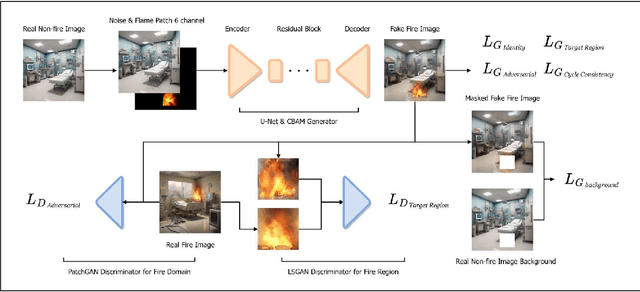

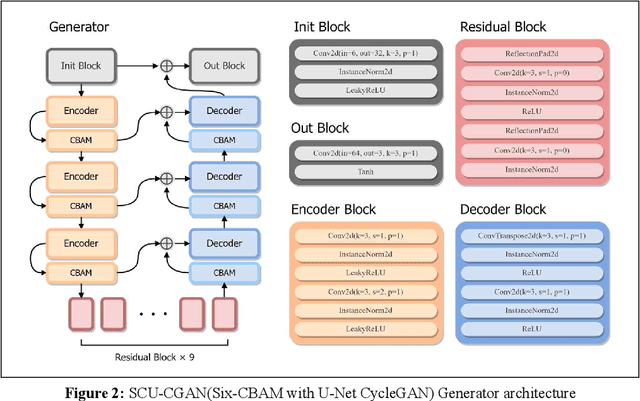
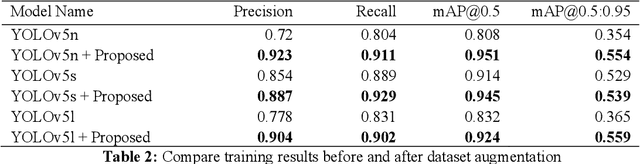
Fire has long been linked to human life, causing severe disasters and losses. Early detection is crucial, and with the rise of home IoT technologies, household fire detection systems have emerged. However, the lack of sufficient fire datasets limits the performance of detection models. We propose the SCU-CGAN model, which integrates U-Net, CBAM, and an additional discriminator to generate realistic fire images from nonfire images. We evaluate the image quality and confirm that SCU-CGAN outperforms existing models. Specifically, SCU-CGAN achieved a 41.5% improvement in KID score compared to CycleGAN, demonstrating the superior quality of the generated fire images. Furthermore, experiments demonstrate that the augmented dataset significantly improves the accuracy of fire detection models without altering their structure. For the YOLOv5 nano model, the most notable improvement was observed in the mAP@0.5:0.95 metric, which increased by 56.5%, highlighting the effectiveness of the proposed approach.
Lifetime-configurable soft robots via photodegradable silicone elastomer composites
Feb 28, 2023Developing soft robots that can control their own life-cycle and degrade on-demand while maintaining hyper-elasticity is a significant research challenge. On-demand degradable soft robots, which conserve their original functionality during operation and rapidly degrade under specific external stimulation, present the opportunity to self-direct the disappearance of temporary robots. This study proposes soft robots and materials that exhibit excellent mechanical stretchability and can degrade under ultraviolet (UV) light by mixing a fluoride-generating diphenyliodonium hexafluorophosphate (DPI-HFP) with a silicone resin. Spectroscopic analysis revealed the mechanism of Si-O-Si backbone cleavage using fluoride ion (F-), which was generated from UV exposed DPI-HFP. Furthermore, photo-differential scanning calorimetry (DSC) based thermal analysis indicated increased decomposition kinetics at increased temperatures. Additionally, we demonstrated a robotics application of this composite by fabricating a gaiting robot. The integration of soft electronics, including strain sensors, temperature sensors, and photodetectors, expanded the robotic functionalities. This study provides a simple yet novel strategy for designing lifecycle mimicking soft robotics that can be applied to reduce soft robotics waste, explore hazardous areas where retrieval of robots is impossible, and ensure hardware security with on-demand destructive material platforms.