 Add to Chrome
 Add to Firefox
 Add to Edge
HBRB-BoW: A Retrained Bag-of-Words Vocabulary for ORB-SLAM via Hierarchical BRB-KMeans
Mar 04, 2026
In visual simultaneous localization and mapping (SLAM), the quality of the visual vocabulary is fundamental to the system's ability to represent environments and recognize locations. While ORB-SLAM is a widely used framework, its binary vocabulary, trained through the k-majority-based bag-of-words (BoW) approach, suffers from inherent precision loss. The inability of conventional binary clustering to represent subtle feature distributions leads to the degradation of visual words, a problem that is compounded as errors accumulate and propagate through the hierarchical tree structure. To address these structural deficiencies, this paper proposes hierarchical binary-to-real-and-back (HBRB)-BoW, a refined hierarchical binary vocabulary training algorithm. By integrating a global real-valued flow within the hierarchical clustering process, our method preserves high-fidelity descriptor information until the final binarization at the leaf nodes. Experimental results demonstrate that the proposed approach yields a more discriminative and well-structured vocabulary than traditional methods, significantly enhancing the representational integrity of the visual dictionary in complex environments. Furthermore, replacing the default ORB-SLAM vocabulary file with our HBRB-BoW file is expected to improve performance in loop closing and relocalization tasks.

Soft Inductive Bias Approach via Explicit Reasoning Perspectives in Inappropriate Utterance Detection Using Large Language Models
Dec 09, 2025Recent incidents in certain online games and communities, where anonymity is guaranteed, show that unchecked inappropriate remarks frequently escalate into verbal abuse and even criminal behavior, raising significant social concerns. Consequently, there is a growing need for research on techniques that can detect inappropriate utterances within conversational texts to help build a safer communication environment. Although large-scale language models trained on Korean corpora and chain-of-thought reasoning have recently gained attention, research applying these approaches to inappropriate utterance detection remains limited. In this study, we propose a soft inductive bias approach that explicitly defines reasoning perspectives to guide the inference process, thereby promoting rational decision-making and preventing errors that may arise during reasoning. We fine-tune a Korean large language model using the proposed method and conduct both quantitative performance comparisons and qualitative evaluations across different training strategies. Experimental results show that the Kanana-1.5 model achieves an average accuracy of 87.0046, improving by approximately 3.89 percent over standard supervised learning. These findings indicate that the proposed method goes beyond simple knowledge imitation by large language models and enables more precise and consistent judgments through constrained reasoning perspectives, demonstrating its effectiveness for inappropriate utterance detection.
* in Korean language, Published in the Proceedings of the 37th Annual Conference on Human and Language Technology, 2025, pp. 714-719. (English translation assisted by GPT)
SCU-CGAN: Enhancing Fire Detection through Synthetic Fire Image Generation and Dataset Augmentation
Dec 09, 2025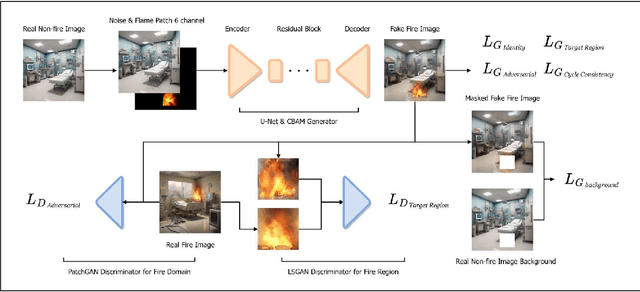

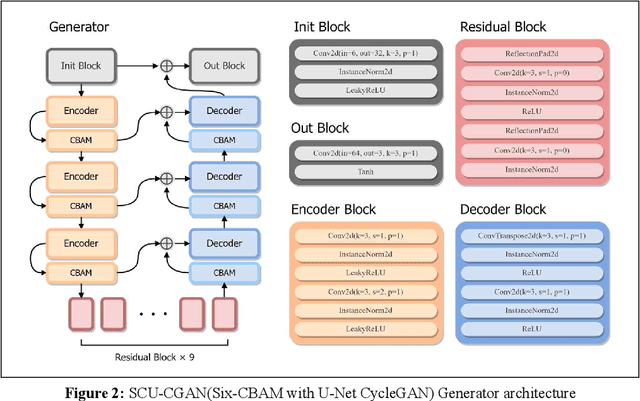
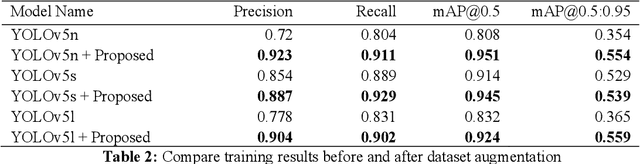
Fire has long been linked to human life, causing severe disasters and losses. Early detection is crucial, and with the rise of home IoT technologies, household fire detection systems have emerged. However, the lack of sufficient fire datasets limits the performance of detection models. We propose the SCU-CGAN model, which integrates U-Net, CBAM, and an additional discriminator to generate realistic fire images from nonfire images. We evaluate the image quality and confirm that SCU-CGAN outperforms existing models. Specifically, SCU-CGAN achieved a 41.5% improvement in KID score compared to CycleGAN, demonstrating the superior quality of the generated fire images. Furthermore, experiments demonstrate that the augmented dataset significantly improves the accuracy of fire detection models without altering their structure. For the YOLOv5 nano model, the most notable improvement was observed in the mAP@0.5:0.95 metric, which increased by 56.5%, highlighting the effectiveness of the proposed approach.