 Add to Chrome
 Add to Firefox
 Add to Edge
STADA: Specification-based Testing for Autonomous Driving Agents
Mar 11, 2026
Simulation-based testing has become a standard approach to validating autonomous driving agents prior to real-world deployment. A high-quality validation campaign will exercise an agent in diverse contexts comprised of varying static environments, e.g., lanes, intersections, signage, and dynamic elements, e.g., vehicles and pedestrians. To achieve this, existing test generation techniques rely on template-based, manually constructed, or random scenario generation. When applied to validate formally specified safety requirements, such methods either require significant human effort or run the risk of missing important behavior related to the requirement. To address this gap, we present STADA, a Specification-based Test generation framework for Autonomous Driving Agents that systematically generates the space of scenarios defined by a formal specification expressed in temporal logic (LTLf). Given a specification, STADA constructs all distinct initial scenes, a diverse space of continuations of those scenes, and simulations that reflect the behaviors of the specification. Evaluation of STADA on a variety of LTLf specifications formalized in SCENEFLOW using three complementary coverage criteria demonstrates that STADA yields more than 2x higher coverage than the best baseline on the finest criteria and a 75% increase for the coarsest criteria. Moreover, it matches the coverage of the best baseline with 6 times fewer simulations. While set in the context of autonomous driving, the approach is applicable to other domains with rich simulation environments.

Quality Assessment of Prompts Used in Code Generation
Apr 15, 2024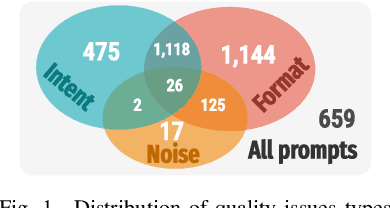
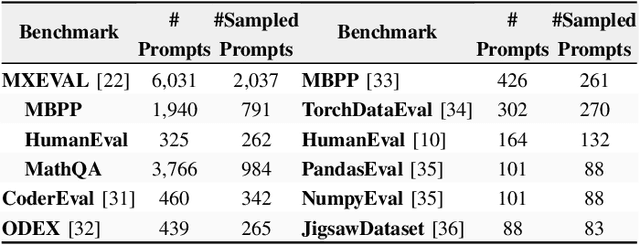
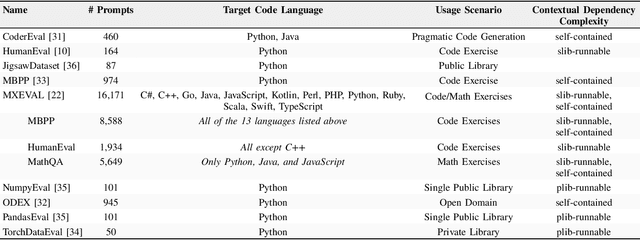

Large Language Models (LLMs) are gaining popularity among software engineers. A crucial aspect of developing effective code-generation LLMs is to evaluate these models using a robust benchmark. Evaluation benchmarks with quality issues can provide a false sense of performance. In this work, we conduct the first-of-its-kind study of the quality of prompts within benchmarks used to compare the performance of different code generation models. To conduct this study, we analyzed 3,566 prompts from 9 code generation benchmarks to identify quality issues in them. We also investigated whether fixing the identified quality issues in the benchmarks' prompts affects a model's performance. We also studied memorization issues of the evaluation dataset, which can put into question a benchmark's trustworthiness. We found that code generation evaluation benchmarks mainly focused on Python and coding exercises and had very limited contextual dependencies to challenge the model. These datasets and the developers' prompts suffer from quality issues like spelling and grammatical errors, unclear sentences to express developers' intent, and not using proper documentation style. Fixing all these issues in the benchmarks can lead to a better performance for Python code generation, but not a significant improvement was observed for Java code generation. We also found evidence that GPT-3.5-Turbo and CodeGen-2.5 models possibly have data contamination issues.