 Add to Chrome
 Add to Firefox
 Add to Edge
Structured Redundancy Modeling for Efficient Visual Token Pruning in High-Resolution MLLMs
Jul 25, 2026
Recent high-resolution Multimodal Large Language Models (MLLMs) generate thousands of visual tokens per input, leading to a visual token explosion that introduces severe latency bottlenecks. While token pruning mitigates this issue, state-of-the-art subset-optimization methods typically rely on iterative subset construction to jointly capture visual diversity and instruction relevance. As visual token counts scale, this sequential dependency introduces significant selection overhead, severely limiting the translation of theoretical FLOPs reductions into actual wall-clock speedups. To address this limitation, we propose Single-Forward Pruner (SFPruner), a structural reformulation of visual token pruning that embeds redundancy control directly into the scoring space, bypassing the need for iterative combinatorial optimization. Our non-iterative framework achieves redundancy-aware importance selection in a single forward pass through two complementary mechanisms. First, to attenuate redundancy at the covariance level, we introduce a semantics-guided ridge leverage scheme. By integrating instruction relevance and visual saliency, this mechanism suppresses dominant covariance directions and mitigates representation bias. Second, ranking-based directional masking resolves residual overlap through asymmetric similarity competition, where higher-scoring tokens explicitly suppress redundant lower-scoring alternatives via parallel tensor operations. Extensive evaluations demonstrate that our approach maintains stable selection costs, reducing the token selection process by up to 110 ms, from 112.4 ms to just 2.5 ms at 512 tokens in Qwen2.5-VL. This structural efficiency successfully translates theoretical token reductions into tangible inference speedups while preserving highly competitive performance against state-of-the-art techniques under aggressive compression.

AgilePruner: An Empirical Study of Attention and Diversity for Adaptive Visual Token Pruning in Large Vision-Language Models
Mar 01, 2026Large Vision-Language Models (LVLMs) have adopted visual token pruning strategies to mitigate substantial computational overhead incurred by extensive visual token sequences. While prior works primarily focus on either attention-based or diversity-based pruning methods, in-depth analysis of these approaches' characteristics and limitations remains largely unexplored. In this work, we conduct thorough empirical analysis using effective rank (erank) as a measure of feature diversity and attention score entropy to investigate visual token processing mechanisms and analyze the strengths and weaknesses of each approach. Our analysis reveals two insights: (1) Our erank-based quantitative analysis shows that many diversity-oriented pruning methods preserve substantially less feature diversity than intended; moreover, analysis using the CHAIR dataset reveals that the diversity they do retain is closely tied to increased hallucination frequency compared to attention-based pruning. (2) We further observe that attention-based approaches are more effective on simple images where visual evidence is concentrated, while diversity-based methods better handle complex images with distributed features. Building on these empirical insights, we show that incorporating image-aware adjustments into existing hybrid pruning strategies consistently improves their performance. We also provide a minimal instantiation of our empirical findings through a simple adaptive pruning mechanism, which achieves strong and reliable performance across standard benchmarks as well as hallucination-specific evaluations. Our project page available at https://cvsp-lab.github.io/AgilePruner.
AnoSeg: Anomaly Segmentation Network Using Self-Supervised Learning
Oct 07, 2021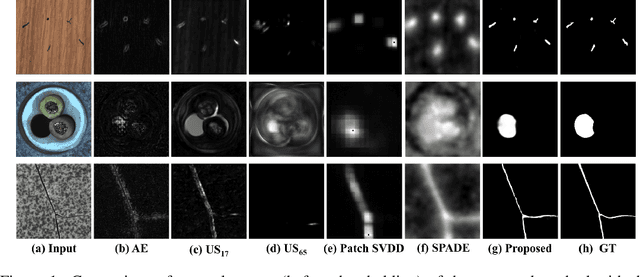
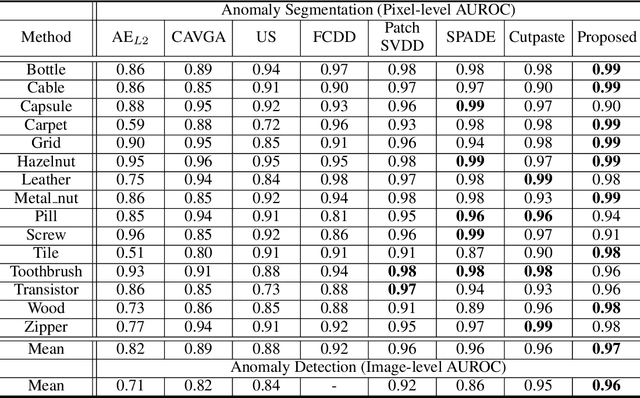
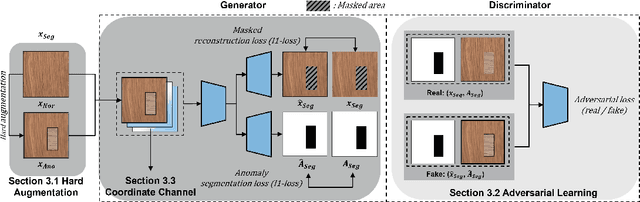

Anomaly segmentation, which localizes defective areas, is an important component in large-scale industrial manufacturing. However, most recent researches have focused on anomaly detection. This paper proposes a novel anomaly segmentation network (AnoSeg) that can directly generate an accurate anomaly map using self-supervised learning. For highly accurate anomaly segmentation, the proposed AnoSeg considers three novel techniques: Anomaly data generation based on hard augmentation, self-supervised learning with pixel-wise and adversarial losses, and coordinate channel concatenation. First, to generate synthetic anomaly images and reference masks for normal data, the proposed method uses hard augmentation to change the normal sample distribution. Then, the proposed AnoSeg is trained in a self-supervised learning manner from the synthetic anomaly data and normal data. Finally, the coordinate channel, which represents the pixel location information, is concatenated to an input of AnoSeg to consider the positional relationship of each pixel in the image. The estimated anomaly map can also be utilized to improve the performance of anomaly detection. Our experiments show that the proposed method outperforms the state-of-the-art anomaly detection and anomaly segmentation methods for the MVTec AD dataset. In addition, we compared the proposed method with the existing methods through the intersection over union (IoU) metric commonly used in segmentation tasks and demonstrated the superiority of our method for anomaly segmentation.