 Add to Chrome
 Add to Firefox
 Add to Edge
Perturbation: A simple and efficient adversarial tracer for representation learning in language models
Mar 25, 2026
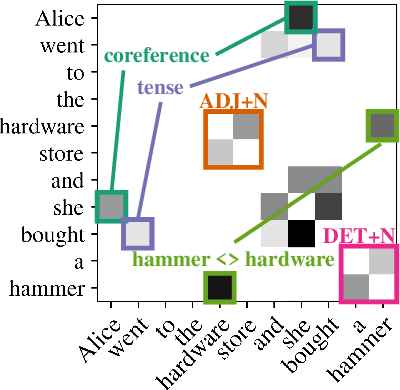
Linguistic representation learning in deep neural language models (LMs) has been studied for decades, for both practical and theoretical reasons. However, finding representations in LMs remains an unsolved problem, in part due to a dilemma between enforcing implausible constraints on representations (e.g., linearity; Arora et al. 2024) and trivializing the notion of representation altogether (Sutter et al., 2025). Here we escape this dilemma by reconceptualizing representations not as patterns of activation but as conduits for learning. Our approach is simple: we perturb an LM by fine-tuning it on a single adversarial example and measure how this perturbation ``infects'' other examples. Perturbation makes no geometric assumptions, and unlike other methods, it does not find representations where it should not (e.g., in untrained LMs). But in trained LMs, perturbation reveals structured transfer at multiple linguistic grain sizes, suggesting that LMs both generalize along representational lines and acquire linguistic abstractions from experience alone.

Constructions are Revealed in Word Distributions
Mar 08, 2025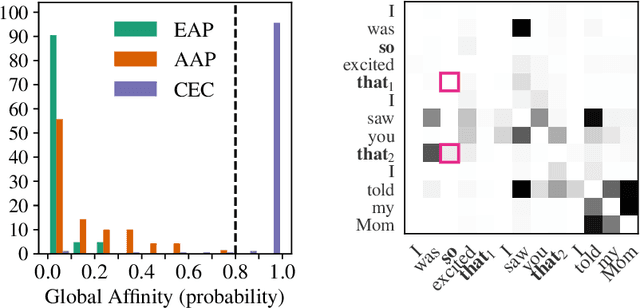
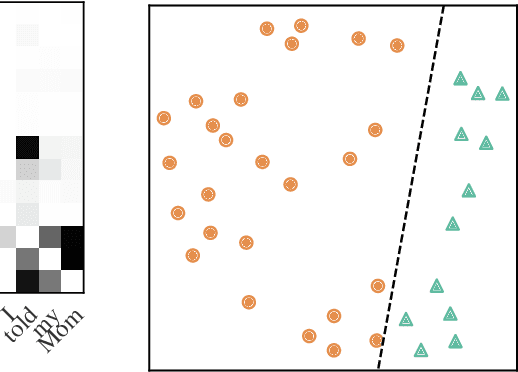
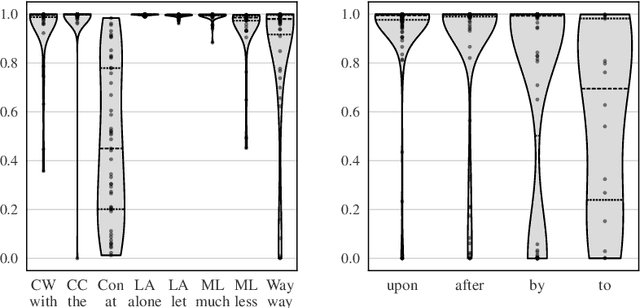
Construction grammar posits that constructions (form-meaning pairings) are acquired through experience with language (the distributional learning hypothesis). But how much information about constructions does this distribution actually contain? Corpus-based analyses provide some answers, but text alone cannot answer counterfactual questions about what caused a particular word to occur. For that, we need computable models of the distribution over strings -- namely, pretrained language models (PLMs). Here we treat a RoBERTa model as a proxy for this distribution and hypothesize that constructions will be revealed within it as patterns of statistical affinity. We support this hypothesis experimentally: many constructions are robustly distinguished, including (i) hard cases where semantically distinct constructions are superficially similar, as well as (ii) schematic constructions, whose "slots" can be filled by abstract word classes. Despite this success, we also provide qualitative evidence that statistical affinity alone may be insufficient to identify all constructions from text. Thus, statistical affinity is likely an important, but partial, signal available to learners.