 Add to Chrome
 Add to Firefox
 Add to Edge
Embedding Software Intent: Lightweight Java Module Recovery
Dec 17, 2025
As an increasing number of software systems reach unprecedented scale, relying solely on code-level abstractions is becoming impractical. While architectural abstractions offer a means to manage these systems, maintaining their consistency with the actual code has been problematic. The Java Platform Module System (JPMS), introduced in Java 9, addresses this limitation by enabling explicit module specification at the language level. JPMS enhances architectural implementation through improved encapsulation and direct specification of ground-truth architectures within Java projects. Although many projects are written in Java, modularizing existing monolithic projects to JPMS modules is an open challenge due to ineffective module recovery by existing architecture recovery techniques. To address this challenge, this paper presents ClassLAR (Class-and Language model-based Architectural Recovery), a novel, lightweight, and efficient approach that recovers Java modules from monolithic Java systems using fully-qualified class names. ClassLAR leverages language models to extract semantic information from package and class names, capturing both structural and functional intent. In evaluations across 20 popular Java projects, ClassLAR outperformed all state-of-the-art techniques in architectural-level similarity metrics while achieving execution times that were 3.99 to 10.50 times faster.

A Comprehensive Study of Bug-Fix Patterns in Autonomous Driving Systems
Feb 04, 2025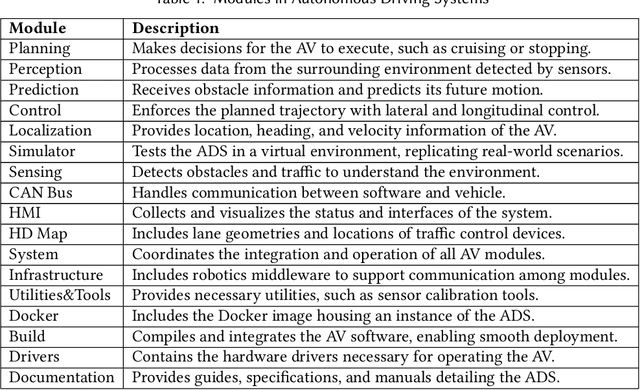

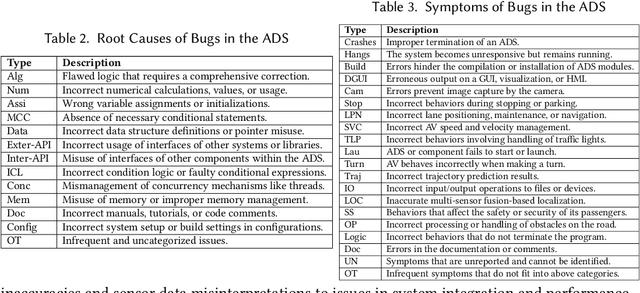
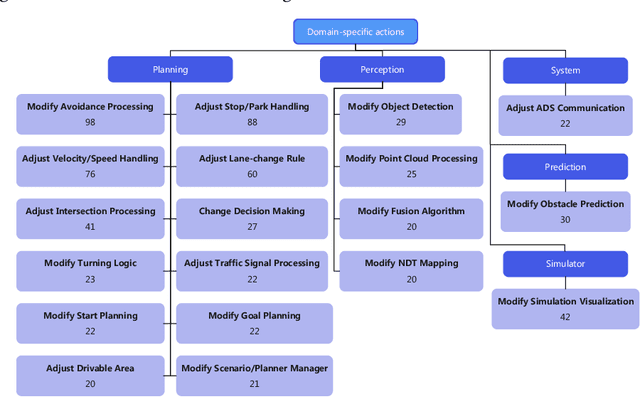
As autonomous driving systems (ADSes) become increasingly complex and integral to daily life, the importance of understanding the nature and mitigation of software bugs in these systems has grown correspondingly. Addressing the challenges of software maintenance in autonomous driving systems (e.g., handling real-time system decisions and ensuring safety-critical reliability) is crucial due to the unique combination of real-time decision-making requirements and the high stakes of operational failures in ADSes. The potential of automated tools in this domain is promising, yet there remains a gap in our comprehension of the challenges faced and the strategies employed during manual debugging and repair of such systems. In this paper, we present an empirical study that investigates bug-fix patterns in ADSes, with the aim of improving reliability and safety. We have analyzed the commit histories and bug reports of two major autonomous driving projects, Apollo and Autoware, from 1,331 bug fixes with the study of bug symptoms, root causes, and bug-fix patterns. Our study reveals several dominant bug-fix patterns, including those related to path planning, data flow, and configuration management. Additionally, we find that the frequency distribution of bug-fix patterns varies significantly depending on their nature and types and that certain categories of bugs are recurrent and more challenging to exterminate. Based on our findings, we propose a hierarchy of ADS bugs and two taxonomies of 15 syntactic bug-fix patterns and 27 semantic bug-fix patterns that offer guidance for bug identification and resolution. We also contribute a benchmark of 1,331 ADS bug-fix instances.